Lung abscess is a necrotizing lung infection characterized by a pus-filled circumscribed cavitary lesion. It is most commonly caused by aspiration of oral secretions in patients who are at risk for aspiration and is indolent in onset. Symptoms are productive cough, fever, night sweats, and weight loss. Diagnosis is based primarily on chest radiograph. Treatment usually is with a combination beta-lactam/beta-lactamase inhibitor or a carbapenem.
Etiology of Lung Abscess
Aspiration of oral secretions (most common)
Endobronchial obstruction
Direct extension
Hematogenous seeding of the lungs (less common)
Most lung abscesses develop after aspiration of oral secretions in patients with gingivitis or poor oral hygiene. Typically, patients have altered consciousness as a result of intake of alcohol or recreational drugs, or use of anesthesia, sedatives, or opioids. Older patients and those unable to handle their oral secretions, often because of neurologic disease, are also at risk. Lung abscesses can then form as a result of a localized pneumonia that develops necrosis and a cavitary lesion filled with pus (1).
Lung abscesses can also develop secondary to endobronchial obstruction (eg, due to bronchial carcinoma or foreign body) or to immunosuppression (eg, due to advanced HIV infection or after transplantation and use of immunosuppressants).
A less common cause of lung abscess is necrotizing pneumonia that may develop from hematogenous seeding of the lungs due to suppurative thromboembolism (eg, septic embolism due to IV drug use or Lemierre syndrome) or right-sided endocarditis. In contrast to aspiration and obstruction, these conditions typically present acutely and cause multiple rather than isolated lung abscesses.
Direct infection (eg, contiguous spread from empyema, subphrenic or mediastinal abscess) rather than hematogenous seeding is possible with certain pyogenic bacteria (eg, Staphylococcus aureus).
Etiology reference
1. Vaarst JK, Sperling S, Dahl VN, et al. Lung abscess: Clinical characteristics of 222 Danish patients diagnosed from 2016 to 2021. Respir Med 2023;216:107305. doi:10.1016/j.rmed.2023.107305
Pathophysiology of Lung Abscess
The most common pathogens of lung abscesses due to aspiration are anaerobic bacteria, but about half of all cases involve both anaerobic and aerobic organisms (see table ).
The most common anaerobic pathogens are
Peptostreptococcus
Fusobacterium
Prevotella
Bacteroides
The most common aerobic pathogens are
Staphylococci—sometimes methicillin-resistant Staphylococcus aureus (MRSA)
Occasionally, cases are due to gram-negative bacteria, especially Klebsiella (1). Immunocompromised patients with lung abscess are most commonly infected with Pseudomonas aeruginosa or other gram-negative bacilli but also may have infection with Nocardia, mycobacteria, or fungi.
Introduction of these pathogens into the lungs first causes inflammation, which, over a week or two, leads to tissue necrosis and then abscess formation. The abscess usually ruptures into a bronchus, and its contents are expectorated, leaving an air- and fluid-filled cavity. In about 10% of cases, direct or indirect extension (via bronchopleural fistula) into the pleural cavity can result in empyema. Less commonly, contiguous spread from long-standing and untreated or inadequately treated empyema can spread to lung parenchyma and become localized, leading to an abscess.
Lung abscesses can result from either necrotizing pneumonia or gangrene. Necrotizing pneumonia is a severe complication of pneumonia marked by swift deterioration of lung tissue and the formation of cavitary lesions causing abscesses. In contrast, pulmonary gangrene represents a rare and severe complication of necrotizing pneumonia, characterized by widespread necrosis of lung tissue. Rare cases of pulmonary gangrene (extensive necrosis involving a lobe or a lung) or fulminant pneumonia with sepsis have been reported with pathogens such as MRSA, Pneumococcus, and Klebsiella. Some patients are at risk of abscess due to Mycobacterium tuberculosis, and rare cases are due to amebic infection (eg, with Entamoeba histolytica), hydatid cysts, paragonimiasis, or infection with Burkholderia pseudomallei.
Infectious Causes of Cavitary Lung Lesions
Causes | Examples (Disorder) |
|---|---|
Aerobic organisms | Burkholderia pseudomallei*, † Klebsiella pneumoniae* Nocardia‡ Pseudomonas aeruginosa* Staphylococcus aureus§ Streptococcus milleri§ Other streptococci§ |
Anaerobic organisms | Actinomyces‡ Bacteroides* Clostridium‡ Fusobacterium* Peptostreptococcus§ Prevotella* |
Fungi | Aspergillus (aspergillosis) Blastomyces dermatitidis (blastomycosis) Coccidioides immitis (coccidioidomycosis) Cryptococcus neoformans (cryptococcosis) Histoplasma capsulatum (histoplasmosis) Pneumocystis jirovecii (P. jirovecii pneumonia) Rhizomucor (mucormycosis) Rhizopus (mucormycosis) Sporothrix schenckii (sporotrichosis) |
Mycobacteria | Mycobacterium avium-cellulare Mycobacterium kansasii Mycobacterium tuberculosis (tuberculosis)† |
Parasites | Entamoeba histolytica (amebiasis)† Echinococcus granulosus (echinococcosis)† Echinococcus multilocularis (echinococcosis)† Paragonimus westermani (paragonimiasis)† |
* Gram-negative bacilli. | |
† These causes usually occur only in certain areas of high prevalence or after travel to such areas. | |
‡ Gram-positive bacilli. | |
§ Gram-positive cocci. | |
Pathophysiology reference
1. Takayanagi N, Kagiyama N, Ishiguro T, Tokunaga D, Sugita Y. Etiology and outcome of community-acquired lung abscess. Respiration 2010;80(2):98-105. doi:10.1159/000312404
Symptoms and Signs of Lung Abscess
Symptoms of abscess due to anaerobic bacteria or mixed anaerobic and aerobic bacteria are usually chronic, developing over weeks or months, and include productive cough, fever and chills, night sweats, and weight loss (1, 2). Digital clubbing is possible. Patients may also present with hemoptysis and pleuritic chest pain. Sputum may be purulent or blood-streaked and classically smells or tastes foul. Patients may have fetid breath. Anorexia and fatigue due to chronic inflammation may be present.
Symptoms of abscess due to aerobic bacteria develop more acutely (hours to days) and resemble bacterial pneumonia. Abscesses due to organisms other than anaerobes (eg, Mycobacteria, Nocardia) lack putrid respiratory secretions and may be more likely to occur in nondependent lung regions and develop subacutely (weeks to months).
Signs of lung abscess, when present, are nonspecific and resemble those of pneumonia: altered breath sounds indicating consolidation or effusion, temperature ≥ 38° C, crackles over the affected area, egophony, and dullness to percussion in the presence of effusion. Patients typically have signs of periodontal disease and a history of a predisposing cause of aspiration, such as dysphagia or a condition causing impaired consciousness (3).
Symptoms and signs references
1. Montméat V, Bonny V, Urbina T, et al. Epidemiology and Clinical Patterns of Lung Abscesses in ICU: A French Multicenter Retrospective Study. Chest 2024;165(1):48-57. doi:10.1016/j.chest.2023.08.020
2. Vaarst JK, Sperling S, Dahl VN, et al. Lung abscess: Clinical characteristics of 222 Danish patients diagnosed from 2016 to 2021. Respir Med 2023;216:107305. doi:10.1016/j.rmed.2023.107305
3. Moreira Jda S, Camargo Jde J, Felicetti JC, Goldenfun PR, Moreira AL, Porto Nda S. Lung abscess: analysis of 252 consecutive cases diagnosed between 1968 and 2004. J Bras Pneumol 2006;32(2):136-143. doi:10.1590/s1806-37132006000200009
Diagnosis of Lung Abscess
Chest radiograph
Very often chest computed tomography (CT) for better visualization or if endobronchial obstruction is suspected
Gram stain and sputum cultures for aerobic bacteria and gram stain and blood cultures for aerobic and anaerobic bacteria
If clinically indicated, sputum cultures for fungi, and mycobacteria
Bronchoscopy as needed to exclude (endobronchial) cancer, detect unusual pathogens such as fungi or mycobacteria and in patients with a negative culture, in atypical presentations, and in immunocompromised patients
Gram stain and culture of any pleural fluid
Lung abscess is suspected based on history in a patient who is at risk (eg, aspiration-prone due to altered consciousness or dysphagia or who is immunosuppressed) and is confirmed by chest radiograph showing cavitation.
In an anaerobic infection due to aspiration, chest radiograph classically shows consolidation with a single cavity containing an air-fluid level in portions of the lung that would be dependent when the patient is recumbent (eg, the posterior segments of the upper lobes or the superior or lateral basal segments of the lower lobes). This pattern helps distinguish anaerobic abscess from other causes of cavitary pulmonary disease, because diffuse or embolic pulmonary disease often causes multiple cavitations, and tuberculosis typically involves the apices.

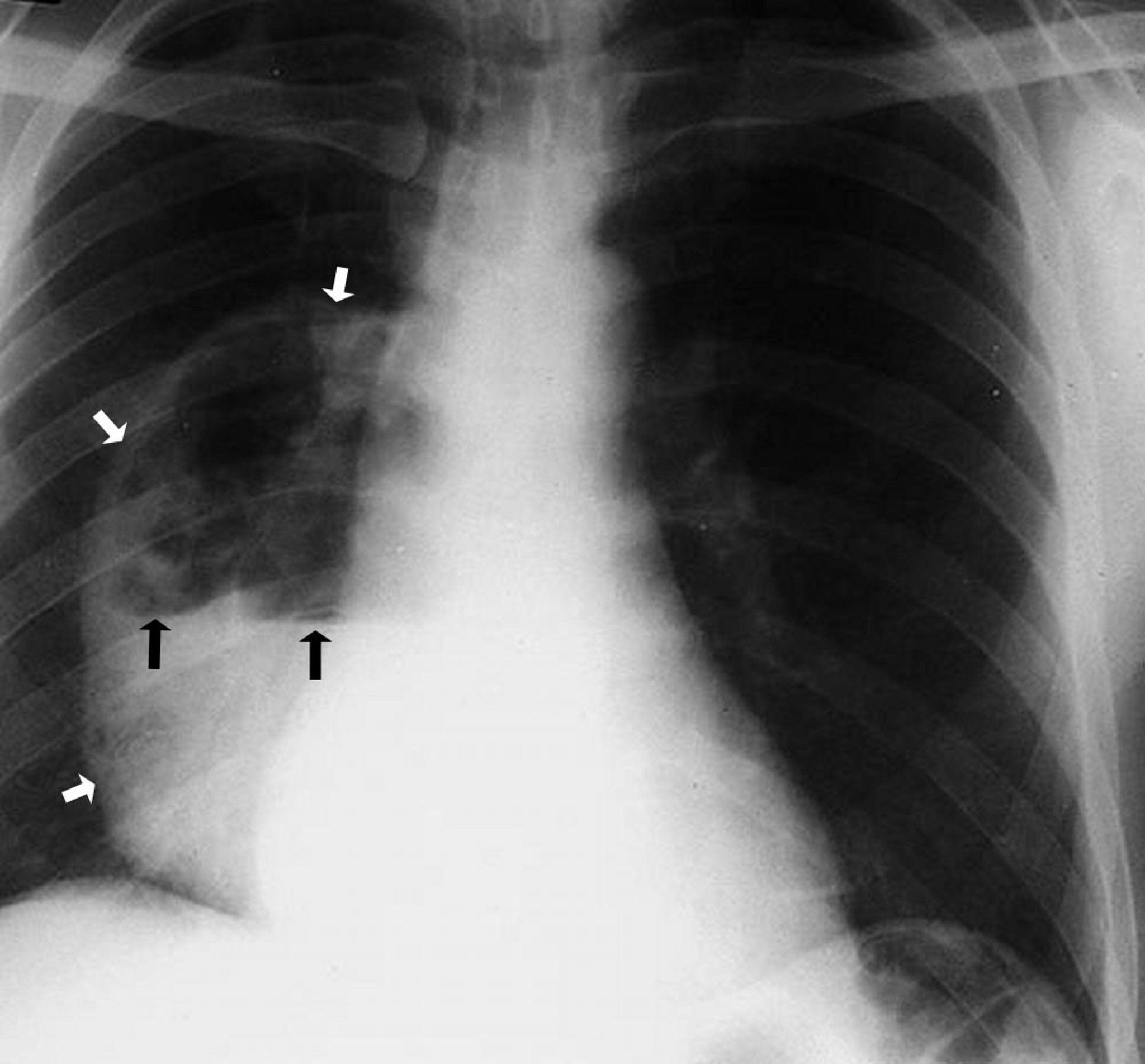
This photo shows a large right lower lobe abscess demonstrating a cavity that contains an air-fluid level. The white arrows point out the boundary of the abscess showing the walls separated from the lung parenchyma. The black arrows demarcate the level where the air above and fluid below meet.
By permission of the publisher. From Leaf H. In Atlas of Infectious Diseases: Pleuropulmonary and Bronchial Infections. Edited by GL Mandell (series editor) and MS Simberkoff. Philadelphia, Current Medicine, 1996.
CT is not routinely needed (eg, if cavitation is clear on chest radiograph in a patient who has risk factors for lung abscess). However, CT may be useful when cavitation is suspected but not clearly visualized on the chest radiograph, when an underlying pulmonary mass obstructing the drainage of a lung segment is suspected, or when an abscess needs to be differentiated from empyema or bulla with an air-fluid level.

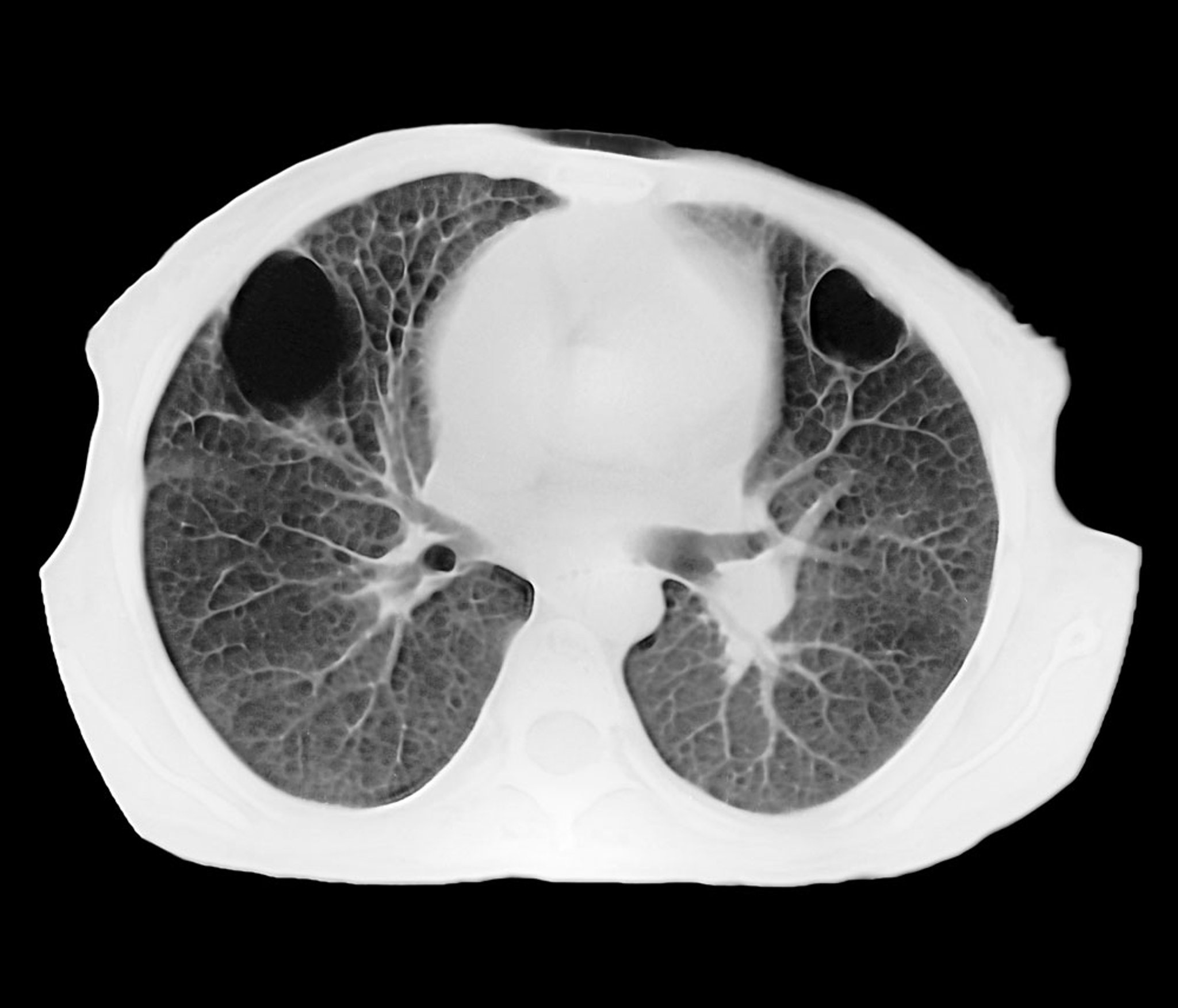
This axial CT shows 2 well-circumscribed parenchymal lung abscesses in the anterior right and left lobes. The black interior corresponds to an accumulation of pus.
ZEPHYR/SCIENCE PHOTO LIBRARY
Bronchial carcinoma can lead to airway obstruction that causes pneumonia and abscess formation. Cavitating bronchial carcinoma should be suspected in patients who do not respond to antimicrobial treatment or have atypical findings such as a cavitary lesion without surrounding consolidation or no infectious signs and symptoms such as fever.
Bronchoscopy is sometimes performed to exclude cancer or the presence of a foreign body or to detect unusual pathogens, such as fungi or mycobacteria. Bronchoscopy is also performed if patients are immunocompromised and should be considered in patients who fail to respond appropriately to initial empiric antibiotics.
Transthoracic or transesophageal echocardiography should be considered to exclude infective endocarditis in patients with multiple lung abscesses.
Gram stain and cultures
Gram stain and culture of both sputum and blood samples should be obtained to help identify the causative organism. Blood samples should be sent for both aerobic and anaerobic cultures. Sputum samples, however, should generally be sent only for aerobic culture; sputum cultures are often contaminated with oral flora, which complicates the interpretation of anaerobic cultures. If sputum is putrid, then anaerobic infection is assumed to be the cause. If empyema is present, pleural fluid provides a good source for anaerobic culture (1). Bronchoscopic samples have less oropharyngeal contamination and should be sent for anaerobic cultures.
When clinical findings make anaerobic infection less likely, aerobic, fungal, or mycobacterial infection should be suspected, and attempts should be made to identify a pathogen. Cultures of sputum, bronchoscopic aspirates, or both are helpful.
Differential diagnosis
Cavitary pulmonary lesions are not always caused by lung abscess (2). Other causes of cavitary pulmonary lesions include the following:
Empyema or bulla with air-fluid level
Cystic (saccular) bronchiectasis
Lung infarction
Nodular silicosis nodule with central necrosis
Pulmonary sequestration
Diagnosis references
1. Bartlett JG. Anaerobic bacterial infections of the lung. Chest 1987;91(6):901-909. doi:10.1378/chest.91.6.901
2. Gadkowski LB, Stout JE. Cavitary pulmonary disease. Clin Microbiol Rev 2008;21(2):305-333. doi:10.1128/CMR.00060-07
Treatment of Lung Abscess
IV antibiotics or, for less seriously affected patients, oral antibiotics
Percutaneous, endobronchial, or surgical drainage of any abscess that does not respond to antibiotics or of any empyema
The primary choice is a combination beta-lactam/beta-lactamase inhibitor, for example, ampicillin/sulbactam (The primary choice is a combination beta-lactam/beta-lactamase inhibitor, for example, ampicillin/sulbactam (1). Alternatives, especially for patients in whom gram-negative infection is suspected, include a carbapenem (eg, imipenem/cilastatin) or combination therapy with metronidazole plus ceftriaxone. In patients who are allergic to penicillin, moxifloxacin, or combination therapy with levofloxacin and metronidazole are alternative choices. Clindamycin is rarely used now because of concerns for ). Alternatives, especially for patients in whom gram-negative infection is suspected, include a carbapenem (eg, imipenem/cilastatin) or combination therapy with metronidazole plus ceftriaxone. In patients who are allergic to penicillin, moxifloxacin, or combination therapy with levofloxacin and metronidazole are alternative choices. Clindamycin is rarely used now because of concerns forClostridioides difficile infection and antibiotic resistance.
Less seriously ill patients may be given oral antibiotics such as amoxicillin/clavulanic acid or, in patients allergic to penicillin, moxifloxacin. IV regimens can be converted to oral ones when the patient defervesces and is clinically stable (Less seriously ill patients may be given oral antibiotics such as amoxicillin/clavulanic acid or, in patients allergic to penicillin, moxifloxacin. IV regimens can be converted to oral ones when the patient defervesces and is clinically stable (2).
For infections involving MRSA, the best treatment is linezolid or vancomycin. For infections involving MRSA, the best treatment is linezolid or vancomycin.
If gram-negative bacilli are cultured in significant concentrations from sputum or blood and are identified on gram stain, the antibiotic regimen should be modified to cover the specific pathogen in addition to anaerobes.
Optimal duration of treatment is unknown, but common practice is to treat until the chest radiograph shows complete resolution or a small, stable, residual scar, which generally takes 3 to 6 weeks or longer. In general, the larger the abscess, the longer it will take for radiographs to show resolution.
Although previously recommended, most authorities do not recommend chest physical therapy and postural drainage any longer because of the potential for spillage of infection into other bronchi with extension of the infection or acute obstruction.
If patients fail to defervesce or improve clinically after 7 to 10 days, they should be evaluated for resistant or unusual pathogens, airway obstruction, and noninfectious causes of cavitation, which usually involves a bronchoscopic evaluation of the affected area of the lung. CT scan can help detect development of complications such as empyema and identify the optimal interventional approach to the abscess itself. An accompanying empyema must be drained. Surgical removal or drainage of lung abscesses is necessary in the roughly 10% of patients in whom lesions do not respond to antibiotics and in those who develop pulmonary gangrene. Resistance to antibiotic treatment is most common with large cavities and with post-obstructive abscesses (3).
Percutaneous catheter drainage of subpleural abscesses or bronchoscopic placement under imaging guidance (ultrasound,CT, or fluoroscopy) of a pigtail catheter in central abscesses can help facilitate drainage (4, 5). When surgery is necessary, lobectomy is the most common procedure; segmental resection may suffice for small lesions. Pneumonectomy may be necessary for multiple abscesses unresponsive to pharmacotherapy or for pulmonary gangrene.
Treatment references
1. Reinhardt JF, Johnston L, Ruane P, et al. A randomized, double-blind comparison of sulbactam/ampicillin and clindamycin for the treatment of aerobic and aerobic-anaerobic infections. Rev Infect Dis 1986;8 Suppl 5:S569-S575. doi:10.1093/clinids/8.supplement_5.s569
2. Ott SR, Allewelt M, Lorenz J, Reimnitz P, Lode H; German Lung Abscess Study Group. Moxifloxacin vs ampicillin/sulbactam in aspiration pneumonia and primary lung abscess. Infection 2008;36(1):23-30. doi:10.1007/s15010-007-7043-6
3. Kuhajda I, Zarogoulidis K, Tsirgogianni K, et al. Lung abscess-etiology, diagnostic and treatment options. Ann Transl Med 2015;3(13):183. doi:10.3978/j.issn.2305-5839.2015.07.08
4. Herth F, Ernst A, Becker HD. Endoscopic drainage of lung abscesses: technique and outcome. Chest 2005;127(4):1378-1381. doi:10.1378/chest.127.4.1378
5. Kelogrigoris M, Tsagouli P, Stathopoulos K, Tsagaridou I, Thanos L. CT-guided percutaneous drainage of lung abscesses: review of 40 cases. JBR-BTR 2011;94(4):191-195. doi:10.5334/jbr-btr.583
Key Points
Lung abscesses are most often caused by aspiration of oral secretions by patients who have impaired consciousness; thus, anaerobic bacteria are among the common pathogens.
Suspect lung abscess in patients prone to aspiration, who have subacute constitutional and pulmonary symptoms, and whose chest radiograph shows compatible lesions such as cavities.
Treat initially with antibiotics; if patients do not respond within 7 to 10 days, evaluate them for unusual or resistant pathogens, bronchial obstructive lesions, and noninfectious causes of lung cavitation.
Drain empyemas and consider surgical removal or drainage of lung abscesses that do not respond to pharmacotherapy and in patients who develop pulmonary gangrene.
Drug Information for the Topic