
Staphylococci are gram-positive aerobic organisms. Staphylococcus aureus is the most pathogenic; it typically causes skin infections and sometimes pneumonia, endocarditis, and osteomyelitis. It commonly leads to abscess formation. Some strains produce toxins that cause gastroenteritis, scalded skin syndrome, and toxic shock syndrome. Diagnosis is based on Gram stain and culture. Treatment is usually with penicillinase-resistant beta-lactams, but because antibiotic resistance is common, vancomycin or other antibiotics may be required.
Staphylococcal species are bacteria characterized by their microscopic appearance of grape-like, spherical clusters of organisms. There are both coagulase-positive and coagulase-negative species; the ability to clot blood by producing coagulase distinguishes the virulent pathogen, Staphylococcus aureus, from the less virulent coagulase-negative staphylococcal species. S. aureus is among the most ubiquitous and dangerous human pathogens, for both its virulence and its ability to develop antibiotic resistance.
Coagulase-negative species such as S. epidermidis are associated with hospital-acquired infections; S. saprophyticus causes urinary infections. S. lugdunensis, another coagulase-negative species, can cause invasive disease with virulence similar to that of S. aureus. Unlike most coagulase-negative staphylococcal species, S. lugdunensis often remains sensitive to penicillinase-resistant beta-lactam antibiotics (ie, methicillin-sensitive).
A carrier state is common. Pathogenic staphylococci are ubiquitous. They are carried, usually transiently, in the anterior nares of approximately 32% of healthy adults (1) and on the skin of about 20 to 30% (2); from these locations, staphylococci can cause infection in the host and others. Carriage rates are higher in hospitalized patients and hospital personnel. S. aureus infections are more prevalent in carriers than in non-carriers and are usually caused by the colonizing strain.
Risk factors for staphylococcal infections
People who are predisposed to staphylococcal infections include:
Neonates and breastfeeding mothers
Patients with influenza, chronic bronchopulmonary disorders (eg, cystic fibrosis, emphysema), leukemia, HIV, malignancies, chronic skin disorders, or diabetes mellitus
Patients with a transplant, an implanted prosthesis, other foreign bodies, or an indwelling intravascular plastic catheter
Patients receiving exogenous glucocorticoids, irradiation, immunosuppressants, or antitumor chemotherapy
Patients with defects in chemotaxis (eg, Job, Chediak-Higashi, and Wiskott-Aldrich syndromes) and phagocytosis
Injection drug users
Patients who have chronic kidney disease and are being treated with dialysis
Patients with surgical incisions, open wounds, or burns
Predisposed patients may acquire antibiotic-resistant staphylococci from other patients, health care personnel, or inanimate objects in health care settings. Transmission via the hands of personnel is the most common means of spread, but airborne spread also can occur.
General references
1. Mainous AG 3rd, Hueston WJ, Everett CJ, Diaz VA. Nasal carriage of Staphylococcus aureus and methicillin-resistant S aureus in the United States, 2001-2002. Ann Fam Med. 2006;4(2):132-137. doi:10.1370/afm.526
2. Parlet CP, Brown MM, Horswill AR. Commensal Staphylococci Influence Staphylococcus aureus Skin Colonization and Disease. Trends Microbiol. 2019;27(6):497-507. doi:10.1016/j.tim.2019.01.008
Diseases Caused by Staphylococci
Staphylococci cause disease by:
Direct tissue invasion
Sometimes exotoxin production
Direct tissue invasion is the most common mechanism for staphylococcal disease, including the following:
Infectious (septic) arthritis (native and prosthetic joints)
Multiple exotoxins are sometimes produced by staphylococci. Some have local effects; others trigger cytokine release from certain T cells, causing serious systemic effects (eg, skin lesions, shock, organ failure, death). Panton-Valentine leukocidin (PVL) is a toxin produced by strains infected with a certain bacteriophage. PVL is typically present in strains of community-associated methicillin-resistant S. aureus (CA-MRSA) and has been thought to mediate the ability to necrotize (1); however, this effect has not been verified (2).
Toxin-mediated staphylococcal diseases include the following:
The infections and disorders listed below are further discussed elsewhere in The Manual.
Staphylococcal bacteremia
S. aureus bacteremia, which frequently causes metastatic foci of infection, may occur with any localized S. aureus infection but is particularly common with infection related to intravascular catheters or other foreign bodies, or among people who inject drugs (via direct inoculation from skin carriage). It may also occur without any obvious primary site.
S. epidermidis and other coagulase-negative staphylococci cause hospital-acquired bacteremia associated with intravascular catheters and other foreign bodies because they can form biofilms on these materials.
Staphylococcal bacteremia is an important cause of morbidity (especially prolongation of hospitalization) and mortality in patients who are debilitated.
Staphylococcal skin infections
Skin infections are the most common form of staphylococcal disease. Superficial infections may be diffuse, with vesicular pustules and crusting (impetigo) or sometimes cellulitis, or focal with nodular abscesses (furuncles and carbuncles). Deeper cutaneous abscesses are common. Severe necrotizing skin infections may occur.

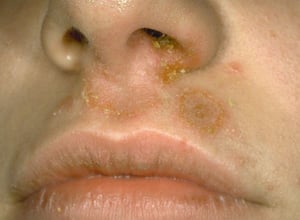
In impetigo, clusters of vesicopustular or bullous lesions form, rupture, and develop a honey-colored crust.
In impetigo, clusters of vesicopustular or bullous lesions form, rupture, and develop a honey-colored crust.
Image courtesy of Thomas Habif, MD.

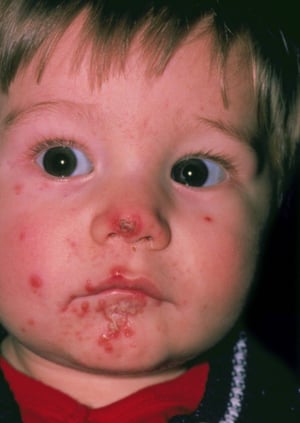
This photo shows clusters of vesicles and pustules with developing honey-colored crust on the nose.
This photo shows clusters of vesicles and pustules with developing honey-colored crust on the nose.
DR P. MARAZZI/SCIENCE PHOTO LIBRARY

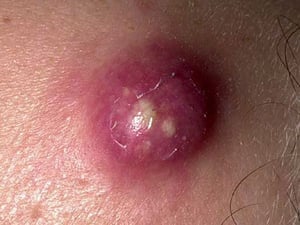
Furuncles (boils) are tender nodules or pustules that involve a hair follicle and are caused by staphylococcal infection.
Furuncles (boils) are tender nodules or pustules that involve a hair follicle and are caused by staphylococcal infectio
Image provided by Thomas Habif, MD.
In impetigo, clusters of vesicopustular or bullous lesions form, rupture, and develop a honey-colored crust.
In impetigo, clusters of vesicopustular or bullous lesions form, rupture, and develop a honey-colored crust.
Image courtesy of Thomas Habif, MD.
This photo shows clusters of vesicles and pustules with developing honey-colored crust on the nose.
This photo shows clusters of vesicles and pustules with developing honey-colored crust on the nose.
DR P. MARAZZI/SCIENCE PHOTO LIBRARY
Furuncles (boils) are tender nodules or pustules that involve a hair follicle and are caused by staphylococcal infection.
Furuncles (boils) are tender nodules or pustules that involve a hair follicle and are caused by staphylococcal infectio
Image provided by Thomas Habif, MD.
Staphylococci are commonly implicated in wound and burn infections, postoperative incision infections, and mastitis or breast abscess in breastfeeding mothers.
Staphylococcal neonatal infections
Neonatal infections occur within 4 weeks after birth and include:
Skin lesions with or without exfoliation
Staphylococcal pneumonia
Pneumonia of staphylococcal origin that occurs in a community setting is not common, but may develop in patients with one or more of the following characteristics:
Influenza
Chronic bronchopulmonary or other high-risk diseases
Glucocorticoid or immunosuppressant therapy
Indwelling IV catheters for home parenteral therapy or hemodialysis
Injection drug use
Staphylococcal pneumonia may be a primary infection or result from hematogenous spread of S. aureus infection elsewhere in the body (eg, IV catheter infection, endocarditis, soft-tissue infection) or from injection drug use. However, S. aureus is a common cause of hospital-acquired pneumonia, including ventilator-associated pneumonia.
Staphylococcal pneumonia is occasionally characterized by formation of lung abscesses followed by rapid development of pneumatoceles and empyema. Community-acquired methicillin-resistant S. aureus (CA-MRSA) often causes severe necrotizing pneumonia.
Staphylococcal endocarditis
Endocarditis can develop, particularly in people who use injection drugs and patients with prosthetic heart valves. Because of intravascular catheter use and implantation of cardiac devices, S. aureus is a leading cause of bacterial endocarditis.
S. aureus endocarditis is an acute febrile illness often accompanied by visceral abscesses, embolic phenomena, pericarditis, subungual petechiae, subconjunctival hemorrhage, purpuric lesions, heart murmurs, perivalvular abscess, conduction defects, and eventually, heart failure secondary to cardiac valve damage.
Staphylococcal osteomyelitis
Osteomyelitis occurs more commonly in children and is often the result of acute hematogenous spread. It causes chills, fever, and pain over the affected bone. Subsequently, the overlying soft tissue becomes red and swollen. Articular infection may occur and frequently results in joint effusions via contiguous spread, suggesting septic arthritis rather than osteomyelitis. Most infections of the vertebrae and intervertebral disks in adults involve S. aureus.
Staphylococcal infectious arthritis
Joints typically become secondarily infected via hematogenous infection, but infection can also be caused by extension of a bone infection (osteomyelitis), trauma, or direct primary infection during joint surgery. Prosthetic joints are particularly prone to infection. Staphylococcal infection of a prosthetic joint in the months after implantation is usually acquired during surgery, whereas infections occurring more than 12 months after surgery are likely due to hematogenous spread. However, infections still may be secondary to organisms that were inadvertently introduced at the time of implantation and remained dormant and then became clinically evident several months later.
Staphylococcal toxic shock syndrome
Staphylococcal toxic shock syndrome may result from use of vaginal tampons or other devices that may complicate any type of S. aureus infection (eg, postoperative wound infection, infection of a burn, skin infection). Although most cases have been due to methicillin-susceptible S. aureus (MSSA), cases due to MRSA are commensurate with the increased prevalence of both nosocomial and community MRSA infections.
Staphylococcal scalded skin syndrome
Staphylococcal scalded skin syndrome, which is caused by several toxins termed exfoliatins (primarily exfoliative toxins A and B [ETA and ETB]), is an exfoliative dermatitis of childhood characterized by large bullae and peeling of the upper layer of skin. Eventually, exfoliation occurs. Scalded skin syndrome most commonly occurs in infants and children < 5 years.


This photo shows erythema with overlying desquamation in sheets, particularly in the intertriginous area of the groin and axillae and around the umbilicus. Often there is also perioral peeling.
Staphylococcal food poisoning
Staphylococcal food poisoning is caused by ingesting a preformed heat-stable staphylococcal enterotoxin. Food can be contaminated by staphylococcal carriers or people with active skin infections. If food is incompletely cooked or left at room temperature, staphylococci reproduce and elaborate enterotoxin. Many foods can serve as growth media, and, despite contamination, they may have a normal taste and odor. Severe nausea and vomiting begin 2 to 8 hours after ingestion, typically followed by abdominal cramps and diarrhea. The attack is brief, often lasting < 12 hours.
Diseases caused by staphylococci references
1. Huang J, Zhang T, Zou X, Wu S, Zhu J. Panton-valentine leucocidin carrying Staphylococcus aureus causing necrotizing pneumonia inactivates the JAK/STAT signaling pathway and increases the expression of inflammatory cytokines. Infect Genet Evol. 2020;86:104582. doi:10.1016/j.meegid.2020.104582
2. Saeed K, Gould I, Esposito S, et al. Panton-Valentine leukocidin-positive Staphylococcus aureus: a position statement from the International Society of Chemotherapy. Int J Antimicrob Agents. 2018;51(1):16-25. doi:10.1016/j.ijantimicag.2017.11.002
Diagnosis of Staphylococcal Infections
Gram stain and culture
Molecular detection tests (eg, real-time polymerase chain reaction [PCR])
Imaging studies of bone (MRI, CT or radionuclide bone scans)
Rarely, skin or bone biopsy
Rarely, isolation of bacteria from food samples
The diagnosis of staphylococcal infections is based on Gram stain and culture of infected material.
Antibiotic susceptibility tests should be done because methicillin-resistant organisms are common and require alternative therapy.
In osteomyelitis, radiographic changes may not be apparent for 10 to 14 days, and bone rarefaction and periosteal reaction may not be detected for even longer. Abnormalities in MRI, CT, or radionuclide bone scans are often apparent earlier. Bone biopsy (open or percutaneous) should be done for pathogen identification and susceptibility testing.
When staphylococcal scalded skin syndrome is suspected, cultures should be obtained from blood, urine, the nasopharynx, the umbilicus, abnormal skin, or any suspected focus of infection; the intact bullae are sterile. Although the diagnosis is usually clinical, a biopsy of the affected skin may help confirm the diagnosis.
Staphylococcal food poisoning is usually suspected because of case clustering (eg, within a family, attendees of a social gathering, or customers of a restaurant). Confirmation (typically by the health department) entails isolating staphylococci from suspect food and sometimes testing for enterotoxins.
MRSA surveillance in health care institutions
Horizontal infection prevention practices (ie, prevention of multiple infections across different pathogens) such as good hand hygiene, environmental cleaning, and disinfecting are essential to reducing nosocomial infections and preventing the spread of organisms, including MRSA (1). Some institutions that have a high incidence of methicillin-resistant S. aureus (MRSA) nosocomial infections or are experiencing an outbreak may implement MRSA screening programs (active surveillance) for all or select high-risk patient populations (eg, patients in critical care settings or those with known prior MRSA infection or colonization) using rapid laboratory techniques to evaluate nasal swab specimens. Subsequent timely contact isolation of MRSA-colonized or infected patients may help to decrease the incidence of nosocomial MRSA infections.
Screening for MRSA colonization with antibiotic susceptibility testing is also frequently performed prior to high-risk surgeries such as cardiovascular, neurosurgical, and orthopedic procedures, particularly if prosthetic material is being placed. This testing can be used to determine which patients may benefit from decolonization attempts and when to include anti-MRSA coverage in perioperative antibiotic prophylaxis regimens (eg, vancomycin).
In patients with pneumonia, PCR testing for MRSA colonization in the nares has been shown to have a negative predictive value of > 95% for MRSA lung infection and may therefore be useful in antibiotic management (2).
Diagnosis references
1. Popovich KJ, Aureden K, Ham DC, et al. SHEA/IDSA/APIC Practice Recommendation: Strategies to prevent methicillin-resistant Staphylococcus aureus transmission and infection in acute-care hospitals: 2022 Update. Infect Control Hosp Epidemiol. 2023;44(7):1039-1067. doi:10.1017/ice.2023.102
2. Parente DM, Cunha CB, Mylonakis E, Timbrook TT. The Clinical Utility of Methicillin-Resistant Staphylococcus aureus (MRSA) Nasal Screening to Rule Out MRSA Pneumonia: A Diagnostic Meta-analysis With Antimicrobial Stewardship Implications. Clin Infect Dis. 2018;67(1):1-7. doi:10.1093/cid/ciy024
Treatment of Staphylococcal Infections
Local measures (eg, debridement, removal of catheters)
Antibiotics selected based on severity of infection and local resistance patterns
Management of staphylococcal infections includes abscess drainage, debridement of necrotic tissue, removal of foreign bodies (including intravascular catheters), and use of antibiotics as determined by institutional protocols.
Initial choice and dosage of antibiotics depend on:
Infection site
Illness severity
Probability that resistant strains are involved
Thus, it is essential to know local resistance patterns for initial therapy (and ultimately, to remain cognizant of organism susceptibility to usual antistaphylococcal antibiotics).
Treatment of toxin-mediated staphylococcal disease (the most serious of which is toxic shock syndrome) involves decontamination of the toxin-producing area (exploration of surgical wounds, irrigation, debridement), intensive support (including IV fluids, vasopressors, and respiratory assistance), electrolyte balancing, and antimicrobials. In vitro evidence supports the use of a combination of beta-lactamase–resistant, antistaphylococcal antimicrobial agent IV (eg, nafcillin, oxacillin, vancomycin) plus a protein synthesis inhibitor (eg, clindamycin, linezolid). In severe cases, IV immune globulin may be beneficial in improving survival (1).
Antibiotic resistance
Many staphylococcal strains produce penicillinase, an enzyme that inactivates several beta-lactam antibiotics; these strains are resistant to penicillin G, ampicillin, amoxicillin, and antipseudomonal penicillins (eg, piperacillin).
Penicillinase-resistant penicillins (eg, methicillin, oxacillin, nafcillin, cloxacillin, dicloxacillin) and first generation cephalosporins are the preferred antibiotics to treat staphylococcal infections. However, the high prevalence of MRSA in both healthcare and community settings may limit their empiric use. Tetracyclines (eg, doxycycline), trimethoprim/sulfamethoxazole (TMP/SMX), vancomycin, daptomycin, anti-MRSA cephalosporins (eg, ceftaroline, ceftobiprole) and linezolid can frequently still be used. Clindamycin resistance among staphylococcal isolates varies widely.
MRSA isolates were initially associated with infections acquired in a health care facility and demonstrated resistance to multiple classes of antibiotics, including erythromycin, clindamycin, and fluoroquinolones. Community-associated MRSA (CA-MRSA) subsequently emerged and is now widespread. CA-MRSA tends to be less resistant to multiple antibiotics than hospital-acquired MRSA. These strains, although resistant to most beta-lactams, are often susceptible to TMP/SMX and tetracyclines (minocycline, doxycycline). They are often susceptible to clindamycin, but there is the potential for emergence of clindamycin resistance by strains inducibly resistant to erythromycin (laboratories may report these strains as D-test positive). The distinction between healthcare-associated MRSA (classically, USA100/200 strains) and CA-MRSA (such as USA300 strains) has become less clear, and the patient's location at the time of infection may not entirely accurately reflect these initial distinctions (2).
Vancomycin is effective against most MRSA, sometimes with rifampin and an aminoglycoside added for some serious infections (ie, osteomyelitis, prosthetic joint infections, prosthetic valve endocarditis). An alternative antibiotic (eg, daptomycin, linezolid, tedizolid, dalbavancin, oritavancin, telavancin, tigecycline, omadacycline, lefamulin, eravacycline, delafloxacin, quinupristin/dalfopristin, TMP/SMX, ceftaroline, ceftobiprole) should be considered when treating MRSA strains with a vancomycin minimum inhibitory concentration (MIC) of ≥ 1.5 mcg/mL.
Vancomycin-resistant S. aureus (VRSA; MIC ≥ 16 mcg/mL) and vancomycin-intermediate–susceptible S. aureus (VISA; MIC 4 to 8 mcg/mL) strains have appeared in the United States. These organisms require linezolid, tedizolid, quinupristin/dalfopristin, daptomycin, TMP/SMX, delafloxacin, oritavancin, ceftaroline, or ceftobiprole. Dalbavancin and telavancin are active against VISA but have little activity against VRSA. Oritavancin is active against both VISA and VRSA.
Because incidence of MRSA has increased, initial empiric treatment for serious staphylococcal infections (particularly those that occur in a health care setting) should include an antibiotic with reliable activity against MRSA. Thus, appropriate antibiotics include the following:
For proven or suspected bloodstream infections, vancomycin or daptomycin
For pneumonia,vancomycin, telavancin, or linezolid (because daptomycin is not reliably active in the lungs)
Table summarizes treatment options.
Antibiotic Treatment of Staphylococcal Infections in Adults
Infection | Antibiotics |
|---|---|
Community-acquired cutaneous infections (non-MRSA) | Dicloxacillin or cephalexin |
Penicillin-allergic patients | Erythromycin Clarithromycin Azithromycin Clindamycin |
Community-acquired cutaneous infections likely to be due to MRSA | Sulfamethoxazole/trimethoprim Clindamycin Linezolid Tedizolid Delafloxacin Omadacycline |
Sulfa-allergic patients | Clindamycin Linezolid Tedizolid Doxycycline Delafloxacin Omadacycline |
Serious infections unlikely to be due to MRSA | Nafcillin or oxacillin Cefazolin |
Penicillin-allergic patients | Clindamycin Vancomycin |
Serious infection highly likely to be due to MRSA | Vancomycin Linezolid Daptomycin Ceftobiprole (not available in the United States) Ceftaroline Delafloxacin Omadacycline 2 |
Documented MRSA | By reported sensitivities |
Vancomycin-resistant staphylococci* | Linezolid Quinupristin/dalfopristin Daptomycin Oritavancin Ceftobiprole (not available in the United States) Ceftaroline |
* No clinical data are available, but listed antibiotics appear to be active in vitro. | |
MRSA = methicillin-resistant Staphylococcus aureus. | |
Treatment references
1. Amreen S, Brar SK, Perveen S, Chaudhry MR, AlBabtain S, Khan S. Clinical Efficacy of Intravenous Immunoglobulins in Management of Toxic Shock Syndrome: An Updated Literature Review. Cureus. 2021;13(1):e12836. Published 2021 Jan 21. doi:10.7759/cureus.12836
2. Thiede SN, Snitkin ES, Trick W, et al. Genomic Epidemiology Suggests Community Origins of Healthcare-Associated USA300 Methicillin-Resistant Staphylococcus aureus. J Infect Dis. 2022;226(1):157-166. doi:10.1093/infdis/jiac056
Prevention of Staphylococcal Infections
Aseptic precautions (eg, thoroughly washing hands between patient examinations, sterilizing shared equipment) help decrease spread in health care institutions.
Contact isolation procedures should be used for patients harboring resistant microbes until their infections have been cured. Based on a 2020 review of the current evidence, the CDC continues to recommend the use of contact precautions for MRSA colonized or infected patients (1).
Multidisciplinary guidelines for antibiotic prophylaxis before certain types of surgery suggest that most patients can be given a single parenteral dose of an antibiotic shortly before surgery. Cefazolin is used for most procedures. However, in patients with MRSA colonization documented by culture or polymerase chain reaction (PCR) testing, vancomycin should be added (2).
Staphylococcal food poisoning can be prevented by appropriate food preparation. Patients with staphylococcal skin infections should not handle food, and food should be consumed immediately or refrigerated and not kept at room temperature.
Decolonization of MRSA carriers
The S. aureus organism recurs in up to 50% of carriers and frequently becomes resistant. For certain MRSA carriers (eg, orthopedic, vascular, and cardiovascular surgical patients), some experts recommend nasal decolonization with mupirocin ointment 2 times a day for 5 to 10 days and topical body decolonization regimens with a skin antiseptic solution (eg, chlorhexidine) or dilute bleach baths (about 5 mL/L) for 5 to 14 days.
Topical nasal mupirocin has been proved somewhat effective for reducing MRSA infection in hospitalized patients (eg, patients in intensive care units, those undergoing major surgeries). Although mupirocin resistance is emerging, a randomized multicenter trial of 2121 participants showed a 30% reduction in postdischarge MRSA infection risk over 1 year for patients who were colonized with MRSA and treated with decolonization for 5 days twice a month for 6 months (3). The decolonization intervention involved the use of 4% rinse-off chlorhexidine for daily bathing or showering, 0.12% chlorhexidine mouthwash twice daily, and 2% nasal mupirocin twice daily.
Prevention references
1. Centers for Disease Control and Prevention. Infection Control Guidance: Preventing Methicillin-resistant Staphylococcus aureus (MRSA) in Healthcare Facilities. June 27, 2025. Accessed September 4, 2025.
2. Bratzler DW, Dellinger EP, Olsen KM, et al: Clinical practice guidelines for antimicrobial prophylaxis in surgery. Surg Infect (Larchmt) 14(1):73–156, 2013. doi: 10.1089/sur.2013.9999
3. Huang SS, Singh R, McKinnell JA, et al: Decolonization to reduce postdischarge infection risk among MRSA carriers. N Engl J Med 380:638–650, 2019.
Key Points
Staphylococcus aureus is the most dangerous staphylococcal species.
Most staphylococcal diseases involve direct tissue invasion and cause skin and soft-tissue infections, IV catheter infections, pneumonia, endocarditis, and osteomyelitis.
Some strains produce a toxin that can cause toxic shock syndrome, scalded skin syndrome, or food poisoning.
Methicillin-resistant strains are common, and vancomycin resistance is appearing in the United States.
Antibiotic choice depends on source and location of infection and community or institutional resistance patterns.
Drug Information for the Topic