Atopic dermatitis (commonly referred to as eczema) is chronic, itchy inflammation of the upper layers of the skin that often develops in people who have hay fever or asthma and in people who have family members with these conditions.
Atopic dermatitis is very common, particularly in high-income countries and among people who have a tendency to develop allergies.
Infants tend to develop red, oozing, crusted rashes on the face, scalp, hands, arms, feet, or legs.
Older children and adults tend to develop one or a few patches, usually on the hands, upper arms, in front of the elbows, or behind the knees.
Doctors base the diagnosis on the appearance of the rash and the person's personal and family medical histories.
Treatment includes practicing general skin care, applying corticosteroids to the skin, and sometimes using treatments such as phototherapy or immune system‒modulating medications.
(See also Overview of Dermatitis.)
Atopic dermatitis is one of the most common skin disorders, particularly in children living in urban areas or high-income countries. Each year, up to 10% of adults and 20% of children are diagnosed with atopic dermatitis.
Most people develop the disorder before age 5, and many before age 1. Atopic dermatitis that develops during childhood frequently goes away or lessens greatly by adulthood. Atopic dermatitis may also begin during late adulthood or even later in life.
Atopic dermatitis is caused by a genetic defect of the skin barrier that predisposes the skin to inflammation. It often runs in families, and many people or their family members who have atopic dermatitis also have asthma, hay fever, or both. Atopic dermatitis is not an allergy to a particular substance, but having atopic dermatitis increases the likelihood of also developing asthma and hay fever (what doctors call an atopic triad).
Atopic dermatitis is not contagious.
Dalili za Ukurutu
Atopic dermatitis usually begins in infancy, as early as 3 months of age.
In the early (acute) phase, red, oozing, and crusted areas develop, and blisters also may occur. Itching is often intense.
In the chronic (later) phase, scratching and rubbing create areas that appear dry and thickened (lichenified).

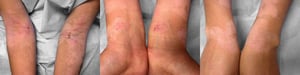
Flexural areas are the parts of the body where skin folds or creases, such as behind the knees and the inner folds of the elbows. These 3 photos show redness, scaling, and mild skin thickening on the inner folds of the elbows (left), wrists (center), and ankles (right).
Flexural areas are the parts of the body where skin folds or creases, such as behind the knees and the inner folds of t
Photos courtesy of Thomas Ruenger, MD, PhD.

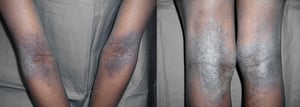
Flexural areas are the parts of the body where skin folds or creases, such as behind the knees and the inner folds of the elbows. These 2 photos show redness, scaling, and skin thickening on the inner folds of the elbows (left) and the backs of the knees (right). Redness is more difficult to see in people who have dark skin.
Flexural areas are the parts of the body where skin folds or creases, such as behind the knees and the inner folds of t
Photos courtesy of Thomas Ruenger, MD, PhD.

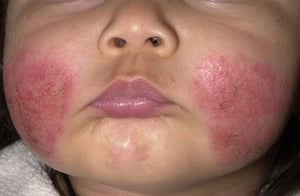
Atopic dermatitis usually develops in infancy. In the early (acute) phase, the rash appears on the face and then spreads to the neck, scalp, arms, and legs.
Atopic dermatitis usually develops in infancy. In the early (acute) phase, the rash appears on the face and then spread
Image provided by Thomas Habif, MD.

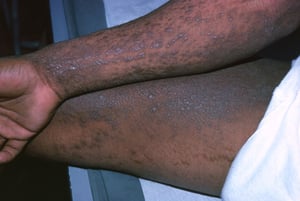
Picha hii inaonyesha ngozi kuongezeka unene kwa kiasi kikubwa (ngozi kuwa nene yenye mabaka) na kuongezeka kwa weusii katika ngozi (kuongezeka kwa rangi ya asili kupita kiasi) kutokana na michubuko ya muda mrefu.
Picha hii inaonyesha ngozi kuongezeka unene kwa kiasi kikubwa (ngozi kuwa nene yenye mabaka) na kuongezeka kwa weusii k
Picha kwa hisani ya Karen McKoy, MD.
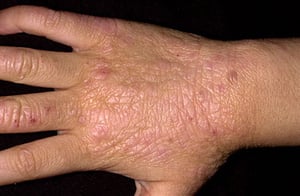
Lichenification is thickened skin that has accentuated skinfolds or creases that appear as deep grooves and wrinkles. The lichenification in this photo is the result of repeated scratching and rubbing that occurred during an episode of atopic dermatitis.
Lichenification is thickened skin that has accentuated skinfolds or creases that appear as deep grooves and wrinkles. T
Photo provided by Thomas Habif, MD.
Flexural areas are the parts of the body where skin folds or creases, such as behind the knees and the inner folds of the elbows. These 3 photos show redness, scaling, and mild skin thickening on the inner folds of the elbows (left), wrists (center), and ankles (right).
Flexural areas are the parts of the body where skin folds or creases, such as behind the knees and the inner folds of t
Photos courtesy of Thomas Ruenger, MD, PhD.
Flexural areas are the parts of the body where skin folds or creases, such as behind the knees and the inner folds of the elbows. These 2 photos show redness, scaling, and skin thickening on the inner folds of the elbows (left) and the backs of the knees (right). Redness is more difficult to see in people who have dark skin.
Flexural areas are the parts of the body where skin folds or creases, such as behind the knees and the inner folds of t
Photos courtesy of Thomas Ruenger, MD, PhD.
Atopic dermatitis usually develops in infancy. In the early (acute) phase, the rash appears on the face and then spreads to the neck, scalp, arms, and legs.
Atopic dermatitis usually develops in infancy. In the early (acute) phase, the rash appears on the face and then spread
Image provided by Thomas Habif, MD.
Picha hii inaonyesha ngozi kuongezeka unene kwa kiasi kikubwa (ngozi kuwa nene yenye mabaka) na kuongezeka kwa weusii katika ngozi (kuongezeka kwa rangi ya asili kupita kiasi) kutokana na michubuko ya muda mrefu.
Picha hii inaonyesha ngozi kuongezeka unene kwa kiasi kikubwa (ngozi kuwa nene yenye mabaka) na kuongezeka kwa weusii k
Picha kwa hisani ya Karen McKoy, MD.
Lichenification is thickened skin that has accentuated skinfolds or creases that appear as deep grooves and wrinkles. The lichenification in this photo is the result of repeated scratching and rubbing that occurred during an episode of atopic dermatitis.
Lichenification is thickened skin that has accentuated skinfolds or creases that appear as deep grooves and wrinkles. T
Photo provided by Thomas Habif, MD.
In infants, rashes on the face spread to the neck, eyelids, scalp, hands, arms, feet, and legs. Large areas of the body may be affected.
In older children and adults, a rash often occurs (and recurs) in only one or a few spots, especially on the front of the neck, the inner folds of the elbows, and behind the knees.
Although the color, intensity, and location of the rash vary, the rash always itches. In older children and adults, intense itching is the main symptom. The itching often leads to uncontrollable scratching, triggering a cycle of itching-scratching-itching that makes the problem worse. Continuous scratching causes the skin to thicken (lichenification).
Itching worsens with dry air, irritation, and emotional stress.
Common environmental triggers include
Excessive bathing or washing
Harsh soaps
Presence of the bacterium Staphylococcus aureus on the skin
Sweating
Rough fabrics and wool
Matatizo ya Ukurutu
Scratching and rubbing can also tear the skin, leaving an opening for bacteria to enter and cause infections of the skin, tissues below the skin, and nearby lymph nodes. Widespread inflammation and scaling of the skin also can develop.


This photo shows acute dermatitis complicated by an infection with Staphylococcus aureus bacteria.

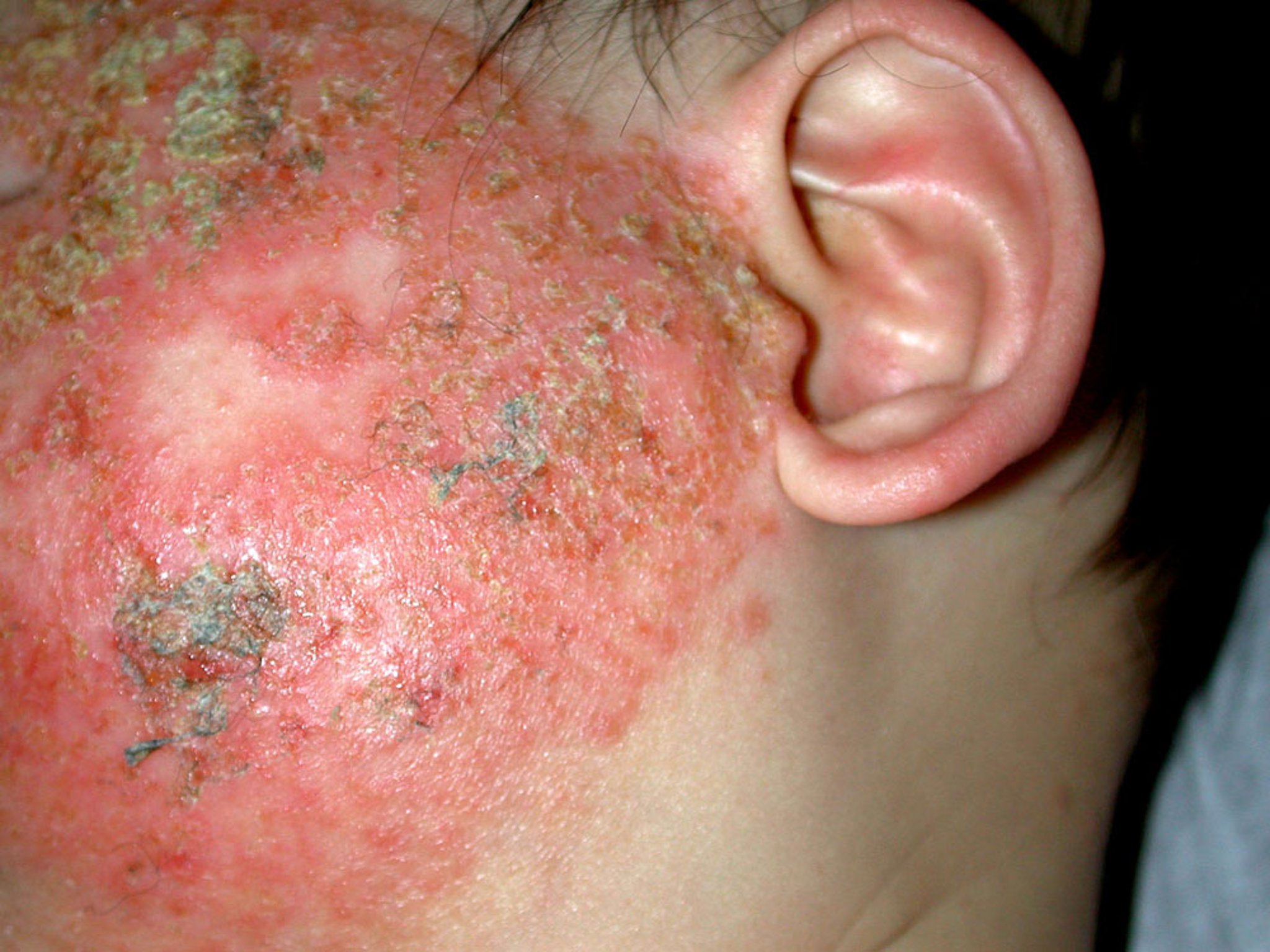
This photo shows acute dermatitis complicated by an infection.
Photo courtesy of Thomas Ruenger, MD, PhD.
In people with atopic dermatitis, infection with the herpes simplex virus, which in other people usually affects a small area with tiny, slightly painful blisters, may cause a serious illness with widespread dermatitis, blistering, and high fever (eczema herpeticum).


In people with atopic dermatitis, infection with the herpes simplex virus may cause a serious illness with widespread dermatitis, blistering, and high fever (eczema herpeticum).
People with atopic dermatitis are also more prone to develop other viral infections of the skin (such as common warts and molluscum contagiosum) and fungal skin infections.
People who have atopic dermatitis also have a higher risk of allergic contact reactions. These contact reactions are triggered when the skin comes in to contact with an allergen, which is a substance that sensitizes the skin. For example, contact allergies to nickel, the most common contact allergen, are twice as common among people who have atopic dermatitis than among people who do not have atopic dermatitis.
Utambuzi wa Ukurutu
The appearance of the rash and the person's family history
A doctor makes the diagnosis of atopic dermatitis based on the typical appearance of the rash and whether the patient or other family members have allergies, hay fever, or asthma.
Matibabu ya Ukurutu
Measures to relieve itching
Skin care
Topical corticosteroids
Other topical immune system‒modulating medications (such as tacrolimus, crisaborole, and ruxolitinib)
Phototherapy
Systemic immune system-modulating medications for moderate to severe disease (such as dupilumab, tralokinumab, and upadacitinib)
Sometimes antibiotics or antivirals
No cure exists, but itching can be relieved with medications applied to the skin (topical medications) or medications taken by mouth (oral medications).
Treatments for itching can usually be given at home, but people who have erythroderma, severe cellulitis, or eczema herpeticum may need to be hospitalized.
Doctors educate people about good skin care practices and the importance of breaking the itch–scratch cycle.
Utunzaji wa jumla na kutuliza mwasho
Certain skin care measures are helpful:
Using soap substitutes instead of regular soap
Applying moisturizers (ointments or creams) immediately after bathing, while the skin is damp
Reducing the frequency of bathing (showers/baths should be limited to once a day, and sponge baths can be substituted to decrease the number of days with full baths)
Limiting the temperature of bathing water to lukewarm
Blotting or patting the skin dry after bathing rather than rubbing
Taking baths with diluted bleach for people who have certain skin infections (for example, 60 mL [¼ cup] of household bleach [6%] into 76 L [20 gallons] of warm water)
Antihistamines, such as hydroxyzine and diphenhydramine, can help relieve itching. These medications are preferably taken at bedtime to avoid sleepiness during the day.
People should also try to reduce their emotional stress.
Kotikosteroidi
Topical corticosteroids are the mainstay of treatment.
Specific treatments include applying a corticosteroid ointment or cream. To limit the use of corticosteroids in people being treated for long periods (because long-term use can lead to thinning of the skin, stretch marks, or acne-like bumps), doctors sometimes replace the corticosteroids with noncorticosteroid treatments for eczema, for a week or more at a time.
Matibabu mengine
The immune system‒modulating medications tacrolimus and pimecrolimus also are helpful and can limit the need for long-term corticosteroid use. These medications are usually given as ointments or creams.
Crisaborole, a phosphodiesterase-4 inhibitor, is an ointment that can be used to reduce itching, swelling, and redness in people 2 years or older. It cannot be used on mucous membranes (such as the lining of the nose or mouth).
Janus kinase (JAK) inhibitors interfere with the communication between cells that coordinate inflammation by inhibiting the enzyme JAK. Ruxolitinib cream is a JAK inhibitor that can be used to treat mild to moderate atopic dermatitis in people 12 years of age or older who do not have a weakened or impaired immune system.
Phototherapy (exposure to ultraviolet light) may help, especially therapy using narrowband ultraviolet B light. If office-based phototherapy is not available or too inconvenient, home phototherapy is a good alternative. Several home phototherapy devices have programmable features that allow specialists to control the number of treatments and supervise a person's use of the device. Natural sun exposure is an alternative when phototherapy is not available.
Dupilumab and tralokinumab are biologic agents that are injected. These agents are given to people with moderate to severe atopic dermatitis that is not adequately controlled with other treatments.
Oral JAK inhibitors (such as upadacitinib, abrocitinib, and baricitinib) are systemic immunosuppressants that may be used in people 12 or older with moderate to severe atopic dermatitis that is not well controlled.
When biologic agents and oral JAK inhibitors are not suitable or available, conventional systemic immunosuppressant agents such as cyclosporine, mycophenolate, methotrexate, and azathioprine may be used.
Antibiotics may be given to people who have skin infections caused by Staphylococcus aureus or other bacteria. Antibiotic ointments may be applied directly to the skin or pills may be taken by mouth.
People who have the bacterium Staphylococcus aureus in their nose may be given the antibiotic mupirocin to apply inside their nostrils, thus preventing skin infection.
Parents should cut their children's fingernails short to minimize scratching and thus reduce the risk of infection.
Eczema herpeticum is treated with antiviral medications, such as acyclovir or valacyclovir. These medications are taken by mouth but can also be given by intravenous infusion for people who are hospitalized.
Ubashiri wa Ukurutu
Atopic dermatitis often lessens by the time children are 5 years of age. However, flare-ups are common throughout adolescence and into adulthood.
Atopic dermatitis is more likely to persist for a long time in females compared to males, and in people who developed atopic dermatitis at an early age, have a severe case, have a family history, or have rhinitis or asthma . Even in these people, however, atopic dermatitis frequently resolves or lessens significantly by adulthood.
Because the symptoms of atopic dermatitis are visible and sometimes disabling, children may develop long-term emotional problems as they face the challenge of living with the disorder during their developmental years.
Kinga ya Ukurutu
Avoiding excessive washing or bathing, reducing the use of soap, using lukewarm water when washing or bathing, and applying moisturizers very often can prevent or at least reduce flare-ups.
Identifying and avoiding triggers that worsen the condition can help. Triggers include sweat, stress, soaps, and detergents.