Bipolar and related disorders are characterized by alternating episodes of mania and depression, although many patients have a predominance of one or the other. Exact cause is unknown, but heredity, changes in the level of brain neurotransmitters, and psychosocial factors may be involved. Diagnosis is based on standard psychiatric criteria. Treatment consists of mood-stabilizing medications, sometimes with psychotherapy.
Bipolar disorders usually begin in the teens, 20s, or 30s (see also Bipolar Disorder in Children and Adolescents) (1). Lifetime prevalence, estimated using a worldwide sample, is approximately 2.5% in men and 2.3% in women (2).
Bipolar disorders are classified as:
Bipolar I disorder: Defined by the presence of at least 1 manic episode; depressive episodes also occur in most patients. Incidence is similar in men and women (1, 2).
Bipolar II disorder: Defined by the presence of at least 1 major depressive episode with at least 1 hypomanic episode but no manic episodes. Incidence is somewhat higher in women (3).
Cyclothymic disorder: Patients have prolonged (> 2-year) periods that include both hypomanic and depressive episodes; however, these episodes do not meet the specific criteria for a manic, hypomanic, or major depressive disorder.
Substance-/medication-induced bipolar disorder: Defined by the presence of a mood disturbance consistent with mania that develops during or soon after an exposure, intoxication, or withdrawal from a substance (eg, cocaine, corticosteroids) that is capable of producing such symptoms.
Bipolar and related disorder due to another medical condition: Defined by the presence of a mood disturbance consistent with mania that is caused by a medication condition (eg, Cushing syndrome, traumatic brain injury) and does not occur exclusively during an episode of delirium.
Unspecified bipolar disorder: Disorders with clear bipolar features that do not meet the specific criteria for other bipolar disorders.
(See also Overview of Mood Disorders.)
General references
1. American Psychiatric Association. Diagnostic and Statistical Manual of Mental Disorders, 5th ed, Text Revision (DSM-5-TR). American Psychiatric Association Publishing; 2022.
2. Nierenberg AA, Agustini B, Köhler-Forsberg O, et al. Diagnosis and Treatment of Bipolar Disorder: A Review. JAMA. 2023;330(14):1370-1380. doi:10.1001/jama.2023.18588
3. Diflorio A, Jones I. Is sex important? Gender differences in bipolar disorder. Int Rev Psychiatry. 22(5):437-452, 2010. doi: 10.3109/09540261.2010.514601
Etiology of Bipolar Disorders
The exact cause of bipolar disorder is unknown. Heritability of bipolar disorders is estimated to be 70 to 90% (1). There is also evidence of dysregulation of the neurotransmitters serotonin, norepinephrine, and dopamine (2).
Psychosocial factors may be involved. Stressful life events are often associated with initial development of symptoms and later exacerbations, although cause and effect have not been established (3).
Certain medications and substances can trigger exacerbations in some patients with bipolar disorder; these include:
Sympathomimetics (eg, cocaine, amphetamines)
Corticosteroids
Certain antidepressants (eg, tricyclics, noradrenergic reuptake inhibitors)
(See table for a comprehensive list of medical conditions and substances that may cause symptoms of bipolar disorder.)
Etiology references
1. Gordovez FJA, McMahon FJ. The genetics of bipolar disorder. Mol Psychiatry. 25(3):544-559, 2020. doi: 10.1038/s41380-019-0634-7
2. Magioncalda P, Martino M. A unified model of the pathophysiology of bipolar disorder. Mol Psychiatry. 2022;27(1):202-211. doi:10.1038/s41380-021-01091-4
3. Carvalho AF, Firth J, Vieta E. Bipolar Disorder. N Engl J Med. 2020;383(1):58-66. doi:10.1056/NEJMra1906193
Symptoms and Signs of Bipolar Disorders
Bipolar disorder begins with an acute phase of symptoms of depression or mania, followed by a repeating course of remission and relapse. Remissions are often complete, but many patients have residual symptoms, and for some, the ability to function at work is severely impaired. Relapses are discrete episodes of more intense symptoms that are manic, depressive, hypomanic, or a mixture of depressive and manic features. (See figure .)
Manic patients may be inexhaustibly, excessively, and impulsively involved in various pleasurable, high-risk activities (eg, gambling, dangerous sports, sexual indiscretions) without insight into possible harm. Unwise investments, spending sprees, and other personal choices may have irreparable consequences.
Patients in a manic episode may be exuberant and flamboyantly or colorfully dressed and often have an authoritative manner with a rapid, unstoppable flow of speech. Patients may make clang associations (new thoughts that are triggered by word sounds rather than meaning). Easily distracted, patients may constantly shift from one theme or endeavor to another. However, they tend to believe they are in their best mental state.
Lack of insight and an increased capacity for activity often lead to intrusive behavior and can be a dangerous combination. Interpersonal friction results and may cause patients to feel that they are being unjustly treated or persecuted. As a result, patients may become a danger to themselves or to other people. Accelerated mental activity is experienced as racing thoughts by patients and is observed as flights of ideas by the clinician.
Episodic Patterns in Bipolar I and Bipolar II Disorders
Data from Nierenberg AA, Agustini B, Köhler-Forsberg O, et al. Diagnosis and Treatment of Bipolar Disorder: A Review. JAMA. 2023;330(14):1370-1380. doi:10.1001/jama.2023.18588 |

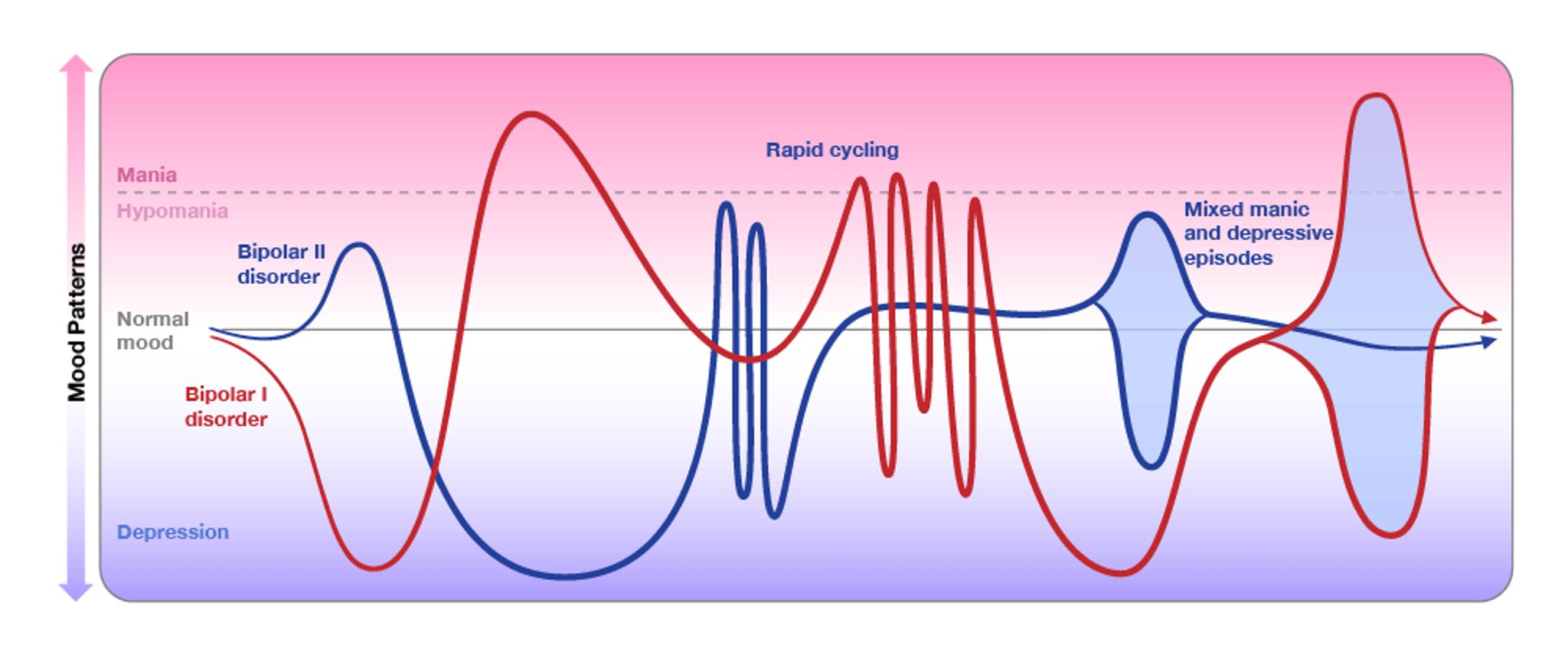
Episodes last from a few weeks to 6 months; depressive episodes typically last longer than manic or hypomanic episodes.
Cycles—time from onset of one episode to that of the next—vary in length among patients. Some patients have infrequent episodes, perhaps only a few over a lifetime, whereas others have rapid-cycling forms (usually defined as ≥ 4 episodes/year). Only a minority alternate back and forth between mania and depression with each cycle; in most, one or the other predominates.
Patients may attempt or complete suicide. Lifetime incidence of suicide in patients with bipolar disorder is estimated to be approximately 20 to 60 times that of the general population (1), and 15 to 20% of people with bipolar disorder die by suicide (2).
Symptoms and signs references
1. Plans L, Barrot C, Nieto E, et al. Association between completed suicide and bipolar disorder: A systematic review of the literature. J Affect Disord. 242:111-122, 2019. doi: 10.1016/j.jad.2018.08.054
2. Nierenberg AA, Agustini B, Köhler-Forsberg O, et al. Diagnosis and Treatment of Bipolar Disorder: A Review. JAMA. 2023;330(14):1370-1380. doi:10.1001/jama.2023.18588
Diagnosis of Bipolar Disorders
Psychiatric assessment
Thyroxine (T4) and thyroid-stimulating hormone (TSH) level to screen for hyperthyroidism
Exclusion of stimulant abuse clinically or by blood or urine toxicology screening
Routine laboratory tests (eg, complete blood cell count, basic metabolic panel) to exclude other general medical conditions
Diagnosis of bipolar I disorder requires meeting the Diagnostic and Statistical Manual of Mental Disorders, 5th edition, Text Revision (DSM-5-TR) criteria for a manic episode (1). The manic episode may have been preceded or followed by hypomanic or major depressive episodes.
A manic episode is defined as having an abnormally and persistently elevated, expansive, or irritable mood and increased activity or energy that lasts ≥ 1 week (or less if hospitalization is necessary) plus ≥ 3 additional symptoms (or ≥ 4 if the mood is only irritable) (1):
Inflated self-esteem or grandiosity
Decreased need for sleep
More talkativeness than usual or pressure to keep talking
Flight of ideas or racing of thoughts
Distractibility
Increased goal-directed activity or psychomotor agitation
Excessive involvement in activities with high potential for painful consequences (eg, buying sprees, foolish business investments, sexual indiscretions)
The mood disturbance must result in severe impairment, include psychotic features, or result in hospitalization, and is not caused by substance use or another medical condition.
Diagnosis of bipolar I disorder may include specifiers to clarify the type and severity of the current episode, whether there are psychotic features, and whether the patient is in full or partial remission. The symptoms of mania must not be better accounted for by schizophrenia or a related disorder.
Diagnosis of bipolar II disorder requires meeting the DSM-5-TR criteria for at least 1 hypomanic episode as well as at least 1 major depressive episode (1).
A hypomanic episode is a variant of a manic episode that is of shorter duration and often has less severe symptoms. A hypomanic episode is defined as a distinct period of an abnormally and persistently elevated, expansive, or irritable mood and increased activity or energy that are present for most of the day, nearly every day. The episode lasts ≥ 4 days and includes ≥ 3 of the additional symptoms listed above in the definition of a manic episode (1). A hypomanic episode sometimes lasts a week or longer, but it is differentiated from a manic episode because it does not involve psychotic features, marked impairment in function, or the need for hospitalization.
A major depressive episode is defined as having ≥ 5 of the following symptoms during the same 2-week period, and at least 1 of the symptoms must be depressed mood or loss of interest or pleasure and, with the exception of suicidal thoughts or attempts, all symptoms are present nearly every day (1).
Depressed mood most of the day
Markedly diminished interest or pleasure in all or almost all activities for most of the day
Significant weight gain or loss (eg, a change of >5% of body weight in a month) or decreased or increased appetite
Insomnia (often sleep-maintenance insomnia) or hypersomnia
Psychomotor agitation or retardation observed by others (not self-reported)
Fatigue or loss of energy
Feelings of worthlessness or excessive or inappropriate guilt
Diminished ability to think or concentrate or indecisiveness
Recurrent thoughts of death or suicide, a suicide attempt, or specific plan for suicide
The symptoms must be severe enough to markedly impair social or occupational functioning or to require hospitalization to prevent harm to self or others.
The differential diagnosis of bipolar disorders includes the following:
Bipolar and related disorder due to another medical condition
Substance-/medication-induced bipolar and related disorder
Some patients who present with depressive symptoms may have previously experienced hypomania or mania but do not report it unless they are specifically questioned. Skillful questioning may reveal morbid signs (eg, excesses in spending, impulsive sexual escapades, stimulant use), although such information is more likely to be provided by relatives. A structured inventory such as the Mood Disorder Questionnaire may be useful. All patients must be asked gently but directly about suicidal ideation, plans, or activity.
Similar acute manic or hypomanic symptoms may result from stimulant use, treatment with corticosteroids or dopamine agonists, or general medical disorders such as hyperthyroidism or pheochromocytoma. Patients with hyperthyroidism typically have other physical symptoms and signs, but thyroid function testing (T4 and TSH levels) is a reasonable screen for new patients. Patients with pheochromocytoma have marked intermittent or sustained hypertension; if hypertension is absent, testing for pheochromocytoma is not indicated. Other disorders less commonly cause symptoms of mania, but depressive symptoms may occur in a number of disorders (see table ).
A review of substance use (especially of amphetamines and cocaine) and blood or urine toxicology screening can help identify such causes. However, because substance use may simply have triggered an episode in a patient with bipolar disorder, seeking evidence of symptoms (manic or depressive) not related to substance use is important.
Some patients with schizoaffective disorder have manic symptoms, but such patients have psychotic features that have persisted beyond the abnormal mood episodes.
Patients with bipolar disorder may also have anxiety disorders (eg, social phobia, panic attacks, obsessive-compulsive disorders, and personality disorders), making the diagnosis challenging.
Diagnosis reference
1. American Psychiatric Association. Diagnostic and Statistical Manual of Mental Disorders, 5th ed, Text Revision (DSM-5-TR). American Psychiatric Association Publishing; 2022.
Treatment of Bipolar Disorders
Mood stabilizers (eg, lithium, certain antiseizure medications), a second-generation antipsychotic, or a combination
Support and psychotherapy
Sometimes electroconvulsive therapy or phototherapy
Treatment of bipolar disorder usually has 3 phases:
Acute: To stabilize and control the initial, sometimes severe manifestations
Continuation: To attain full remission
Maintenance or prevention: To keep patients in remission
Although most patients with hypomania can be treated as outpatients, severe mania or depression often requires inpatient management.
(See also Medications for Treatment of Bipolar Disorder.)
Pharmacotherapy for bipolar disorder
Medications for bipolar disorder include the following (1–3):
Mood stabilizers: Lithium and certain antiseizure medications, especially valproate, carbamazepine, and lamotrigine
Antipsychotics, usually atypical (second-generation) agents: Quetiapine, asenapine, aripiprazole, paliperidone, risperidone, cariprazine, olanzapine, ziprasidone, lurasidone, lumateperone.
These medications are used alone or in combination for all phases of treatment (1, 3). Doses of the same medication may vary depending on the phase of illness (eg, acute mania, acute depression, maintenance).
Choice of pharmacotherapy for bipolar disorder can be difficult because all medications have significant adverse effects, drug interactions are common, and no medication is universally effective. Selection should be based on authoritative guidelines (1), as well as on what has previously been effective and well tolerated in a given patient. If the patient has not previously been given medications to treat bipolar disorder (or medication history is unknown), choice is based on the patient’s medical history (ie, which mood stabilizer's adverse effect profile is most compatible with the patient's medical history) and the severity of symptoms.
First-line medications for acute mania include lithium, quetiapine, divalproex, asenapine, aripiprazole, paliperidone, and cariprazine (1). Because lithium takes 4 to 10 days to work, a medication that works more rapidly is often given to control excited thought and activity. Other medications or combinations are used for maintenance therapy in bipolar I disorder and bipolar II disorder.
For severe manic psychosis, in which immediate patient safety and symptom management are compromised, urgent behavioral control usually requires a sedating second-generation antipsychotic, sometimes supplemented initially with a benzodiazepine, such as lorazepam or clonazepam (see table ).
For less severe acute episodes in patients without contraindications (eg, renal disorders), lithium is a good first choice for both mania and depressive episodes. Because its onset is slow (4 to 10 days), patients with significant symptoms may also be given an antiseizure medication or a second-generation antipsychotic.
Recommended first-line medications for acute bipolar I depression include quetiapine, a combination of lurasidone and lithium or divalproex, lithium monotherapy, lamotrigine, cariprazine, or lurasidone; the first-line medication for acute bipolar II depression is quetiapine (1).
Specific antidepressants (eg, selective serotonin reuptake inhibitors [SSRIs]) are sometimes added for severe depression, but their effectiveness is controversial; they are not recommended as sole therapy for depressive episodes. Ketamine has also been shown to be effective in the treatment of severe bipolar depression (4). Haloperidol can be effective for acute mania.
Stimulants, such as lisdexamfetamine, methylphenidate, and modafinil, may be used for coexisting attention-deficit hyperactivity disorder provided that mood stabilizers are also being taken when mania is present, or as an adjunct in treatment-resistant bipolar depression (5, 6).
Once remission is achieved, maintenance therapy with mood stabilizers (including antipsychotics) or combination therapy is indicated for all patients with bipolar I disorder . If episodes recur during maintenance treatment, clinicians should determine whether adherence is poor and, if so, whether nonadherence preceded or followed recurrence. Reasons for nonadherence should be explored to determine whether a change in mood stabilizer type or dosing would render treatment more acceptable.
Support and psychotherapy
Enlisting the support of loved ones is crucial to preventing major episodes.
Group therapy and psychoeducation are often recommended for patients and their partner; there, they learn about bipolar disorder, its social sequelae, and the central role of mood stabilizers in treatment (1, 2).
Individual psychotherapy, including cognitive-behavioral therapy, interpersonal therapy, family-focused therapy, and other methods, may help patients better cope with problems of daily living and adjust to a new way of identifying themselves (1–3).
More than half of patients may not fully adhere to medication regimens (1). When nonadherence is because patients believe that these medications make them less alert and creative, the clinician can explain that decreased creativity is relatively uncommon because mood stabilizers usually provide opportunity for a more even performance in interpersonal, scholastic, professional, and artistic pursuits.
Patients should be counseled to limit intake of alcohol, to minimize sleep deprivation, and to recognize early signs of relapse.
If patients tend to be financially extravagant, finances should be turned over to a trusted family member. Patients with increased sexual activity during periods of mania or hypomania should be informed about the risk and prevention of sexually transmitted infections, as well as potential consequences for relationships.
Support groups (eg, the Depression and Bipolar Support Alliance [DBSA]) can help patients by providing a forum to share their common experiences and feelings.
Other treatments
Electroconvulsive therapy (ECT) is sometimes used for bipolar depression refractory to treatment and is also effective for mania (1–3, 7).
Phototherapy can be useful in treating depressive symptoms of seasonal bipolar I or bipolar II disorder (with autumn-winter depression and spring-summer hypomania) or nonseasonal bipolar I or bipolar II disorder (8). It is probably most useful as augmentative therapy.
Transcranial magnetic stimulation, which is sometimes used to treat severe, resistant depression, has also proven effective in bipolar depression (3, 9).
Treatment references
1. Keramatian K, Chithra NK, Yatham LN. The CANMAT and ISBD Guidelines for the Treatment of Bipolar Disorder: Summary and a 2023 Update of Evidence. Focus (Am Psychiatr Publ). 2023;21(4):344-353. doi:10.1176/appi.focus.20230009
2. Nierenberg AA, Agustini B, Köhler-Forsberg O, et al. Diagnosis and Treatment of Bipolar Disorder: A Review. JAMA. 2023;330(14):1370-1380. doi:10.1001/jama.2023.18588
3. Goes FS. Diagnosis and management of bipolar disorders. BMJ. 2023;381:e073591. Published 2023 Apr 12. doi:10.1136/bmj-2022-073591
4. Wilkowska A, Szałach Ł, Cubała WJ. Ketamine in bipolar disorder: A review. Neuropsychiatr Dis Treat. 16:2707-2717, 2020. doi: 10.2147/NDT.S282208
5. Tsapakis EM, Preti A, Mintzas MD, Fountoulakis KN. Adjunctive treatment with psychostimulants and stimulant-like drugs for resistant bipolar depression: a systematic review and meta-analysis. CNS Spectr. Published online July 9, 2020. doi:10.1017/S109285292000156X
6. Miskowiak KW, Obel ZK, Guglielmo R, et al. Efficacy and safety of established and off-label ADHD drug therapies for cognitive impairment or attention-deficit hyperactivity disorder symptoms in bipolar disorder: A systematic review by the ISBD Targeting Cognition Task Force. Bipolar Disord. 2024;26(3):216-239. doi:10.1111/bdi.13414
7. Perugi G, Medda P, Toni C, et al. The role of electroconvulsive therapy (ECT) in bipolar disorder: Effectiveness in 522 patients with bipolar depression, mixed-state, mania and catatonic features. Curr Neuropharmacol. 15(3):359-371, 2017. doi: 10.2174/1570159X14666161017233642
8. Dong C, Shi H, Liu P, et al. A critical overview of systematic reviews and meta-analyses of light therapy for non-seasonal depression. Psychiatry Res. 314:114686, 2022. doi: 10.1016/j.psychres.2022.114686
9. Trapp NT, Purgianto A, Taylor JJ, et al. Consensus review and considerations on TMS to treat depression: A comprehensive update endorsed by the National Network of Depression Centers, the Clinical TMS Society, and the International Federation of Clinical Neurophysiology. Clin Neurophysiol. 2025;170:206-233. doi:10.1016/j.clinph.2024.12.015
Key Points
Bipolar disorder is a cyclic condition that involves episodes of mania with or without depression (bipolar I) or hypomania plus depression (bipolar II).
Bipolar disorder markedly impairs the ability to function at work and to interact socially, and risk of suicide is significant; however, mild manic states (hypomania) are sometimes adaptive because they can produce high energy, creativity, confidence, and supernormal social functioning.
Length and frequency of cycles vary among patients; some patients have only a few over a lifetime, whereas others have ≥ 4 episodes/year (rapid-cycling forms).
Only a few patients alternate back and forth between mania and depression during each cycle; in most cycles, one or the other predominates.
Diagnosis is based on clinical criteria, but stimulant use disorder and general medical disorders (such as hyperthyroidism or pheochromocytoma) must be ruled out by examination and testing.
Treatment depends on the manifestations and their severity but typically involves mood stabilizers and antiseizure medications (eg, lithium, valproate, carbamazepine, lamotrigine) and/or second-generation antipsychotics (eg, aripiprazole, lurasidone, olanzapine, quetiapine, risperidone, ziprasidone, cariprazine).
Drug Information for the Topic