Stasis dermatitis is inflammation of the skin of the lower legs resulting from the pooling of blood and fluid.
(See also Overview of Dermatitis.)
Stasis dermatitis occurs in people who have chronic swelling (edema) resulting from chronic venous insufficiency of the lower legs (damage to leg veins that prevents blood from flowing normally), heart failure, or lymphedema.
Stasis dermatitis usually occurs on the shins but can also affect other areas that are prone to swelling such as the arms after radiation therapy to the lymph nodes.
Dalili za Stasis Dermatitis
At first, the skin is itchy, red, scaly, and thickened, usually on the shins.
Eventually, areas of the skin may break down and form an open sore (ulcer). Ulcers sometimes become infected with bacteria, causing cellulitis (a bacterial infection of the skin), and are usually painful.

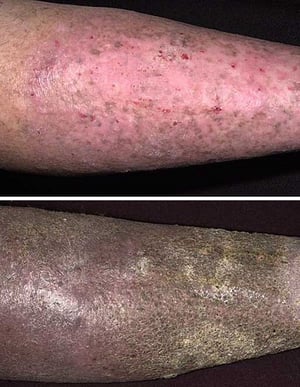
Chronic venous insufficiency causes the skin to be discolored and to develop scaling, weeping, and crusting. The changes are visible in people with light skin (top) and people with dark skin (bottom).
Chronic venous insufficiency causes the skin to be discolored and to develop scaling, weeping, and crusting. The change
Images provided by Thomas Habif, MD.

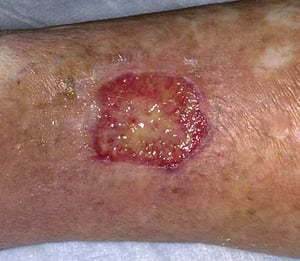
In this photo of a person with stasis dermatitis, the skin is broken down, forming an open sore (ulcer).
In this photo of a person with stasis dermatitis, the skin is broken down, forming an open sore (ulcer).
Image provided by Thomas Habif, MD.


This photo shows a large, weeping, open sore (ulcer) that is at high risk of developing into a chronic leg ulcer. The skin around the ulcer has become thicker and darker.
This photo shows a large, weeping, open sore (ulcer) that is at high risk of developing into a chronic leg ulcer. The s
Roberto A. Penne-Casanova/SCIENCE PHOTO LIBRARY


This large venous stasis ulcer is surrounded by reddish brown skin.
This large venous stasis ulcer is surrounded by reddish brown skin.
© Springer Science+Business Media
Chronic venous insufficiency causes the skin to be discolored and to develop scaling, weeping, and crusting. The changes are visible in people with light skin (top) and people with dark skin (bottom).
Chronic venous insufficiency causes the skin to be discolored and to develop scaling, weeping, and crusting. The change
Images provided by Thomas Habif, MD.
In this photo of a person with stasis dermatitis, the skin is broken down, forming an open sore (ulcer).
In this photo of a person with stasis dermatitis, the skin is broken down, forming an open sore (ulcer).
Image provided by Thomas Habif, MD.
This photo shows a large, weeping, open sore (ulcer) that is at high risk of developing into a chronic leg ulcer. The skin around the ulcer has become thicker and darker.
This photo shows a large, weeping, open sore (ulcer) that is at high risk of developing into a chronic leg ulcer. The s
Roberto A. Penne-Casanova/SCIENCE PHOTO LIBRARY
This large venous stasis ulcer is surrounded by reddish brown skin.
This large venous stasis ulcer is surrounded by reddish brown skin.
© Springer Science+Business Media
When chronic venous insufficiency is the cause, the skin can turn yellow-brown, varicose veins (dilated, twisted veins) usually develop, and the skin may become hard, thick, painful, and tender.
Utambuzi wa Stasis Dermatitis
The appearance of the skin and presence of chronic venous insufficiency
Possibly ultrasound
Doctors diagnose stasis dermatitis in people who have the characteristic skin changes and other symptoms of leg swelling and chronic venous insufficiency.
Sometimes more extensive evaluation and imaging tests (such as ultrasound) are needed.
Matibabu ya Stasis Dermatitis
Measures to prevent blood from pooling in the legs
Measures to relieve dermatitis
For ulcers, special dressings or an Unna paste boot
For infection, antibiotics
The cause of the chronic swelling is treated.
Matibabu ya upungufu wa mishipa wa muda mrefu
Long-term treatment is aimed at treating chronic venous insufficiency by keeping blood from pooling in the veins around the ankles.
Several times a day (about every 2 hours) and while sleeping, if possible, people should elevate their legs above the level of the heart.
Properly fitted prescription support stockings (compression stockings) also prevent pooling of blood and decrease swelling. Over-the-counter store "support" stockings are not usually adequate.
Matibabu ya dermatitis
For dermatitis that has started recently, and if there are no ulcers, a corticosteroid cream or ointment applied to the affected areas can help. If the disorder worsens, as evidenced by increased warmth, redness, oozing, or small ulcers, a more absorbent dressing, such as a hydrocolloid dressing, can be used.
In stasis dermatitis, the skin is easily irritated. Antibiotic creams, first-aid (anesthetic) creams, wool alcohols, witch hazel, lanolin, or other chemicals can make the disorder worse and should not be used.
Matibabu ya vidonda
Ulcers are best treated with compresses and dressings made with zinc oxide paste. Special moisture-absorbing hydrocolloid or hydrogel dressings also may be used.
Some people may need an Unna paste boot, which is a woven stretch wrap filled with a gelatin paste that contains zinc. The wrap is applied to the ankle and lower leg where it hardens, similar to but softer than a cast. The boot limits swelling and helps protect the skin from irritation, and the paste helps heal the skin. At first the boot is changed every 2 or 3 days, but later it is changed only once or twice a week. After the ulcer heals, an elastic support should be applied before the person rises in the morning. Regardless of the dressing used, reduction of swelling (usually with compression) is essential for healing.
Antibiotics applied to the skin are useful for treating some open or irritated areas of skin and ulcers. Antibiotics given by mouth are used to treat cellulitis.
Sometimes, skin from elsewhere on the body may be grafted to cover very large ulcers.