Chronic venous insufficiency is damage to leg veins that prevents blood from flowing normally. Post-thrombotic syndrome is chronic venous insufficiency that results from a blood clot in the veins and causes symptoms.
Chronic venous insufficiency may cause leg discomfort, swelling, and skin rash, discoloration, and/or ulcers.
Post-thrombotic syndrome is chronic venous insufficiency that resulted from a blood clot in the veins (deep vein thrombosis).
Doctors use duplex ultrasound for diagnosis.
Keeping the leg elevated, wearing compression stockings, and carefully treating any wounds are necessary for treatment.
(See also Overview of the Venous System.)
The number of people in the United States who have chronic venous insufficiency is unknown. Different studies have given estimates of the number of people affected, and those estimates vary greatly. Post-thrombotic syndrome may develop in up to 50% of people with deep vein thrombosis, usually within 1 to 2 years.
Matibabu ya Upungufu wa Vena wa Muda Mrefu
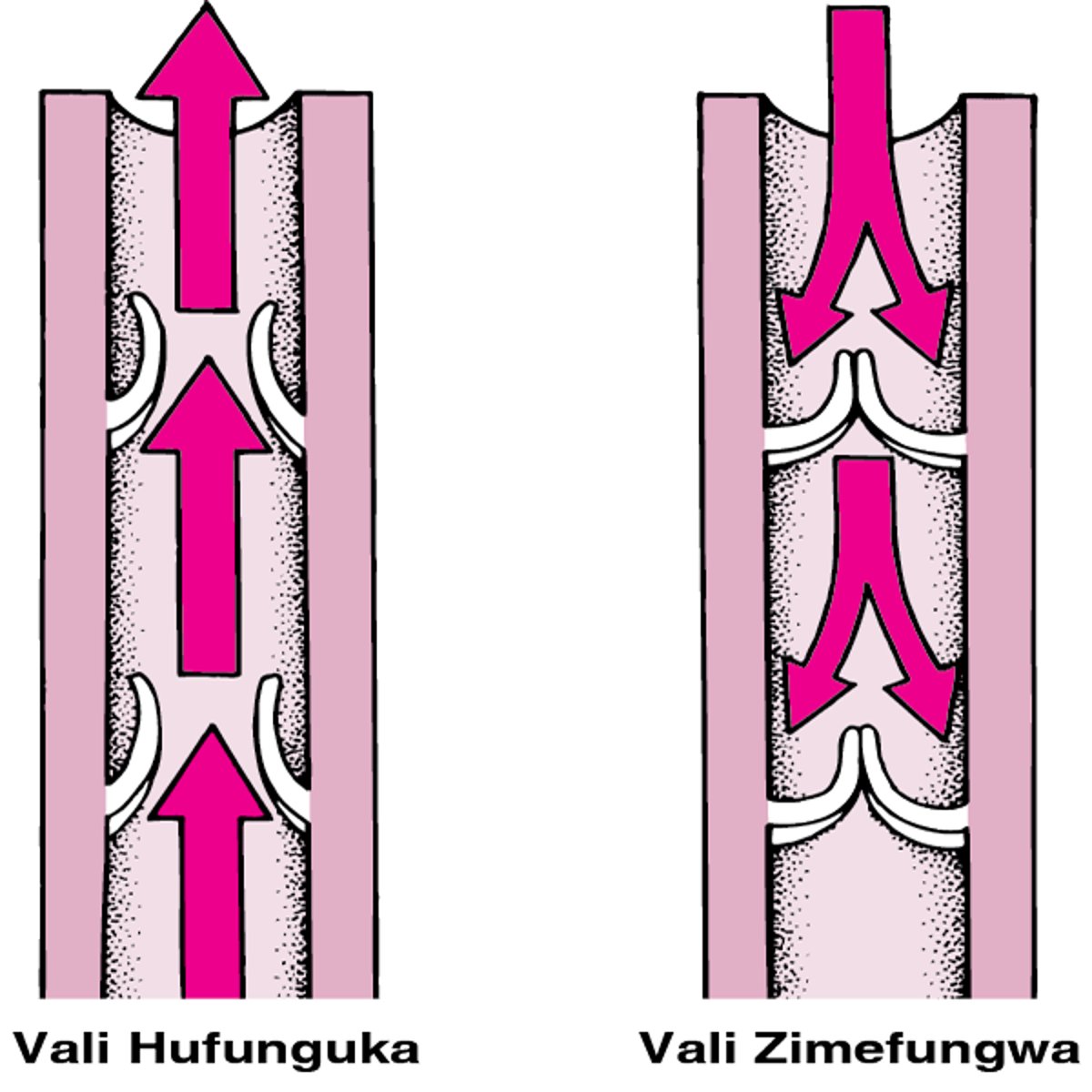
Arteries carry blood with oxygen and nutrients away from the heart to the rest of the body. Veins return blood to the heart from the rest of the body. Blood returns from the legs through shallow and deep veins. Contraction of leg muscles pushes blood through the deep veins. Valves in the veins keep blood flowing upward toward the heart and stop the blood from flowing backward.
Chronic venous insufficiency occurs when scar tissue damages the leg veins or the valves in the veins. These changes decrease blood flow in the veins and increase the pressure in the veins. The increased pressure and low blood flow cause fluid to accumulate in the legs and other symptoms.
Vali za Mwelekeo Mmoja kwenye Mishipa
One-way valves consist of two flaps (cusps or leaflets) with edges that meet. These valves help veins return blood to the heart. As blood moves toward the heart, it pushes the flaps open like a pair of one-way swinging doors (shown on the left). If gravity or muscle contractions momentarily pull the blood backward or if blood begins to back up in a vein, the flaps are immediately pushed closed, preventing backward flow (shown on the right). |

Risk factors for chronic venous insufficiency include:
Previous blood clot in the legs (deep vein thrombosis)
Aging
Injury to the legs
Sitting or standing for long periods
Pregnancy
A blood clot may cause chronic venous insufficiency because scar tissue from the clot may damage the valves in the veins. Some people may then develop post-thrombotic syndrome, which is chronic venous insufficiency with symptoms.
Ugonjwa wa baada ya thrombosi
Not everyone who has a blood clot in the leg develops post-thrombotic syndrome. People who are at increased risk following a blood clot in the leg include those who have had:
Several episodes of blood clots in the same leg
A blood clot in the upper part of the leg and/or pelvic region
People who have obesity also may be at increased risk of post-thrombotic syndrome.
Matibabu ya Upungufu wa Vena wa Muda Mrefu
People with chronic venous insufficiency have leg swelling (edema), which typically is worse at the end of the day because blood must flow upward against gravity when a person is standing or sitting. Overnight, edema subsides because the veins empty well when people lie down. The swelling may not cause any symptoms, but some people feel fullness, heaviness, aching, cramps, pain, tiredness, and tingling in the legs.
Varicose veins may be present.
Later on, the skin on the inside of the ankle becomes scaly and itchy and may become discolored. The discoloration is caused by red blood cells that escape from swollen (distended) veins into the skin. The discolored skin is vulnerable, and even a minor injury, such as that from scratching or a bump, can break it open, resulting in an ulcer. Ulcers may also develop without any known injury, typically on the inside of the ankle. Ulcers are usually only slightly uncomfortable. A very painful ulcer might be infected.

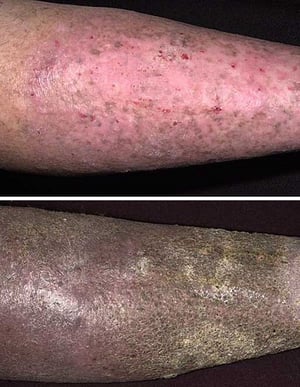
Chronic venous insufficiency causes the skin to be discolored and to develop scaling, weeping, and crusting. The changes are visible in people with light skin (top) and people with dark skin (bottom).
Chronic venous insufficiency causes the skin to be discolored and to develop scaling, weeping, and crusting. The change
Images provided by Thomas Habif, MD.

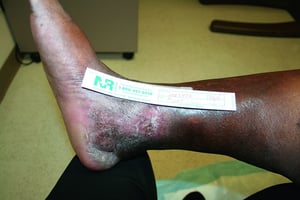
Venous stasis causes the skin to become hard and leathery and darker than the surrounding skin. A shallow ulcer is developing at the ankle.
Venous stasis causes the skin to become hard and leathery and darker than the surrounding skin. A shallow ulcer is deve
© Springer Science+Business Media

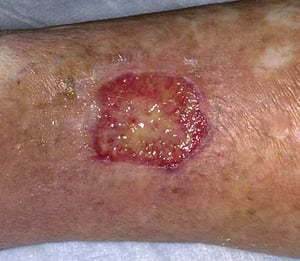
In this photo of a person with stasis dermatitis, the skin is broken down, forming an open sore (ulcer).
In this photo of a person with stasis dermatitis, the skin is broken down, forming an open sore (ulcer).
Image provided by Thomas Habif, MD.


This large venous stasis ulcer is surrounded by reddish brown skin.
This large venous stasis ulcer is surrounded by reddish brown skin.
© Springer Science+Business Media
Chronic venous insufficiency causes the skin to be discolored and to develop scaling, weeping, and crusting. The changes are visible in people with light skin (top) and people with dark skin (bottom).
Chronic venous insufficiency causes the skin to be discolored and to develop scaling, weeping, and crusting. The change
Images provided by Thomas Habif, MD.
Venous stasis causes the skin to become hard and leathery and darker than the surrounding skin. A shallow ulcer is developing at the ankle.
Venous stasis causes the skin to become hard and leathery and darker than the surrounding skin. A shallow ulcer is deve
© Springer Science+Business Media
In this photo of a person with stasis dermatitis, the skin is broken down, forming an open sore (ulcer).
In this photo of a person with stasis dermatitis, the skin is broken down, forming an open sore (ulcer).
Image provided by Thomas Habif, MD.
This large venous stasis ulcer is surrounded by reddish brown skin.
This large venous stasis ulcer is surrounded by reddish brown skin.
© Springer Science+Business Media
If edema is severe and persistent, scar tissue develops and traps fluid in the tissues. As a result, the calf permanently enlarges and feels hard. In such cases, ulcers are more likely to develop, and they heal less easily.
Matibabu ya Upungufu wa Vena wa Muda Mrefu
Doctor's evaluation
Sometimes ultrasound
Doctors usually can diagnose chronic venous insufficiency based on its appearance and symptoms.
Sometimes doctors do ultrasound of the legs to make sure the edema is not caused by deep vein thrombosis.
Matibabu ya Upungufu wa Mishipa wa Muda Mrefu
Treatment involves:
Leg elevation
Compression using properly applied bandages, graduated compression stockings, and/or intermittent pneumatic compression devices
Exercises
Wound care
Sometimes surgery
Elevating the leg above the level of the heart decreases pressure in the veins, and should be done for 30 minutes or longer at least 3 times per day.
Compression is effective and used for all people to help reduce swelling and discomfort. Elastic bandages are used first. Once edema decreases and ulcers begin to heal, people can use commercial graduated compression stockings. Such stockings are available with different amounts of pressure (highest pressure at ankles and lower pressures higher on the leg). Higher pressure stockings are more effective for severe problems but are more uncomfortable. Stockings should be put on when people awaken, before leg edema worsens with activity, and worn all day. Many people have difficulty using the stockings regularly. People may consider the stockings unattractive. More active people may consider stockings irritating or restricting. Some people may have difficulty putting them on.
Intermittent pneumatic compression (IPC) uses a pump to repeatedly inflate and deflate hollow plastic leggings. IPC squeezes blood and fluid out of the lower legs but is cumbersome. IPC therapy is used when compression stockings are not effective or the person in unable to tolerate them.
Exercise, in particular leg strengthening and aerobic exercises, can help.
Wound care is important to heal leg ulcers. Various dressings have been developed that can be left under compression stockings for several days to a week. The Unna boot dressing uses zinc oxide–impregnated bandages. Other dressings provide a moist environment for wound healing and promote growth of new tissue, or others provide a dry environment to absorb liquid discharge from the healing ulcer.
An oral medication called pentoxifylline may be given. Skin creams, balms, and skin medications of any kind have little effect.
Once blood flow in the veins has improved, the ulcer heals by itself. After it has healed, wearing an elastic stocking daily can prevent a recurrence. The stocking must be replaced as soon as it becomes too loose. If possible, the person should purchase 7 stockings or pairs of stockings (if both legs are involved)—one for each day of the week so that stockings remain effective considerably longer.
Surgery is sometimes used. Skin grafting can be a last resort for skin ulcers that have not healed with other measures. However, the grafted skin will reulcerate unless the person consistently follows leg elevation and compression instructions. Procedures to repair venous valves or to bypass damaged veins are sometimes done for people with severe symptoms from chronic venous insufficiency.
Matibabu ya Upungufu wa Vena wa Muda Mrefu
Losing weight, participating in regular exercise, and reducing the amount of sodium in the diet can help keep blood pressure in the leg veins low and reduce the risk of developing chronic venous insufficiency.
People who are at high risk for developing a deep venous thrombosis should be treated with anticoagulation (for example after orthopedic surgery). People who have had deep venous thrombosis should take anticoagulants to prevent post-thrombotic syndrome. Compression stockings do not prevent the development of chronic venous insufficiency but are useful for its treatment.
Taarifa Zaidi
The following English-language resource may be useful. Please note that The Manual is not responsible for the content of this resource.