The heart and blood vessels constitute the cardiovascular (circulatory) system. The blood circulating in this system delivers oxygen and nutrients to the tissues of the body and removes waste products from the tissues.
The blood vessels consist of:
Arteries
Arterioles
Capillaries
Venules
Veins
All blood is carried in these vessels.
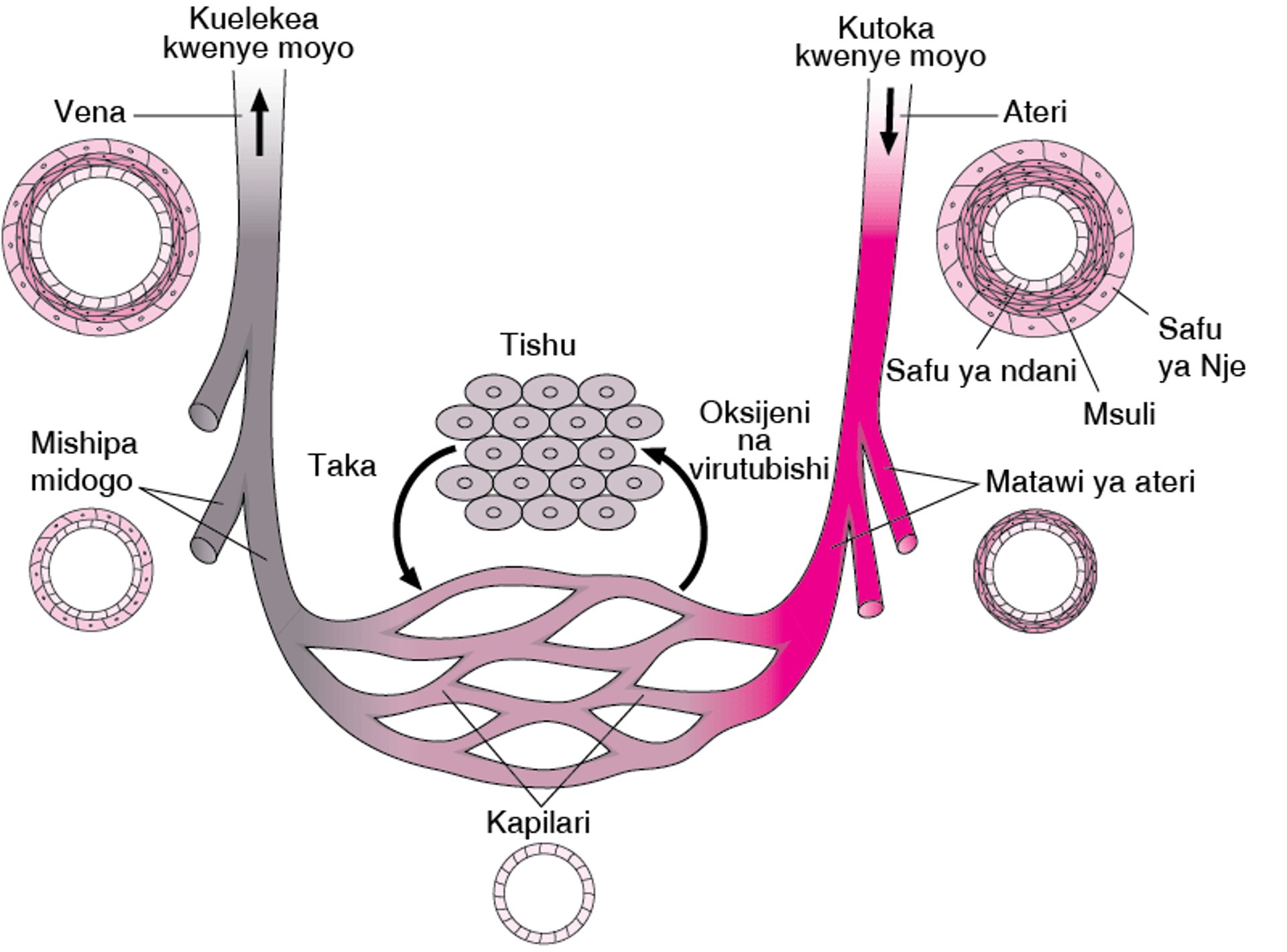
Mishipa ya damu: Kuzungusha Damu
Damu husafiri kutoka kwenye moyo kwenye ateri, ambazo hugawanyika katika mishipa midogo midogo, mwishowe kuwa matawi ya ateri. Matawi ya ateri huungana na mishipa ya damu ambayo ni midogo zaidi inayoitwa kapilari. Kupitia kuta nyembamba za kapilari, oksijeni na virutibishi hupita kutoka kwenye damu na kuingia katika tishu, na takataka hutoka kwenye tishu na kuingia kwenye damu. Kutoka kwenye kapilari, damu hupita kwenye mishipa midogo/venali, kisha huingia kweye vena ili kurejea kwenye moyo. Ateri na matawi ya ateri huwa na kuta za misuli nene kiasi kwa sababu shinikizo la damu ndani yake ni la juu na kwa sababu zinapaswa kurekebisha kipenyo chake ili kudumisha shinikizo la damu na kudhibiti mtiririko wa damu. Vena na mishipa midogo/venali zina kuta za misuli ambazo ni nyembamba na si nene sana kuliko ateri na matawi ya ateri, na sababu kubwa ni kwamba shinikizo lililo kwenye vena na mishipa midogo/venali ni la chini sana. Vena zinaweza kutanuka ili kuhimili uongezeko la ujazo wa damu. |

If a blood vessel breaks, tears, or is cut, blood leaks out, causing bleeding. Blood may flow out of the body, as external bleeding, or it may flow into the spaces around organs or directly into organs, as internal bleeding.
Ateri na viateri
The arteries, which are strong, flexible, and resilient, carry blood away from the heart and bear the highest blood pressures. Because arteries are elastic, they narrow (recoil) passively when the heart is relaxing between beats and thus help maintain blood pressure. The arteries branch into smaller and smaller vessels, eventually becoming very small vessels called arterioles. Arteries and arterioles have muscular walls that can adjust their diameter to increase or decrease blood flow to a particular part of the body.
Kapilari
Capillaries are tiny, extremely thin-walled vessels that act as a bridge between arteries (which carry blood away from the heart) and veins (which carry blood back to the heart). The thin walls of the capillaries allow oxygen and nutrients to pass from the blood into tissues and allow waste products to pass from tissues into the blood.
Venuli na vena
Blood flows from the capillaries into very small veins called venules, then into the veins that lead back to the heart. Veins have much thinner walls than do arteries, largely because the pressure in veins is so much lower. Veins can widen (dilate) as the amount of fluid in them increases. Some veins, particularly veins in the legs, have valves in them, to prevent blood from flowing backward. When these valves leak, the backflow of blood can cause the veins to stretch and become elongated and convoluted (tortuous). Stretched, tortuous veins near the body's surface are called varicose veins.
Majina ya mishipa ya damu
Blood vessels are arranged about the same way in people. Major vessels are given names that are typically based on what organ they connect to or where they are located. For example, the renal arteries and veins connect to the kidneys, and the subclavian arteries and veins are below the clavicle (collarbone).