While in the hospital, new parents should be taught how to feed, bathe, and dress their newborn and become familiar with the newborn's activities, cues, and sounds.
Before hospital discharge, clinicians should discuss with parents the routine aspects of care regarding the umbilical cord, circumcision, weight, and urine and bowel movements. Safe sleep should also be discussed along with ways to soothe a fussy infant and the importance of never shaking a baby. Infants who do not pass meconium in the first 24 hours should be reassessed.
Routine Care and Observation of the Newborn
Neonates can be bathed (if the parents wish) once their temperature has stabilized at 37° C for 2 hours.
Umbilical cord
The umbilical cord clamp can be removed when the cord appears dry, usually at 24 hours.
Umbilical cord care is aimed at reducing the risk of umbilical infection (omphalitis). The umbilical stump should be kept clean and dry; other care varies depending on the birth setting. In a hospital delivery (or properly managed home birth), where the cord is clamped and cut aseptically, dry cord care or cleansing with soap and water is adequate; topical agents do not decrease risk of infection (1). However, when cord clamping and/or cutting is not aseptic (eg, in some medically underserved countries, precipitous out-of-hospital deliveries), applying a topical antiseptic (eg, chlorhexidine) to the cord reduces the risk of omphalitis and neonatal mortality. The cord should be observed daily for redness or drainage.
Circumcision
Circumcision, if desired by the family, can be performed using a local anesthetic (2), within the first few days of life. The procedure should be delayed in any of the following circumstances:

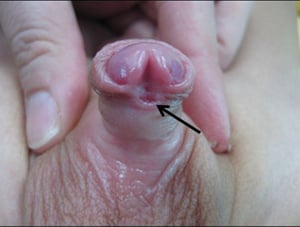
In this image, the arrow is pointing to the meatus.
In this image, the arrow is pointing to the meatus.
Image courtesy of Drs. Ronald Rabinowitz and Jimena Cubillos.

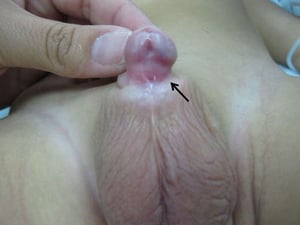
In this image, the arrow is pointing to the meatus.
In this image, the arrow is pointing to the meatus.
Image courtesy of Drs. Ronald Rabinowitz and Jimena Cubillos.

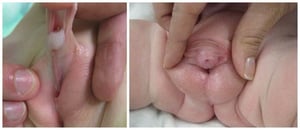
Images courtesy of Drs. Ronald Rabinowitz and Jimena Cubillos.
Images courtesy of Drs. Ronald Rabinowitz and Jimena Cubillos.
In this image, the arrow is pointing to the meatus.
In this image, the arrow is pointing to the meatus.
Image courtesy of Drs. Ronald Rabinowitz and Jimena Cubillos.
In this image, the arrow is pointing to the meatus.
In this image, the arrow is pointing to the meatus.
Image courtesy of Drs. Ronald Rabinowitz and Jimena Cubillos.
Images courtesy of Drs. Ronald Rabinowitz and Jimena Cubillos.
Images courtesy of Drs. Ronald Rabinowitz and Jimena Cubillos.
The infant is medically unstable.
The mother has taken anticoagulants that cross the placenta or higher-dose aspirin (>100 mg/day), or low-dose aspirin (<100 mg) in conjunction with other risk factors.
Vitamin K has not been administered.
There is a family history of bleeding disorders.
The neonate has displacement of the urethral meatus, hypospadias, or any other abnormality of the glans or penis (because the prepuce may be used later in plastic surgical repair).
Circumcision is usually delayed until at least after the first void; not voiding within 12 hours of the procedure may indicate a complication. Circumcision should not be performed if the neonate has hemophilia or another bleeding disorder.
Weight
Neonates typically lose 3 to 9% of their birth weight during the first several days of life (3–5), primarily because fluid is lost in urine and insensibly and secondarily because meconium is passed, vernix caseosa is lost, and the umbilical cord dries (6–8). Breastfed (chestfed) infants are particularly prone to weight loss as this process generally takes 1 to 2 weeks to become established (4, 7, 8). Infants may take 2 to 3 weeks to regain birthweight. Infants born via cesarean section tend to lose more weight and take longer to regain birth weight than those born by vaginal delivery.
Urine and bowel movements
In the first 2 days, urine may stain the diaper orange or pink because of urate crystals, which are a normal result of urine concentration. Most neonates void within 24 hours after birth; the average time of first void is 7 to 9 hours after birth (9), and most void at least 2 times in the second 24 hours of life.
A delay in voiding is more common among male neonates and may result from a tight foreskin; a male neonate’s inability to void may indicate posterior urethral valves. If an infant has been circumcised, lack of voiding within 12 hours of the procedure may indicate a complication.
Meconium
If meconium has not been passed within 24 hours, the clinician should consider evaluating the neonate for anatomic abnormalities, such as imperforate anus, Hirschsprung disease, and cystic fibrosis (which can cause meconium ileus).
Routine care and observation of the newborn references
1. Imdad A, Bautista RM, Senen KA, Uy ME, Mantaring JB 3rd, Bhutta ZA. Umbilical cord antiseptics for preventing sepsis and death among newborns. Cochrane Database Syst Rev. 2013;2013(5):CD008635. Published 2013 May 31. doi:10.1002/14651858.CD008635.pub2
2. American Academy of Pediatrics Task Force on Circumcision. Male circumcision. Pediatrics. 2012;130(3):e756-e785. doi:10.1542/peds.2012-1990
3. Macdonald PD, Ross SR, Grant L, Young D. Neonatal weight loss in breast and formula fed infants. Arch Dis Child Fetal Neonatal Ed. 2003;88(6):F472-F476. doi:10.1136/fn.88.6.f472
4. DiTomasso D, Cloud M. Systematic Review of Expected Weight Changes After Birth for Full-Term, Breastfed Newborns. J Obstet Gynecol Neonatal Nurs. 2019;48(6):593-603. doi:10.1016/j.jogn.2019.09.004
5. Kaur R, Gupta N, Yadav B, et al. Physiological Postnatal Weight Loss Nomograms in Exclusively Breastfed Healthy Infants (≥36 Weeks) during Initial Birth Hospitalization from an Arid Region: A Prospective Cohort Study. Neonatology. 2026;123(2):217-224. doi:10.1159/000549630
6. Paul IM, Schaefer EW, Miller JR, et al. Weight Change Nomograms for the First Month After Birth. Pediatrics. 2016;138(6):e20162625. doi:10.1542/peds.2016-2625
7. Thulier D. Challenging Expected Patterns of Weight Loss in Full-Term Breastfeeding Neonates Born by Cesarean. J Obstet Gynecol Neonatal Nurs. 2017;46(1):18-28. doi:10.1016/j.jogn.2016.11.006
8. Flaherman VJ, Schaefer EW, Kuzniewicz MW, Li SX, Walsh EM, Paul IM. Early weight loss nomograms for exclusively breastfed newborns. Pediatrics. 2015;135(1):e16-e23. doi:10.1542/peds.2014-1532
9. Metaj M, Laroia N, Lawrence RA, Ryan RM. Comparison of breast- and formula-fed normal newborns in time to first stool and urine. J Perinatol. 2003;23(8):624-628. doi:10.1038/sj.jp.7210997
Follow-up After Hospital Discharge of the Newborn
Neonates discharged from the hospital within 48 hours should be evaluated within 2 days to assess feeding success (breast or formula), hydration, and jaundice (for those at increased risk) (1, 2). Those born at home, or discharged earlier than 12 hours may need earlier follow-up to complete recommended screenings (3).
Follow-up for neonates discharged after 48 hours should take place ideally generally within 3 to 5 days, with individual timing determined by risk factors, including those for jaundice and for breastfeeding difficulties, and any identified problems (1, 2).
Follow-up after discharge of the newborn references
1. Shakib J, Buchi K, Smith E, Korgenski K, Young PC. Timing of initial well-child visit and readmissions of newborns. Pediatrics. 2015;135(3):469-474. doi:10.1542/peds.2014-2329
2. Hudak ML; the Committee of Child Health Financing. Scope of health care benefits for neonates, infants, children, adolescents, and young adults through age 26. Pediatrics. 2022; 150(3):e2022058881
3. Watterberg K; COMMITTEE ON FETUS AND NEWBORN. Providing Care for Infants Born at Home. Pediatrics. 2020;145(5):e20200626. doi:10.1542/peds.2020-0626
Drug Information for the Topic