Angioedema is edema of the deep dermis and subcutaneous tissues. It is usually acute but sometimes is a chronic mast cell–mediated reaction caused by exposure to a medication (eg, angiotensin-converting enzyme inhibitors), venom, or dietary, pollen, or animal dander allergens, or it can be idiopathic. Angioedema can also be a hereditary or an acquired disorder characterized by dysregulated complement activation. The main symptom is swelling, often of the face, mouth, upper airways, and intestine, which can be severe. Diagnosis is clinical. C1 inhibitor level and function measurement may be measured to exclude hereditary and acquired C1 inhibitor deficiency. Treatment is with airway management as needed, elimination or avoidance of the allergen, and medications to minimize swelling (eg, H1 blockers).
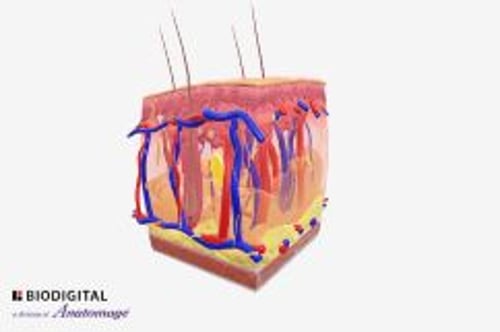
Angioedema is swelling (usually localized) of the subcutaneous tissues due to increased vascular permeability and extravasation of intravascular fluid (1). Known mediators of increased vascular permeability include the following:
Mast cell–derived mediators (eg, histamine, leukotrienes, prostaglandins)
Bradykinin and complement-derived mediators
Mast cell–mediated angioedema typically affects the layers of the skin superficial to subcutaneous tissue, including the dermal-epidermal junction. There, these mediators cause urticaria and pruritus, which thus usually accompany mast cell–mediated angioedema.
In bradykinin-mediated angioedema, the superficial layers of the dermis and epidermis are usually spared, so urticaria and pruritus are absent.
In some cases, the mechanism and cause of angioedema are unknown. Several causes (eg, calcium channel blockers) have no identified mechanism; sometimes a cause (eg, muscle relaxants) with a known mechanism is overlooked clinically.
Angioedema is usually acute or but can be chronic (> 6 weeks).
There are hereditary and acquired forms characterized by an abnormal complement response. (See also Overview of Allergic and Atopic Disorders.)
Acute angioedema
Acute angioedema is mast cell–mediated in most cases. Mast cell–mediated mechanisms include acute allergic, typically IgE-mediated reactions. IgE-mediated angioedema is usually accompanied by acute urticaria (local wheals and erythema in the skin) and pruritus. It may often be caused by the same triggers (eg, medication, venom, dietary, extracted allergens) that are responsible for acute IgE-mediated urticaria.
Acute angioedema can also result from agents that directly stimulate mast cells without involving IgE (ie, via activation of receptors other than Fc epsilon receptor 1). Causes can include opioids, radiopaque contrast agents, aspirin, and nonsteroidal anti-inflammatory drugs (NSAIDs).
Angiotensin-converting enzyme (ACE) inhibitors can cause angioedema in < 1% of treated patients (2), but ACE inhibitors are responsible for approximately 30% of cases of acute angioedema seen in emergency departments (3, 4). ACE inhibitors can directly increase levels of bradykinin. The face and upper airways are most commonly affected. The intestine may also be affected, often presenting with intermittent abdominal pain and bloating. Urticaria does not occur. ACE inhibitor–induced angioedema is variable in onset and may occur soon or years after therapy begins.
Chronic angioedema
The cause of chronic (> 6 weeks) angioedema is usually unknown. IgE-mediated mechanisms are rare, but chronic ingestion of an unsuspected medication or chemical (eg, penicillin in milk, a nonprescription medication, preservatives, other food additives) can rarely be the cause. A few cases are due to hereditary or acquired C1 inhibitor deficiency.
Idiopathic angioedema is angioedema that occurs without urticaria, is chronic and recurrent, and has no identifiable cause.
Hereditary and acquired angioedema
Hereditary angioedema and acquired angioedema are disorders that are characterized by abnormal complement responses and caused by deficiency or dysfunction of C1 inhibitor. Symptoms are those of bradykinin-mediated angioedema.
References
1. Lima H, Zheng J, Wong D, Waserman S, Sussman GL. Pathophysiology of bradykinin and histamine mediated angioedema. Front Allergy. 2023;4:1263432. doi:10.3389/falgy.2023.1263432
2. Montinaro V, Cicardi M. ACE inhibitor-mediated angioedema. Int Immunopharmacol. 2020;78:106081. doi:10.1016/j.intimp.2019.106081
3. Agah R, Bandi V, Guntupalli KK. Angioedema: the role of ACE inhibitors and factors associated with poor clinical outcome. Intensive Care Med. 1997;23(7):793-796. doi:10.1007/s001340050413
4. Gandhi J, Jones R, Teubner D, Gabb G. Multicentre audit of ACE-inhibitor associated angioedema (MAAAA). Aust Fam Physician. 2015;44(8):579-583.
Symptoms and Signs of Angioedema
In angioedema, edema is often asymmetric and mildly painful. It often involves the face, lips, and/or tongue and may also occur on the back of hands or feet, on the genitals, or in the abdomen. Edema of the upper airways may cause respiratory distress and stridor; the stridor may be mistaken for asthma. The airways may be completely obstructed. Edema of the intestine may cause nausea, vomiting, colicky abdominal pain, and/or diarrhea.

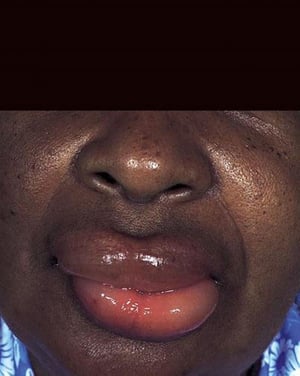
This photo shows acute swelling of the lips in a patient with hereditary C1 inhibitor deficiency.
This photo shows acute swelling of the lips in a patient with hereditary C1 inhibitor deficiency.
By permission of the publisher. From Joe E, Soter N. In Current Dermatologic Diagnosis and Treatment, edited by I Freedberg, IM Freedberg, and MR Sanchez. Philadelphia, Current Medicine, 2001.

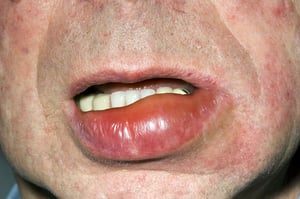
Angioedema of the lips can be asymmetric, as shown in this photo.
Angioedema of the lips can be asymmetric, as shown in this photo.
DR P. MARAZZI/SCIENCE PHOTO LIBRARY

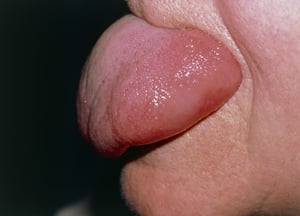
This patient has a swollen tongue due to angioedema.
This patient has a swollen tongue due to angioedema.
SCIENCE PHOTO LIBRARY
This photo shows acute swelling of the lips in a patient with hereditary C1 inhibitor deficiency.
This photo shows acute swelling of the lips in a patient with hereditary C1 inhibitor deficiency.
By permission of the publisher. From Joe E, Soter N. In Current Dermatologic Diagnosis and Treatment, edited by I Freedberg, IM Freedberg, and MR Sanchez. Philadelphia, Current Medicine, 2001.
Angioedema of the lips can be asymmetric, as shown in this photo.
Angioedema of the lips can be asymmetric, as shown in this photo.
DR P. MARAZZI/SCIENCE PHOTO LIBRARY
This patient has a swollen tongue due to angioedema.
This patient has a swollen tongue due to angioedema.
SCIENCE PHOTO LIBRARY
Other manifestations of angioedema depend on the mediator.
Mast cell–mediated angioedema:
Usually develops rapidly over minutes to several hours
May be accompanied by other manifestations of acute allergic reactions (eg, pruritus, urticaria, flushing, bronchospasm, anaphylactic shock)
Bradykinin-mediated angioedema:
Usually develops over hours to a few days
Is not accompanied by other manifestations of allergic reactions
Diagnosis of Angioedema
History and physical examination
For the diagnosis of urticaria, see Urticaria: Evaluation.
Patients with localized swelling but no urticaria should be asked specifically about use of ACE inhibitors.
The cause of angioedema is often evident from the history, and diagnostic tests are seldom required because most reactions are self-limited and do not recur. When angioedema is chronic, a thorough medication and dietary evaluation is warranted.
If no cause is obvious or if family members have angioedema, clinicians should consider measuring C1 inhibitor levels to check for C1 inhibitor deficiency and C4 levels to assess for hereditary or acquired angioedema. Low levels of C4, even between episodes, may help confirm a diagnosis of hereditary angioedema (types 1 and 2) or acquired C1 inhibitor deficiency.
Erythropoietic protoporphyria may mimic allergic forms of angioedema; both can cause edema and erythema after exposure to sunlight. The two can be distinguished by measuring blood and fecal porphyrins.
Pearls & Pitfalls
|
Treatment of Angioedema
Airway management
For mast cell–mediated angioedema, an antihistamine and sometimes a systemic glucocorticoid and epinephrine
For ACE inhibitor–related angioedema, cessation of the medication, occasionallyC1 inhibitor concentrate and fresh frozen plasma
For recurrent idiopathic angioedema, an oral antihistamine
Treatment of angioedema involves identification and elimination of specific triggers and emergent airway management (1). Specific additional treatments generally depend on the underlying mechanism (ie, bradykinin-mediated or mast-cell mediated) of angioedema. The absence of urticaria and pruritus in bradykinin-mediated angioedema is considered one of the most clinically important distinguishing features from histamine-mediated angioedema.
Regardless of the mechanism or underlying trigger, if angioedema involves the airways, securing an airway is the highest priority. Unless the mechanism is obviously bradykinin-mediated (eg, due to use of an ACE inhibitor or to known hereditary or acquired angioedema), epinephrine should be administered IM or subcutaneously as for anaphylaxis. In mast cell–mediated angioedema, treatment usually rapidly reduces airway edema. However, in bradykinin-mediated angioedema, edema may take > 30 minutes to subside after treatment begins. Thus, endotracheal intubation is more likely to be needed in bradykinin-mediated angioedema.
The treatment of angioedema also includes removing or avoiding any triggers (eg, allergen) and using medications that relieve symptoms. If a cause is not obvious, all nonessential medications should be stopped.
For mast cell–mediated angioedema, medications that may relieve symptoms include H1 blockers. Systemic glucocorticoids (eg, prednisone 30 to 40 mg orally once a day for 3 to 5 days) is indicated for more severe reactions. If symptoms are severe, a systemic glucocorticoid and an antihistamine can be given IV (eg, methylprednisolone 125 mg and diphenhydramine 50 mg). Long-term treatment may involve H1 and H2 blockers and occasionally glucocorticoids. Topical glucocorticoids are ineffective.
Patients who have severe mast cell–mediated reactions should be advised to always carry a prefilled, self-injecting syringe of epinephrine (ie, an autoinjector) and oral antihistamines and, if a severe reaction occurs, to self-administer these treatments as quickly as possible and then go to the emergency department. There, they can be closely monitored and treatment can be repeated or adjusted as needed.
For bradykinin-mediated angioedema, epinephrine, glucocorticoids, and antihistamines have not been shown to be effective. Angioedema due to ACE inhibitor use usually resolves about 24 to 48 hours after stopping the medication. If symptoms are severe, progressing, or refractory, treatments used for hereditary or acquired angioedema can be tried. They include C1 inhibitor concentrate, fresh frozen plasma, and possibly ecallantide (which inhibits plasma kallikrein, required for the generation of bradykinin) and icatibant (which blocks bradykinin). Ecallantide must not be self-administered and carries a boxed warning for anaphylaxis.
For idiopathic angioedema, a high dose of a nonsedating oral antihistamine (eg, cetirizine) can be tried.
Treatment reference
1. Moellman JJ, Bernstein JA, Lindsell C, et al. A consensus parameter for the evaluation and management of angioedema in the emergency department. Acad Emerg Med. 2014;21(4):469-484. doi:10.1111/acem.12341
Key Points
In the emergency department, approximately 30% of cases of acute angioedema are caused by angiotensin-converting enzyme (ACE) inhibitors (bradykinin-mediated), although overall, most cases are mast cell–mediated.
For acute angioedema, first make sure the airway is secure; if the airway is affected, give epinephrine subcutaneously or IM unless the cause is obviously bradykinin-mediated angioedema, which is more likely to require endotracheal intubation.
The cause of chronic angioedema is usually unknown.
Swelling always develops; bradykinin-mediated angioedema tends to develop more slowly and to cause fewer symptoms of an acute allergic reaction (eg, pruritus, urticaria, anaphylactic shock) than does mast cell–mediated angioedema.
For chronic angioedema, take a thorough medication and dietary history, consider testing for C1 inhibitor deficiency and measuring C4 levels; testing is rarely necessary for recurrent acute episodes if initial screening was done.
Eliminating or avoiding any associated triggers is key.
For symptomatic and adjunctive treatment, an antihistamine (eg, H1 blocker) and a systemic glucocorticoid can relieve symptoms of mast cell–mediated angioedema; C1 inhibitor concentrate, fresh frozen plasma, and/or ecallantide or icatibant may be tried if bradykinin-mediated angioedema is severe or refractory.
Drug Information for the Topic