Athletes are commonly screened to identify risk before participation in sports. Screening should address cardiovascular and other risks.
Screening for Cardiovascular Risks of Sports Participation
Athletes are commonly screened to identify cardiovascular risks before participation in sports (1, 2, 3, 4). In the United States, athletes are evaluated every 2 years if high school age or younger or with a comprehensive initial evaluation and annual interim evaluations if college age. In Europe, screening is repeated every 2 years regardless of age. In practice, many school systems require annual evaluations, guidelines notwithstanding.
Screening recommendations in the United States—for college-age young adults as well as for children and adolescents—include (2, 3):
History
Physical examination
Selected testing based on findings on history and physical examination
History should include questions about the following:
Known hypertension or heart murmur
Symptoms that are induced by exercise or are unexplained, including syncope (including convulsive syncope), near-syncope, chest pain, dyspnea, or palpitations
Chest pain, particularly new onset, assessing quality (eg, pleuritic, pressing, burning), location, duration, intensity, relation to activity, associated symptoms
Family history of sudden cardiac death at age < 50 years, arrhythmias, dilated cardiomyopathy, hypertrophic cardiomyopathy, long QT syndrome, or Marfan syndrome
Use of performance-enhancing or illicit drugs (visit the U.S. Anti-Doping Agency) and medications that predispose to long QT syndrome
In adults, risk factors for coronary artery disease
Physical examination should consist of a cardiovascular examination that includes blood pressure in both arms, supine and standing cardiopulmonary auscultation, and assessment for other conditions such as features of Marfan syndrome. These measures aim to identify apparently healthy people at high risk of life-threatening cardiac events (eg, people with arrhythmias, hypertrophic cardiomyopathy, or other structural heart disorders).
European guidelines differ from American guidelines in that a screening electrocardiogram (ECG) is recommended for all children, adolescents, and college-age athletes (4); in the United States, guidelines consider ECG screening reasonable but do not recommend it universally (2).
Canadian Guidelines recommend screening in 3 tiers (5):
History/questionnaire
Physical examination
ECG only when indicated according to clinical findings
Testing follows if clinically warranted.
Screening for older adults (35 years or older) with risk factors may include incremental symptom-limited exercise testing, especially if athletes have been sedentary for a number of years.

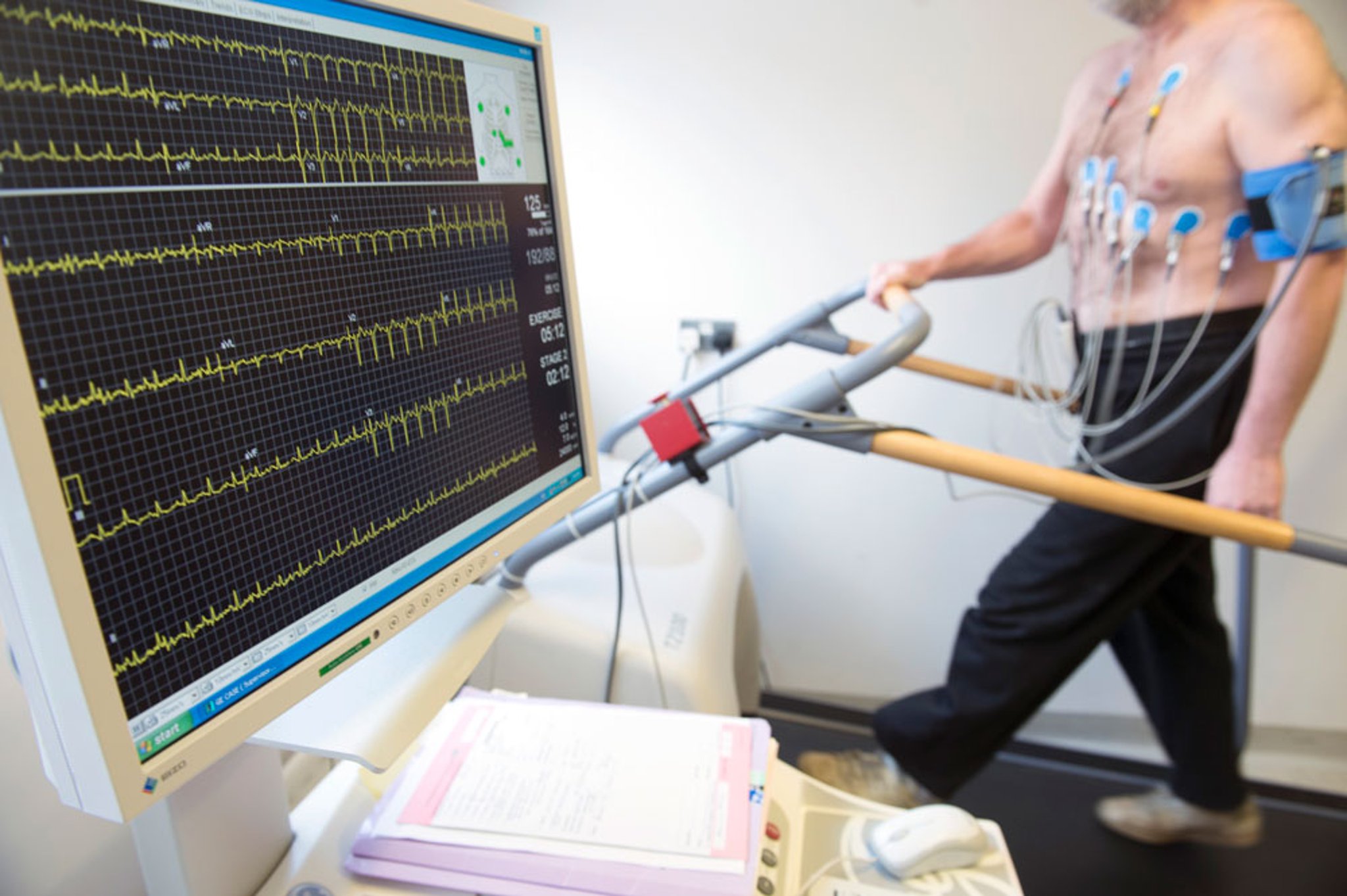
In this photo, a patient walks on a treadmill attached to multiple ECG electrodes; ECG monitoring and recording equipment is in the foreground.
DR P. MARAZZI/SCIENCE PHOTO LIBRARY
History and examination are neither sensitive nor specific (6); false-negative and false-positive findings are common because prevalence of cardiac disorders in an apparently healthy population is very low. Use of screening ECG or echocardiography improves disease detection but produces more false-positive diagnoses; ECG screening continues to be controversial for this reason, as well as the challenges of applying screening to a large population with a relative shortage of clinicians qualified to interpret ECGs (2).
Genetic testing for hypertrophic cardiomyopathy or long QT syndrome is not recommended or even feasible for the screening of athletes.
Selected testing
Athletes with a family history or symptoms or signs of, for example hypertrophic cardiomyopathy, long QT syndrome, arrhythmogenic right ventricular cardiomyopathy, Brugada syndrome, or Marfan syndrome, require further evaluation. Typically evaluation includes one or both of the following:
ECG
Echocardiography
Sometimes genetic testing
Sometimes cardiac MRI, MR angiography, or CT angiography
Suspicion of any of these disorders may preclude sports participation while confirmatory diagnostic evaluation is underway. If a specific disorder is diagnosed, future athletic participation is based on guidelines and by shared decision-making with the patient and family (2).
If ECG reveals Mobitz type II heart block, complete heart block, true right bundle branch block, or left bundle branch block, or there is clinical or electrocardiographic evidence of supraventricular or ventricular rhythm disorders beyond rare ectopy, a search for cardiac disease is required.
Athletes with exertional presyncope or syncope in whom noninvasive testing is unrevealing should also be evaluated for anomalous coronary arteries. Initial evaluation is performed using CT angiography.
If an enlarged aorta is detected on echocardiography (or incidentally), further assessment is needed.
Recommendations for sports participation
Athletes should be counseled against use of illicit and performance-enhancing drugs.
Certain patients should not participate in competitive sports or high-intensity recreational sports, such as those who have:
Severe valvular heart disease, particularly if stenotic
Recent acute coronary syndrome (within about 3 months)
Known aneurysms in the brain or large vessels
Acute myocarditis (3 to 6 months, following resolution of symptoms, myocardial inflammation, and ventricular dysfunction) (7)
For patients who have structural or arrhythmogenic heart disorders (eg, hypertrophic cardiomyopathy, coronary artery anomalies, arrhythmogenic right ventricular cardiomyopathy), sports participation is based on disorder-based guidelines and shared decision-making with the patient and family (2).
Athletes who have had a myocardial infarction will need cardiovascular rehabilitation and a gradual approach to returning to high-intensity physical activity, with a 3 to 6 month time frame considered reasonable for resumption of competitive sports (8).
Cardiovascular screening references
1. Corrado D, Pelliccia A, Bjørnstad HH, et al: Cardiovascular pre-participation screening of young competitive athletes for prevention of sudden death: proposal for a common European protocol. Consensus Statement of the Study Group of Sport Cardiology of the Working Group of Cardiac Rehabilitation and Exercise Physiology and the Working Group of Myocardial and Pericardial Diseases of the European Society of Cardiology. Eur Heart J 26(5):516–524, 2005. doi:10.1093/eurheartj/ehi108
2. Kim JH, Baggish AL, Levine BD, et al. Clinical Considerations for Competitive Sports Participation for Athletes With Cardiovascular Abnormalities: A Scientific Statement From the American Heart Association and American College of Cardiology. J Am Coll Cardiol. 2025;85(10):1059-1108. doi:10.1016/j.jacc.2024.12.025
3. Maron BJ, Thompson PD, Ackerman MJ, et al. Recommendations and considerations related to pre-participation screening for cardiovascular abnormalities in competitive athletes: 2007 update: a scientific statement from the American Heart Association Council on Nutrition, Physical Activity, and Metabolism: endorsed by the American College of Cardiology Foundation. Circulation. 2007;115(12):1643-1655. doi:10.1161/CIRCULATIONAHA.107.181423
4. Pieles GE, Cavarretta E, Orchard JJ, et al. Cardiac evaluation of paediatric athletes. Eur Heart J. 2026;47(21):2561-2583. doi:10.1093/eurheartj/ehag188
5. Johri AM, Poirier P, Dorian P, et al. Canadian Cardiovascular Society/Canadian Heart Rhythm Society joint position statement on the cardiovascular screening of competitive athletes. Can J Cardiol. 2019;35(1):1-11. doi: 10.1016/j.cjca.2018.10.016
6. Harmon KG, Zigman M, Drezner JA. The effectiveness of screening history, physical exam, and ECG to detect potentially lethal cardiac disorders in athletes: a systematic review/meta-analysis. J Electrocardiol. 2015;48(3):329-338. doi:10.1016/j.jelectrocard.2015.02.001
7. Writing Committee, Drazner MH, Bozkurt B, et al. 2024 ACC Expert Consensus Decision Pathway on Strategies and Criteria for the Diagnosis and Management of Myocarditis: A Report of the American College of Cardiology Solution Set Oversight Committee. J Am Coll Cardiol. 2025;85(4):391-431. doi:10.1016/j.jacc.2024.10.080
8. Kim JH, Baggish AL, Levine BD, et al. Clinical Considerations for Competitive Sports Participation for Athletes With Cardiovascular Abnormalities: A Scientific Statement From the American Heart Association and American College of Cardiology. J Am Coll Cardiol. 2025;85(10):1059-1108. doi:10.1016/j.jacc.2024.12.025
Screening for Non-Cardiovascular Risks of Sports Participation
Athletes should also be screened for musculoskeletal and other risks before participation in sports.
Noncardiovascular risk factors are more common than cardiovascular risk factors. Patients are asked about the following:
Previous or current musculoskeletal injuries (including easily triggered dislocations)
Arthritic disorders, particularly those involving major weight-bearing joints (eg, hips, knees, ankles)
Symptoms suggesting systemic infection
Easy bruising or bleeding
Two populations at risk for injuries are commonly overlooked:
Boys who physically mature late are assumed to be at greater risk of injury in contact sports if competing against larger and stronger children, although this is not clearly supported by evidence (1, 2, 3).
People with overweight or obesity are at increased risk of musculoskeletal problems because of excess body weight and associated forces on the joints and tissues. One risk is overuse injury with soft-tissue inflammation, particularly if people increase intensity and duration of exercise too rapidly. A long-term risk is osteoarthritis affecting weight-bearing joints. Another risk may be injury due to sudden stops and starts if they participate in activities that require jumping or high levels of agility.
Athletes, particularly adolescents and young adults, should be asked about use of illicit and performance-enhancing drugs. (Visit the U.S. Anti-Doping Agency.)
In girls and young women, screening should detect delayed onset of menarche. Girls and young women should be screened for the presence of the female athlete triad (eating disorders, amenorrhea or other menstrual dysfunction, and diminished bone mineral density). Two questions are validated screening measures for eating disorders:
Have you ever had an eating disorder?
Are you happy with your weight?
Screening for non-cardiovascular risks references
1. Council on Sports Medicine and Fitness, Brooks A, Loud KJ, et al. Reducing injury risk from body checking in boys' youth ice hockey. Pediatrics. 2014;133(6):1151-1157. doi:10.1542/peds.2014-0692
2. Le Gall F, Carling C, Reilly T. Biological maturity and injury in elite youth football. Scand J Med Sci Sports. 2007;17(5):564-572. doi:10.1111/j.1600-0838.2006.00594.x
3. Malina RM, Morano PJ, Barron M, Miller SJ, Cumming SP, Kontos AP. Incidence and player risk factors for injury in youth football. Clin J Sport Med. 2006;16(3):214-222. doi:10.1097/00042752-200605000-00005
Contraindications to Sports Participation
Other than certain cardiovascular disorders, there are almost no absolute contraindications to sports participation.
Exceptions in children are generally temporary and include:
Acute splenic enlargement or recent infectious mononucleosis (Epstein-Barr virus infection) because splenic rupture is a risk
Symptomatic or persistent fevers, which may decrease exercise tolerance, increase risk of heat-related disorders, and be a sign of serious illness
Possibly significant diarrhea and/or recent significant vomiting because dehydration is a risk
In adults, relative contraindications are more common and lead to recommendations for precautions or for participation in some sports rather than others, for example:
People with a history of frequent and easily triggered dislocations or multiple concussions should participate in noncollision sports.
Males, particularly those with a single testis, should wear a protective cup for most contact sports.
People, particularly those at risk of heat intolerance and dehydration (eg, those with diabetes, cystic fibrosis, sickle cell disease or trait, or previous heat-related illness), should hydrate frequently during prolonged activity.
People with suboptimal seizure control should avoid swimming, weight lifting, and, to prevent injury to others, sports such as archery and riflery.
People who have asthma need to monitor their symptoms closely.
Key Points
Screen younger participants (children through young adults) with history, physical examination, and depending on local practice, electrocardiography; those with abnormal findings or positive family history should have further evaluation.
Screen older participants with risk factors (particularly if they have been sedentary for a number of years) with history, physical examination, and usually an exercise stress test.
Use guidelines and shared decision-making to guide decisions about sports participation in those with most structural or arrhythmogenic heart disorders.
Recommend against participation in children with acute splenic enlargement or recent infectious mononucleosis, symptomatic or persistent fever, and significant diarrhea or vomiting that predispose them to dehydration, until these conditions are resolved.
In all patients, limit participation in specific sports based upon concurrent medical conditions.