Moles are small, usually dark, skin growths that develop from pigment-producing cells in the skin (melanocytes).
Most people have some moles, but the tendency to develop atypical moles is sometimes hereditary.
Moles and atypical moles that change significantly should be biopsied for possible melanoma.
Most noncancerous (benign) moles do not require treatment, but moles that are uncomfortable or a cosmetic concern can be removed with a scalpel and local anesthetic.
(See also Overview of Skin Growths.)
Almost everyone has a few moles, and many people have large numbers of them. People who have more than 50 moles have a somewhat increased risk of melanoma, a cancerous (malignant) growth of melanocytes. They should self-monitor for changes in their moles (see the ABCDEs of melanoma) and also have them examined periodically as part of their primary care.
Moles may be flat or raised, smooth or rough (wartlike), and may have hairs growing from them. Moles are typically skin-colored, yellow, brown, blue-gray, or nearly black. They may be red at first but often darken.

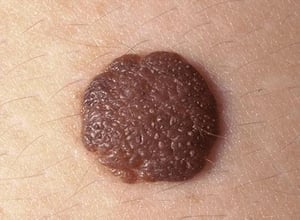
Moles can be tan, yellow, blue-gray, brown, or nearly black spots or bumps.
Moles can be tan, yellow, blue-gray, brown, or nearly black spots or bumps.
Image provided by Thomas Habif, MD.

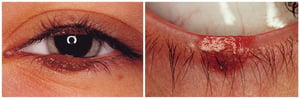
Moles can appear near the eye. In the photo on the left, there is a mole on both the upper and lower eyelids.
Moles can appear near the eye. In the photo on the left, there is a mole on both the upper and lower eyelids.
© Springer Science+Business Media


This photo shows a skin-colored mole on the scalp. This mole is more raised than most.
This photo shows a skin-colored mole on the scalp. This mole is more raised than most.
© Springer Science+Business Media

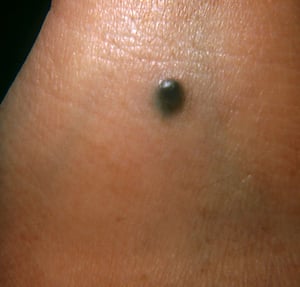
Blue moles are dark because they contain a lot of pigment.
Blue moles are dark because they contain a lot of pigment.
DermPics/SCIENCE PHOTO LIBRARY
Moles can be tan, yellow, blue-gray, brown, or nearly black spots or bumps.
Moles can be tan, yellow, blue-gray, brown, or nearly black spots or bumps.
Image provided by Thomas Habif, MD.
Moles can appear near the eye. In the photo on the left, there is a mole on both the upper and lower eyelids.
Moles can appear near the eye. In the photo on the left, there is a mole on both the upper and lower eyelids.
© Springer Science+Business Media
This photo shows a skin-colored mole on the scalp. This mole is more raised than most.
This photo shows a skin-colored mole on the scalp. This mole is more raised than most.
© Springer Science+Business Media
Blue moles are dark because they contain a lot of pigment.
Blue moles are dark because they contain a lot of pigment.
DermPics/SCIENCE PHOTO LIBRARY
Moles commonly develop in childhood or adolescence, and existing moles often enlarge (in proportion to the body's growth) and may darken. In some people, moles continue to develop throughout life. Moles can appear anywhere on the body. Moles respond to changes in hormone levels in women and may darken during pregnancy. Once formed, moles remain for a lifetime and get less pigmented and more raised or fleshy with time. In people with fair skin, moles occur more commonly on sun-exposed areas of the skin.
Je, Ulijua...
|
Utambuzi wa Kiwaa Cheusi
Examination of the skin
ABCDEs of melanoma
Sometimes biopsy
Moles usually are easily recognized by their typical appearance. They are symmetric and round or oval and have regular borders. They do not itch or hurt, and they are not a form of cancer. However, moles sometimes develop into or resemble melanoma. In fact, many melanomas begin in moles, so a mole that looks suspect should be removed and examined under a microscope (biopsy).
The following changes in a mole may be warning signs of melanoma (known as the ABCDEs of melanoma):
A: Asymmetry—asymmetric appearance (that is, one half does not look the same as the other half)
B: Borders—irregular borders (that is, borders are blurred or jagged, not well-defined and smooth)
C: Color—color changes within the mole, unusual colors, or a color significantly different or darker than the person's other moles
D: Diameter—more than ¼ inch (about 6 millimeters) wide, about the size of most pencil erasers
E: Evolution—a new mole in a person over age 30 or a changing mole
If a mole becomes painful, itchy, bleeds, develops broken skin, or has any warning signs of melanoma, doctors may do a biopsy. If a mole proves to be cancerous, additional surgery may be needed to remove the skin surrounding it.
Matibabu ya Kiwaa Cheusi
Sometimes removal
Most moles are harmless and do not require removal.
Normal moles that are unattractive or located where clothing can irritate them can be removed by a doctor using a scalpel and a local anesthetic.
Kiwaa cheusi kisicho cha kawaida
(Dysplastic Nevi; Atypical Nevi)
Atypical moles are noncancerous (benign) moles that have an abnormal appearance compared to that of typical moles.
People who have atypical moles have an increased risk of developing melanoma, which is cancer of the pigment-producing cells in the skin called melanocytes. The risk of developing melanoma increases when the number of moles increases. Risk also increases in people who spend a lot of time in the sun.
The tendency to grow atypical moles can be hereditary, as in a disorder called familial atypical multiple mole–melanoma syndrome. In this disorder, many atypical moles and melanoma occur in 2 or more first-degree relatives (such as a parent, sibling, or child), and family members have a greater risk of developing melanoma.
Dalili za Kiwaa Cheusi Kisicho cha Kawaida

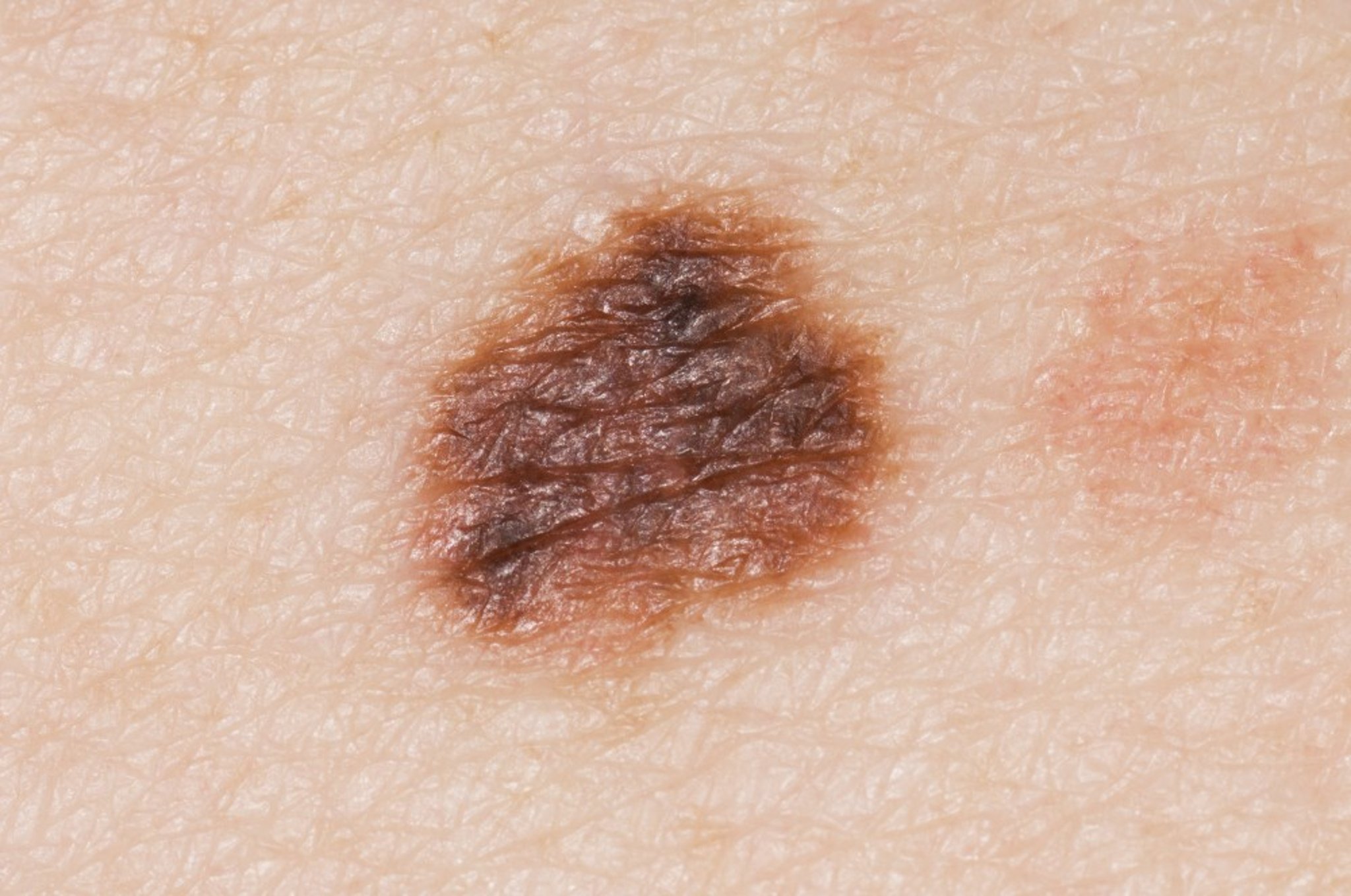
Features of this atypical mole include irregular borders and variable colors.
DR P. MARAZZI/SCIENCE PHOTO LIBRARY
Atypical moles tend to be multicolored (usually in tones of brown and tan against a lighter background) and asymmetric. They also tend to have irregular shapes and borders. They are often larger than (more than ¼ inch [about 6 millimeters] wide) most normal moles. Atypical moles most commonly appear on sun-exposed skin but may occur on covered areas (such as the buttocks, breasts, or scalp).
Utambuzi wa Kiwaa Cheusi Kisicho cha Kawaida
Physical examination
Biopsy
People who have a family history of melanoma should have their skin checked by a dermatologist (a doctor who specializes in skin disorders) and learn about signs of melanoma. People who have had a melanoma should have their skin checked regularly by a dermatologist.
Some dermatologists closely inspect the skin using a hand-held instrument (a procedure called dermoscopy) to see structures in the mole that are not visible to the naked eye and that may indicate that melanoma is more or less likely.
Dermatologists may remove some atypical moles and examine them under a microscope (biopsy).
Kinga ya Kiwaa Cheusi Kisicho cha Kawaida
Self-examination
Photographs of moles
Sun protection
People with atypical moles must regularly look for new moles and any changes in existing moles that might indicate melanoma. To help monitor such changes, they and their dermatologist may take full-body color photographs over time. Atypical moles that change may sometimes be removed. For people with a family history of melanoma or other skin cancers, doctors may recommend that the person receives a comprehensive examination that includes the entire skin surface.
Skin damage caused by ultraviolet (UV) radiation from the sun is a cause of melanoma, particularly recreational sun exposure and sunburns. To limit damage caused by UV radiation, people should avoid the sun during peak hours (about 10 AM to 4 PM) when possible, wear sun-protective clothing, and use and frequently reapply a broad-spectrum sunscreen (such as one that contains zinc oxide or titanium dioxide). People who greatly limit their exposure to the sun may need to take supplemental vitamin D, particularly as they age.
Matibabu ya Kiwaa Cheusi Kisicho cha Kawaida
Sometimes removal
People who have an atypical mole or a mole that is new or changing should be evaluated by a dermatologist, who will determine whether the mole should be removed. Removing all atypical moles does not prevent melanoma.
Taarifa Zaidi
The following English-language resource may be useful. Please note that The Manual is not responsible for the content of this resource.
The Skin Cancer Foundation: This organization empowers people to proactively practice sun protection, early detection, and early treatment of skin cancer by providing everything from a list of recommended sun protection products to guidance on finding a dermatologist.