Tinea versicolor is a fungal infection of the topmost layer of the skin that causes scaly, discolored patches.
This infection is caused by a type of fungus.
Typically, people have tan, brown, salmon, or white scaly patches of skin.
The diagnosis is based on appearance and skin scrapings.
Antifungal skin products, shampoos, and sometimes medications taken by mouth are used to treat the infection.
Tinea versicolor infection often returns.
(See also Overview of Fungal Skin Infections.)
The infection is caused by Malassezia furfur. Malassezia furfur is a type of fungus that can exist as both a yeast and a mold. Yeast and mold are terms that are used to describe what the fungus looks like under a microscope.
Malassezia furfur is typically harmless and normally lives on the skin but in some people causes tinea versicolor. Most affected people are healthy. Some people may be genetically predisposed to overgrowth of this fungus.
Other risk factors for tinea versicolor include heat and humidity and an immune system weakened by steroid (sometimes also known as glucocorticoids or corticosteroids) use, pregnancy, undernutrition, diabetes, or other disorders.
Tinea versicolor is a mild infection and is not considered contagious. It is quite common, especially among young adults.
Dalili za Tinea Versicolor
Tinea versicolor causes many tan, brown, salmon, or white scaly patches to appear on the trunk, neck, abdomen, and occasionally the face. The patches may merge to become larger. The patches do not tan, so in summer, when the surrounding skin tans, the patches may become obvious. People with naturally dark skin may notice lighter patches. People with naturally fair skin may develop darker or lighter patches.
Tinea versicolor usually does not cause other symptoms.

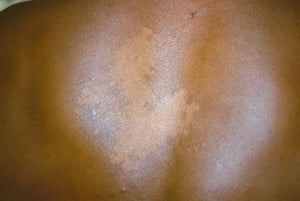
This photo shows lighter patches of skin caused by tinea versicolor.
This photo shows lighter patches of skin caused by tinea versicolor.
Image courtesy of Karen McKoy, MD.

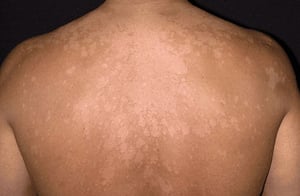
This photo shows multiple pink, scaly patches on the back. These patches are typical of tinea versicolor.
This photo shows multiple pink, scaly patches on the back. These patches are typical of tinea versicolor.
Image provided by Thomas Habif, MD.

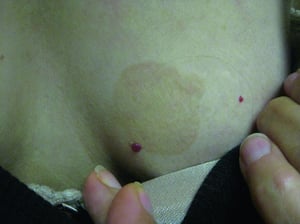
This photo shows a tan patch on the chest that is typical of tinea versicolor.
This photo shows a tan patch on the chest that is typical of tinea versicolor.
© Springer Science+Business Media


© Springer Science+Business Media

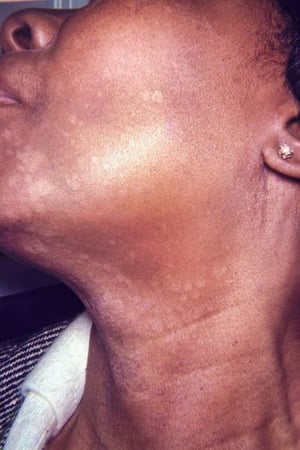
In this photo, the light areas on the face and neck are caused by tinea versicolor.
In this photo, the light areas on the face and neck are caused by tinea versicolor.
Image courtesy of Karen McKoy, MD.
This photo shows lighter patches of skin caused by tinea versicolor.
This photo shows lighter patches of skin caused by tinea versicolor.
Image courtesy of Karen McKoy, MD.
This photo shows multiple pink, scaly patches on the back. These patches are typical of tinea versicolor.
This photo shows multiple pink, scaly patches on the back. These patches are typical of tinea versicolor.
Image provided by Thomas Habif, MD.
This photo shows a tan patch on the chest that is typical of tinea versicolor.
This photo shows a tan patch on the chest that is typical of tinea versicolor.
© Springer Science+Business Media
© Springer Science+Business Media
In this photo, the light areas on the face and neck are caused by tinea versicolor.
In this photo, the light areas on the face and neck are caused by tinea versicolor.
Image courtesy of Karen McKoy, MD.
Utambuzi wa Tinea Versicolor
A doctor's examination of the skin and skin scrapings
Doctors diagnose tinea versicolor by the appearance of the skin and by looking at skin scrapings under a microscope to see the fungus/yeast.
Matibabu ya Tinea Versicolor
Antifungal medications applied to the affected areas or sometimes taken by mouth
Any antifungal medications applied directly to the affected areas (topical) may be used to treat tinea versicolor. Prescription-strength selenium sulfide shampoo is effective if applied to affected skin (not just the scalp) for 10 minutes a day for 1 week or for one 24-hour application each week for 1 month. Other treatments include applying topical ketoconazole daily for 2 weeks and bathing with pyrithione zinc soap or applying sodium thiosulfate/salicylic acid shampoo to the skin daily for 1 to 2 weeks. (See also table .)
Antifungal medications taken by mouth, such as fluconazole, are sometimes used to treat people who have a widespread infection (see table ) or frequent infections.
To lower the chance of the infection coming back, many doctors recommend practicing meticulous hygiene and using pyrithione zinc soap regularly or one of the other topical treatments monthly.
Ubashiri wa Tinea Versicolor
The skin may not regain its normal pigmentation for many months to years after the infection is gone.
Tinea versicolor commonly returns after successful treatment because the yeast that causes it normally lives on the skin.