Screening recommendations for newborns vary by clinical context and country or local regulatory requirements. In the United States, the Health Resources & Services Administration recommends screening for all disorders included in the Recommended Uniform Screening Panel (1, 2).
Recommendations vary by the specific inherited diseases tested for with blood spot newborn screening (3, 4); they may include phenylketonuria, tyrosinemia, biotinidase deficiency, homocystinuria, maple syrup urine disease, galactosemia, congenital adrenal hyperplasia, sickle cell disease, and hypothyroidism. Some recommendations also include testing for cystic fibrosis, disorders of fatty acid oxidation, other organic acidemias, severe combined immunodeficiency, spinal muscular atrophy, some lysosomal disorders (eg, mucopolysaccharidoses, and ).
Blood typing, and sometimes a direct antibody test (DAT, or Coomb test), may be indicated when the mother has Rh-negative or type O blood, or when other blood antibodies are present, because hemolytic disease of the newborn (isoimmune hemolytic anemia) is a risk (5). Mothers are typically screened for antibodies and potential blood group incompatibility during pregnancy. Testing the newborn is necessary if such screening has not been performed; if maternal antibody screening was positive; or if the newborn develops early (<24 hours of life) or rapidly progressive jaundice, which may indicate hemolytic anemia.
Screening for Isoimmune Hemolytic Anemia in the Newborn
DAT = direct antiglobulin test; IVIG = intravenous immune globulin; RhIG = Rh(D) immunoglobulin; TcB = transcutaneous bilirubin; TSB = total serum bilirubin. Data from Kemper AR, Newman TB, Slaughter JL, et al. Clinical Practice Guideline Revision: Management of Hyperbilirubinemia in the Newborn Infant 35 or More Weeks of Gestation. Pediatrics. 2022;150(3):e2022058859. doi:10.1542/peds.2022-058859. |


All neonates are evaluated for jaundice throughout the hospital stay and before discharge. The risk of hyperbilirubinemia is assessed using risk criteria, measurement of bilirubin, or both. Bilirubin can be measured transcutaneously or in serum. Many hospitals screen all neonates and use a predictive nomogram to determine the risk of extreme hyperbilirubinemia (5). Follow-up is based on age in hours at discharge, predischarge bilirubin level and/or rate of bilirubin rise from one determination to another, and risk of developing jaundice.
Infants born to mothers known to be HIV-positive should be tested for HIV with nucleic acid amplification testing, within the first few days if maternal antiretroviral therapy was not provided during pregnancy and at later time intervals for presumptive and definitive exclusion or diagnosis of HIV infection, and for infants who are consuming breast milk from an HIV-positive mother (6, 7). (Prevention of perinatal transmission of HIV is discussed separately.)
Toxicology screening is indicated when any of the following are present: maternal history of drug use, unexplained placental abruption, unexplained premature labor, or evidence of drug withdrawal in the neonate.Toxicology screening should be performed only when it will inform clinical management, and should be governed by standardized policies to reduce the risk of bias in testing (8, 9).
Screening for critical congenital heart disease (CCHD) using pulse oximetry is part of routine newborn assessment. The screening is performed when infants are ≥ 24 hours old, without supplemental oxygen, and is considered failed if (10):
Any oxygen saturation measurement in the right hand or either foot is < 90%.
An oxygen saturation measurement in the right hand or either foot is < 95%, or there is > 3% absolute difference between the oxygen saturation in the right hand (preductal) and either foot (postductal), on 2 separate measurements taken 1 hour apart.
Any infant with a failed screen should have additional testing, including echocardiography and sometimes a chest radiograph and/or electrocardiography. The infant’s pediatrician should be notified, and the infant may need to be evaluated by a cardiologist.
Newborn Screening for Critical Congenital Heart Disease Using Pulse Oximetry
Pulse ox = pulse oximetry. Data from Oster ME, Pinto NM, Pramanik AK, et al. Newborn Screening for Critical Congenital Heart Disease: A New Algorithm and Other Updated Recommendations: Clinical Report. Pediatrics. 2025;155(1):e2024069667. doi:10.1542/peds.2024-069667. |


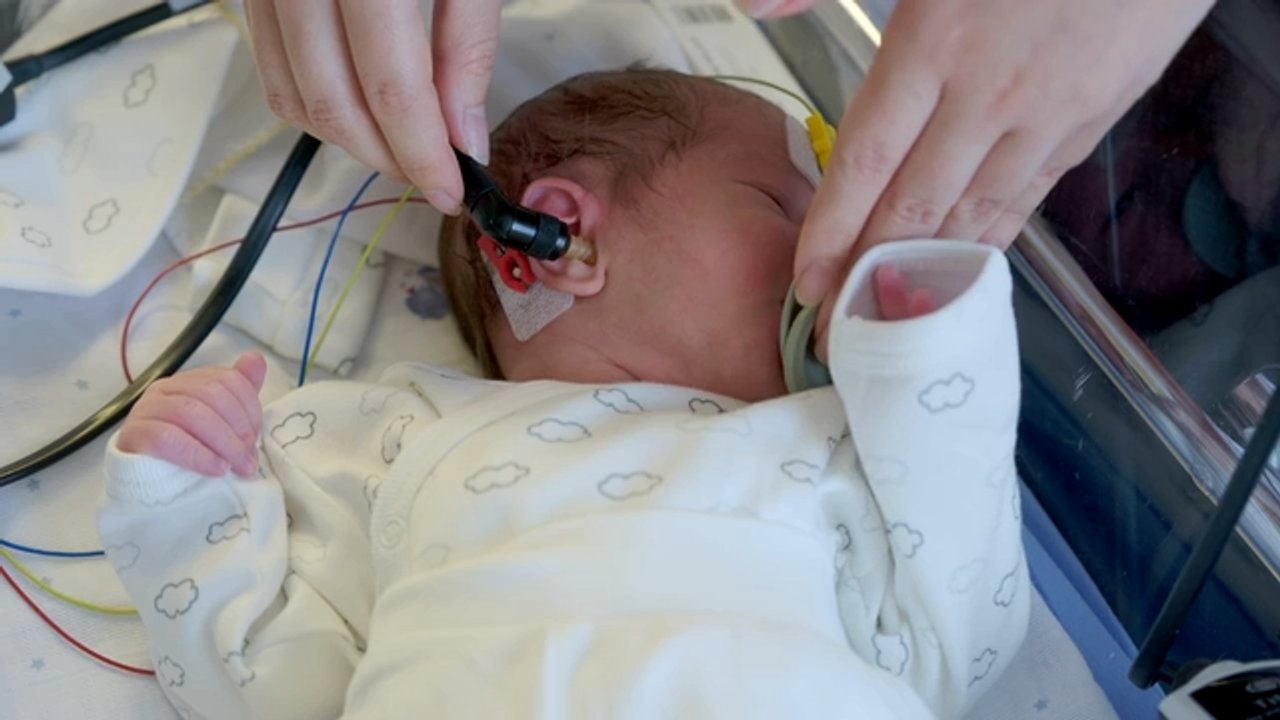
Hearing screening varies by state. Hearing loss is one of the most frequently occurring birth defects. Approximately 2 to 3/1000 infants are born with moderate, profound, or severe hearing loss (11, 12). Hearing loss is approximately 7 times more common among infants admitted to an intensive care unit at birth (13). Currently, hearing screening is performed in the first month of life for all infants born in the United States (14, 15). Some government organizations screen only high-risk neonates (see table ); others screen all neonates. Initial screening often involves using a handheld device to test for echoes produced by healthy ears in response to soft clicks (otoacoustic emissions); if this test is abnormal, auditory brain stem response (ABR) testing is performed. Some institutions use ABR testing as an initial screening test. Further testing by an audiologist may be needed.

Risk Factors for Hearing Deficits in Neonates
Factor | Notes |
|---|---|
Prematurity | NICU admission is associated with approximately 7-fold increased risk† |
Low Apgar score | < 5 at 1 minute or < 7–8 at 5 minutes‡ |
Severe hyperbilirubinemia and kernicterus | Total serum bilirubin ≥ 35 mg/dL (≥ 598 mcmol/L) or ≥ 10 mg/dL (≥ 171 mcmol/L) above exchange transfusion threshold†§ |
Neonatal complications | Perinatal anoxia or hypoxia Prolonged mechanical ventilation ( ≥ 5 days) or supplemental oxygen requirement Seizures or apneic spells |
Congenital infections or other disorders | Zika virus infection |
Medications | Aminoglycosides Loop diuretics (eg, furosemide) Vancomycin |
Maternal medications | Aminoglycosides |
Genetic factors | Responsible for up to 80% of infant hearing loss¶ |
Wroblewska-Seniuk KE, Dabrowski P, Szyfter W, Mazela J. Universal newborn hearing screening: methods and results, obstacles, and benefits. Pediatr Res. 2017;81(3):415-422. doi:10.1038/pr.2016.250. †Davis BE, Leppert MO, German K, et al. Primary Care Framework to Monitor Preterm Infants for Neurodevelopmental Outcomes in Early Childhood. Pediatrics. 2023;152(1):e2023062511. doi:10.1542/peds.2023-062511 ‡Kvestad E, Lie KK, Eskild A, Engdahl B. Sensorineural hearing loss in children: the association with Apgar score. A registry-based study of 392,371 children in Norway. Int J Pediatr Otorhinolaryngol. 2014;78(11):1940-1944. doi:10.1016/j.ijporl.2014.08.032 §Wickremasinghe AC, Risley RJ, Kuzniewicz MW, et al. Risk of Sensorineural Hearing Loss and Bilirubin Exchange Transfusion Thresholds. Pediatrics. 2015;136(3):505-512. doi:10.1542/peds.2014-3357 ¶ Choe G, Park SK, Kim BJ. Hearing loss in neonates and infants. Clin Exp Pediatr. 2023;66(9):369-376. doi:10.3345/cep.2022.01011 | |
References
1. Health Resources & Services Administration (HRSA). Advisory Committee on Heritable Disorders in Newborns and Children. August 2025. Accessed March 25, 2026.
2. Watson MS, Mann MY, Lloyd-Puryear MA, et al, eds. Newborn screening: toward a uniform screening panel and system. Genet Med. 2006;8 Suppl 1(Suppl 1):1S-252S. doi:10.1097/01.gim.0000223891.82390.ad
3. Jansen ME, Metternick-Jones SC, Lister KJ. International differences in the evaluation of conditions for newborn bloodspot screening: a review of scientific literature and policy documents. Eur J Hum Genet. 2016;25(1):10-16. doi:10.1038/ejhg.2016.126
4. González-Irazabal Y, Hernandez de Abajo G, Martínez-Morillo E. Identifying and overcoming barriers to harmonize newborn screening programs through consensus strategies. Crit Rev Clin Lab Sci. 2021;58(1):29-48. doi:10.1080/10408363.2020.1781778
5. Kemper AR, Newman TB, Slaughter JL, et al. Clinical Practice Guideline Revision: Management of Hyperbilirubinemia in the Newborn Infant 35 or More Weeks of Gestation. Pediatrics. 2022;150(3):e2022058859. doi:10.1542/peds.2022-058859
6. Chadwick EG, Ezeanolue EE; COMMITTEE ON PEDIATRIC AIDS. Evaluation and Management of the Infant Exposed to HIV in the United States. Pediatrics. 2020;146(5):e2020029058. doi:10.1542/peds.2020-029058
7. Abuogi L, Noble L, Smith C; COMMITTEE ON PEDIATRIC AND ADOLESCENT HIV ; SECTION ON BREASTFEEDING . Infant Feeding for Persons Living With and at Risk for HIV in the United States: Clinical Report. Pediatrics. 2024;153(6):e2024066843. doi:10.1542/peds.2024-066843
8. Patrick SW, Barfield WD, Poindexter BB; COMMITTEE ON FETUS AND NEWBORN, COMMITTEE ON SUBSTANCE USE AND PREVENTION. Neonatal Opioid Withdrawal Syndrome. Pediatrics. 2020;146(5):e2020029074. doi:10.1542/peds.2020-029074
9. American Society of Addiction Medicine. Public Policy Statement on Substance Use and Substance Use Disorder Among Pregnant and Postpartum People. October 2, 2022. Accessed March 26, 2026.
10. Oster ME, Pinto NM, Pramanik AK, et al. Newborn Screening for Critical Congenital Heart Disease: A New Algorithm and Other Updated Recommendations: Clinical Report. Pediatrics. 2025;155(1):e2024069667. doi:10.1542/peds.2024-069667
11. Renauld JM, Basch ML. Congenital deafness and recent advances towards restoring hearing loss. Curr Protoc. 1(3):e76, 2021. doi: 10.1002/cpz1.76
12. Choe G, Park SK, Kim BJ. Hearing loss in neonates and infants. Clin Exp Pediatr. 2023;66(9):369-376. doi:10.3345/cep.2022.01011
13. Davis BE, Leppert MO, German K, et al. Primary Care Framework to Monitor Preterm Infants for Neurodevelopmental Outcomes in Early Childhood. Pediatrics. 2023;152(1):e2023062511. doi:10.1542/peds.2023-062511
14. American Speech-Language-Hearing Association. Year 2007 Position Statement: Principles and Guidelines for Early Hearing Detection and Intervention Programs. Position statement. Joint Committee on Infant Hearing. Accessed March 26, 2026.
15. Grosse SD, Riehle-Colarusso T, Gaffney M, et al. CDC Grand Rounds: Newborn Screening for Hearing Loss and Critical Congenital Heart Disease. MMWR Morb Mortal Wkly Rep. 2017;66(33):888-890. Published 2017 Aug 25. doi:10.15585/mmwr.mm6633a4