Tendinopathyis a painful condition of the tendon characterized by degenerative changes. It may be caused by repetitive mechanical loading and overuse, but it may also be idiopathic. Symptoms usually include pain with active or resisted motion and tenderness with palpation. Chronic deterioration of the tendon or tendon sheath can cause scars that restrict motion. Diagnosis is clinical, sometimes supplemented with imaging. Treatment includes activity modification and exercise therapy. Nonsteroidal anti-inflammatory drugs (NSAIDs) and glucocorticoid injections are sometimes used for short-term pain relief.
Tendinopathy is a chronic tendon disorder characterized by pain, impaired function, and reduced exercise tolerance, typically resulting from repetitive mechanical loading and failed healing responses (1). It is defined by degenerative changes (collagen disorganization, neovascularization, altered extracellular matrix composition, and increased cellular apoptosis) rather than inflammation.
Tendinopathy most commonly affects the tendons associated with the shoulder (rotator cuff); the long head of the biceps muscle (bicipital tendon); the medial and lateral elbow epicondyles; the patellar tendon; the Achilles tendon (see Achilles Tendinopathy); and the thumb's abductor pollicis longus and extensor pollicis brevis, which share a common fibrous sheath (the resulting disorder is De Quervain syndrome).
General reference
1. Millar NL, Silbernagel KG, Thorborg K, et al. Tendinopathy. Nat Rev Dis Primers. 2021;7(1):1. Published 2021 Jan 7. doi:10.1038/s41572-020-00234-1
Etiology of Tendinopathy
The cause of tendinopathy is often unknown. It usually occurs in people who are middle-aged or older as the vascularity of tendons decreases; repetitive microtrauma may contribute. Repeated or extreme trauma (short of rupture), strain, and excessive or unaccustomed exercise probably also contribute. Fluoroquinolone antibiotics may increase the risk of both tendinopathy and tendon rupture, with the Achilles tendon most frequently affected (1).
Risk of tendinopathy may be increased by certain systemic disorders—most commonly rheumatoid arthritis, systemic sclerosis, gout, reactive arthritis, and diabetes or, very rarely, amyloidosis or markedly elevated blood cholesterol levels. In younger adults, particularly women, disseminated gonococcal infection may cause acute migratory tenosynovitis in the absence of localizing genitourinary symptoms. Nontuberculous mycobacteria, such as Mycobacterium marinum, have a predilection to cause local chronic infection of peripheral tendons, resulting in symptoms of tenosynovitis (2).
Fluoroquinolone antibiotic use has been associated with tendinopathies, including tendon rupture.
Etiology and risk factors references
1. Alves C, Mendes D, Marques FB. Fluoroquinolones and the risk of tendon injury: a systematic review and meta-analysis. Eur J Clin Pharmacol. 2019;75(10):1431-1443. doi:10.1007/s00228-019-02713-1
2. Coda R, Waller S, Vopat B. Nontuberculosis Mycobacterium Infections in Orthopaedic Surgery: Review of the Epidemiology, Pathogenesis, Diagnosis, and Treatment Guidelines. J Am Acad Orthop Surg Glob Res Rev. 2025;9(5):e24.00274. Published 2025 Apr 29. doi:10.5435/JAAOSGlobal-D-24-00274
Symptoms and Signs of Tendinopathy
Affected tendons are usually painful when actively moved or when natural motion is resisted. For example, in patients with posterior tibial tendinopathy, resisted inversion of a plantarflexed foot elicits pain. Occasionally, tendon sheaths become swollen and fluid accumulates, usually when patients have infection, rheumatoid arthritis, or gout. Swelling may be visible or only palpable. Along the tendon, palpation elicits localized tenderness of varying severity.
In systemic sclerosis, the tendon friction rubs occur when tendons move within their tendon sheaths, producing palpable or audible (with a stethoscope) crepitus, typically due to abnormal connective tissue infiltration surrounding the tendon.
Diagnosis of Tendinopathy
Primarily history and physical examination
Sometimes imaging
Usually, the diagnosis can be based on symptoms and physical examination, including palpation or specific maneuvers to assess pain. MRI or ultrasound may be performed to confirm the diagnosis, exclude other disorders, and detect tendon tears and inflammation.
Rotator cuff tendinopathy
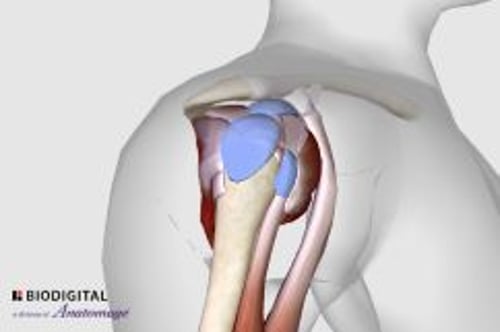
Rotator cuff tendinopathy is the most common cause of shoulder pain. The rotator cuff is composed of 4 tendons, the supraspinatus, infraspinatus, subscapularis, and teres minor. The supraspinatus tendon is most frequently involved and the subscapularis is second. Active abduction in an arc of 40 to 120° and internal rotation cause pain (see also Rotator Cuff Injury/Subacromial Bursitis). Passive abduction causes less pain, but abduction against resistance can increase pain. Calcium deposits in the tendon just below the acromion are sometimes visible on radiograph in cases of calcific tendinopathy. Ultrasound or MRI may help with further evaluation (eg, if the diagnosis is otherwise unclear) and with treatment decisions (eg, presence of significant tears that might warrant surgical interventions).


This radiograph shows radiopaque (white) soft-tissue densities (arrow) located in the region of the supraspinatus tendon.
RAJAAISYA/SCIENCE PHOTO LIBRARY
Bicipital tendinopathy (biceps tendinitis)
Pain in the biceps tendon is aggravated by shoulder flexion or resisted supination of the forearm. Examiners can elicit tenderness proximally over the bicipital groove of the humerus by rolling (flipping) the bicipital tendon under their thumb.
Stenosing flexor tenosynovitis (trigger finger)
Stenosing flexor tenosynovitis (trigger finger) is a common musculoskeletal disorder that is often overlooked. Pain occurs in the palm on the volar aspect of the thumb or other digits and may radiate distally. Palpation of the tendon and sheath elicits tenderness; swelling and sometimes a nodule is present. The affected digit may rest in a flexed position, and passive extension elicits pain. In later stages, the digit may lock when it is flexed, and forceful extension may cause a sudden release with a snap (trigger finger). Acute inflammatory palmar tendinitis/fasciitis has been rarely associated with adenocarcinomas elsewhere in the body (1).
Gluteus medius tendinopathy
Patients with greater trochanteric pain syndrome (formerly called trochanteric bursitis) almost always have gluteus medius tendinopathy. In patients with greater trochanteric pain syndrome, palpation over the lateral prominence of the greater trochanter elicits tenderness. Patients often have a history of chronic pressure on the joint, trauma, a change in gait (eg, due to osteoarthritis, stroke, or leg-length discrepancy), or inflammation at this site (eg, in rheumatoid arthritis).
Diagnosis reference
1. Manger B, Schett G. Palmar fasciitis and polyarthritis syndrome-systematic literature review of 100 cases. Semin Arthritis Rheum. 2014;44(1):105-111. doi:10.1016/j.semarthrit.2014.03.005
Treatment of Tendinopathy
Activity modification and exercise
Nonsteroidal anti-inflammatory drugs (NSAIDs)
Sometimes glucocorticoid injection
Therapy for tendinopathy centers on activity modification, relative rest, and early initiation of exercises, emphasizing eccentric loading (1). NSAIDs may provide short-term pain relief, but evidence is lacking for long-term effectiveness (2). The primary role for NSAID use is to facilitate participation in exercise therapy by reducing pain and increasing range of motion because they do not treat the underlying degenerative pathology.
Injecting a sustained-release glucocorticoid (eg, betamethasone 6 mg/mL, triamcinolone 40 mg/mL, methylprednisolone 20 to 40 mg/mL) into the tendon sheath may be effective for short-term pain relief, but it is not effective for long-term pain relief and some evidence suggests they may increase tendon rupture (1). Injection volume may range from 0.3 mL to 1 mL, depending on the site. An injection through the same needle of an equal or double volume of local anesthetic (eg, 1 to 2% lidocaine) confirms the diagnosis if pain is relieved immediately. Clinicians should be careful not to inject the tendon (which can be recognized by marked resistance to injection); doing so may weaken it, increasing risk of rupture. Patients are advised to rest the adjacent joint to reduce the slight risk of tendon rupture. Infrequently, symptoms can worsen for up to 24 hours after the injection.
Pearls & Pitfalls
|
Other adjunctive treatments such as low-level laser therapy and extracorporeal shockwave therapy are sometimes also used to improve pain and function (1). Patients should be made aware of the costs of these therapies. Rarely, for persistent cases, particularly rotator cuff tendinopathy, surgical exploration with removal of calcium deposits or tendon repair, followed by graded physical therapy, is needed. Occasionally, patients require surgery to release scars that limit function, remove part of a bone causing repetitive friction, or do tenosynovectomy to relieve chronic pain.
Treatment references
1. Irby A, Gutierrez J, Chamberlin C, Thomas SJ, Rosen AB. Clinical management of tendinopathy: A systematic review of systematic reviews evaluating the effectiveness of tendinopathy treatments. Scand J Med Sci Sports. 2020;30(10):1810-1826. doi:10.1111/sms.13734
2. Malmgaard-Clausen NM, Jørgensen OH, Høffner R, et al. No Additive Clinical or Physiological Effects of Short-term Anti-inflammatory Treatment to Physical Rehabilitation in the Early Phase of Human Achilles Tendinopathy: A Randomized Controlled Trial. Am J Sports Med. 2021;49(7):1711-1720. doi:10.1177/0363546521991903
Key Points
Tendinopathy is a painful condition of the tendon that is largely due to degenerative changes rather than inflammation.
Pain, tenderness, and occasionally swelling tend to be maximal along the tendon's course.
Diagnose most cases by examination, including tendon-specific maneuvers, sometimes confirming the diagnosis with MRI or ultrasound.
Treat with activity modification, exercise, NSAIDs, and sometimes glucocorticoid injection.
Drug Information for the Topic