Sturge-Weber syndrome involves an abnormal growth of small blood vessels. It is characterized by a port-wine birthmark on the face, an overgrowth of blood vessels in the tissues that cover the brain (leptomeningeal capillary-venous malformation, sometimes called leptomeningeal angioma), glaucoma (increased pressure in the eyes), or all three.
Sturge-Weber syndrome is caused by a mutation in a gene.
This disorder can cause seizures, weakness, intellectual disability, and glaucoma and can increase the risk of stroke.
If children have a typical birthmark, doctors suspect the disorder and may do an imaging test of the brain or head to check for malformations.
Treatment is focused on relieving or preventing symptoms.
Sturge-Weber syndrome is a neurocutaneous syndrome. A neurocutaneous syndrome causes problems that affect the brain, spine, and nerves (neuro) and the skin (cutaneous).
Sturge-Weber syndrome is present at birth in about 1 of 20,000 to 50,000 people.
Although Sturge-Weber syndrome is caused by a gene mutation, the mutated gene is not inherited. Rather, the mutation that causes this syndrome is new and spontaneous.
This syndrome affects blood vessels, particularly vessels in the skin, in the tissues that cover the brain, and in the eyes. The port-wine birthmark is caused by an overgrowth of small blood vessels (capillaries) just under the skin. Leptomeningeal capillary-venous malformations (formerly called leptomeningeal angiomas) are caused by overgrowths of capillaries in the tissues that cover the brain. These malformations cause seizures and may cause weakness on one side of the body. Malformations may also reduce blood flow in the part of the brain under them. Increased pressure in the eye is caused by the same overgrowth of capillaries in the eye. This increased pressure can cause glaucoma and affect vision. Overgrowth of capillaries in the walls of the arteries may increase the risk of strokes.
Symptoms of Sturge-Weber Syndrome
The port-wine birthmark varies in size and color, ranging from light pink to deep purple. It usually appears on the forehead and upper eyelid of one eye but may also include the lower eyelid and face. If the birthmark includes the upper and lower eyelids on one side of the face, people can also have a leptomeningeal capillary-venous malformation.

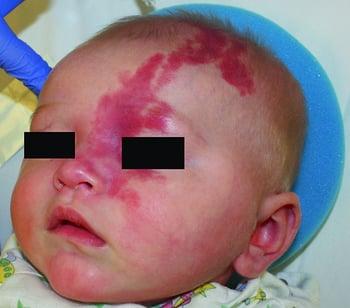
This photo shows an infant with a port-wine stain on the face.
Epileptic seizures can occur in about 75 to 90% of people and typically start by the time children are 1 year old. Usually, seizures occur on only one side of the body, opposite the birthmark, but they may affect the whole body. Up to 60% of people have weakness or paralysis on the side of the body that is opposite the birthmark. Coordination may be lost. The weakness or paralysis sometimes worsens, especially if seizures cannot be controlled.
About 50% of people have intellectual disability, and more have some kind of learning disorder. Intellectual disability is more severe in people whose seizures start before 2 years of age and cannot be controlled with medications. Development of motor and language skills may be delayed.
Glaucoma may damage the optic nerve (which connects the brain to the eye) in the eye on the same side as the birthmark, which may cause loss of vision. The eyeball may enlarge and bulge out. Glaucoma may be present at birth or develop later.
Up to 50% of people with Sturge-Weber syndrome have problems in their mouth, such as overgrowth of the gums and intraoral angiomas, which are overgrowths of blood vessels within the mouth's soft tissues or jawbone.
Diagnosis of Sturge-Weber Syndrome
A doctor's evaluation
Magnetic resonance imaging (MRI) or computed tomography (CT)
Doctors suspect Sturge-Weber syndrome in children with the characteristic birthmark.
Doctors do an MRI scan to check for leptomeningeal capillary-venous malformations in the tissues covering the brain. They do a CT scan of the head if MRI is not available.
Doctors do a neurologic examination to check for evidence of weakness and lack of coordination and/or paralysis. They also do an electroencephalogram (EEG) to identify epilepsy. An EEG is a test that records brain waves using sensors placed on the scalp. It is done to check for abnormal electrical activity in the brain.
Doctors also look for problems in the mouth and examine the eyes.
Treatment of Sturge-Weber Syndrome
Treatment of symptoms
Treatment of Sturge-Weber syndrome is focused on relieving symptoms.
Doctors give medications to control seizures and medications to treat glaucoma. Surgery for glaucoma or surgery for seizures that return despite medication may be required.
People are usually given low doses of aspirin to reduce the risk of strokes. Also, People are usually given low doses of aspirin to reduce the risk of strokes. Also,aspirin may improve blood flow in the part of the brain under a leptomeningeal capillary-venous malformation.
Laser treatment may be used to lighten or remove the birthmark.