





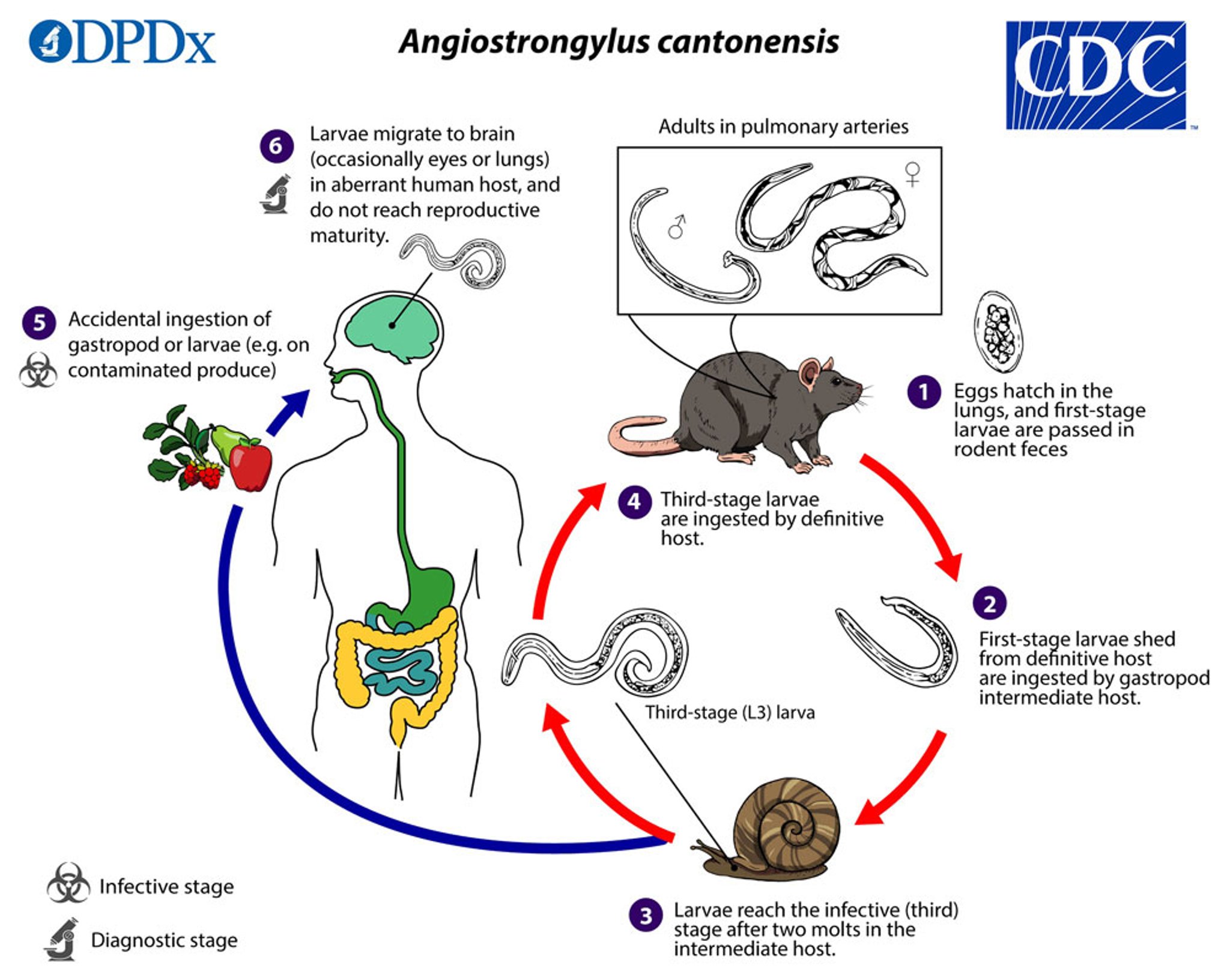
Life Cycle of Angiostrongylus cantonensis
1. Adult worms live in the pulmonary arteries of rats. There, females (the larger worm in the image) lay eggs that hatch into larvae.
2. The larvae are passed in the rat feces.
3. Then the passed larvae are ingested by a snail or slug (called a host) and continue to develop.
4. When an infected slug or snail is ingested by another rat, the larvae migrate to the new rat's brain, where they develop into young adults. The young adults travel to the rat's pulmonary arteries where they fully mature into adult worms.
5. People become infected by eating raw or undercooked infected snails or slugs, raw produce that contains a small snail or slug or part of one, or a transport host such as certain land crabs, frogs, toads, or freshwater prawns or shrimp.
6. Once the larvae are in a person's body, they travel from the digestive tract to the meninges in the brain. Sometimes Angiostrongylus cantonensis affects the eyes. In people, Angiostrongylus cantonensis larvae do not mature to adult worms and do not produce eggs.
Image from the Centers for Disease Control and Prevention, Global Health, Division of Parasitic Diseases and Malaria.