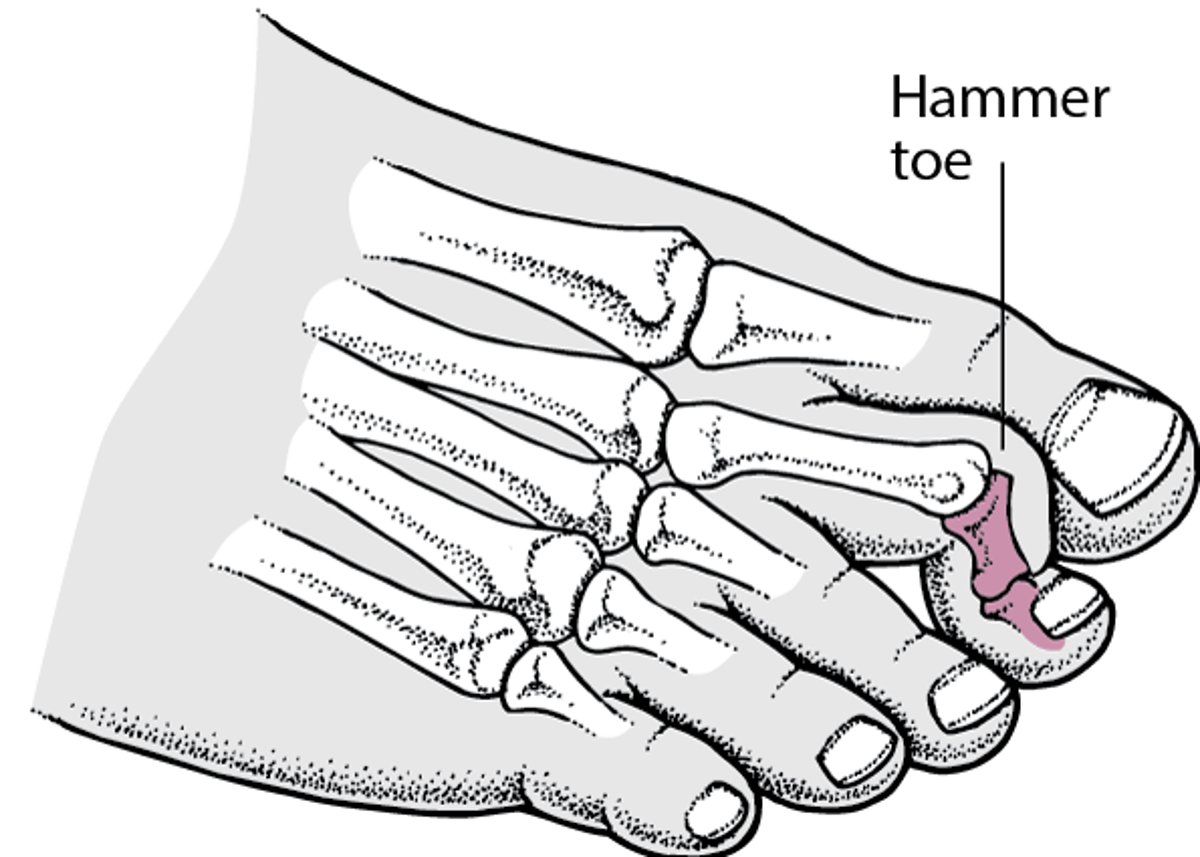
Hammer toe is a toe that is bent in a fixed Z-shaped position.
Pain may be felt when people wear certain shoes, and some people have pain in the ball of the foot.
Diagnosis is based on an examination of the foot, and other joints are examined as well.
Wide shoes and toe pads can relieve irritation, and orthoses can relieve pain.
(See also Overview of Foot Problems.)
Among the causes of hammer toe are tendon imbalances, unusually long metatarsal or toe bones, poor alignment of foot joint surfaces, rheumatoid arthritis, and years of wearing ill-fitting shoes. Because part of the toe is higher than normal, excessive friction may result, leading to calluses/corns and possibly open sores (ulcers) on the top of the toe. The second toe is the most common toe to develop hammer toe deformity.
Wearing shoes, particularly shoes with low and narrow toe boxes, may be painful. Sometimes people develop pain in the ball of the foot (metatarsalgia).
Kidole Kupinda Juu
In hammer toe, usually the second toe, or sometimes the third or fourth toe, becomes bent in a Z-shaped position and cannot be easily straightened without surgery. |

Ugunduzi wa Kidole cha Mguu Kilichopinda
A doctor's examination
Doctors base the diagnosis of hammer toe on an examination of the foot. Doctors also examine the joints to look for arthritis.
Matibabu ya Kidole cha Mguu Kilichopinda
Wide toe box, taping/splinting, and toe pads
For metatarsalgia, orthoses
Doctors treat hammer toe by ensuring that the shoes are comfortable and have a wide enough toe box to avoid further irritation to the toe. Taping/splinting the toe may decrease the deformity temporarily. Toe pads also help by shielding the affected toes from the overlying shoe.
Any ulcer or other skin irritation is treated.
An operation to straighten the hammer toe may be needed when other treatments do not relieve the pain and disability caused by the rigidly fixed toe.
To alleviate the pain caused by metatarsalgia, people can use orthoses (devices placed in the shoe).