Anti-glomerular basement membrane (anti-GBM) disease, a type of pulmonary-renal syndrome, is an autoimmune small vessel vasculitis caused by circulating anti-GBM antibodies, leading to rapidly progressive glomerulonephritis and alveolar hemorrhage. Anti-GBM disease most often develops in genetically susceptible people who smoke cigarettes, but hydrocarbon inhalation exposure and viral respiratory infections are additional possible triggers. Symptoms include dyspnea, cough, fatigue, hemoptysis, and hematuria. Anti-GBM disease is suspected in patients with hemoptysis or hematuria and is confirmed by the presence of anti-GBM antibodies in the blood or in a renal biopsy specimen. Prognosis is good when treatment is begun before onset of respiratory or kidney failure. Treatment includes plasma exchange and immunosuppressants (eg, glucocorticoids, cyclophosphamide).
Anti-GBM (Goodpasture) disease is an autoimmune disorder characterized by the presence of circulating anti-GBM antibodies that target the type IV collagen in the basement membranes of the kidneys and lungs. Its annual prevalence is estimated to be approximately 0.5 to 1 million cases in the general population (1). In another observational study of an inpatient sample in the United States between 2003 and 2014, the inpatient prevalence of anti-GBM disease was estimated to be approximately 10 in 1 million admissions (2). There is a slight male preponderance.
General references
1. Hellmark T, Segelmark M. Diagnosis and classification of Goodpasture's disease (anti-GBM). J Autoimmun. 48-49:108-112, 2014. doi:10.1016/j.jaut.2014.01.024
2. Kaewput W, Thongprayoon C, Boonpheng B, et al. Inpatient Burden and Mortality of Goodpasture's Syndrome in the United States: Nationwide Inpatient Sample 2003-2014. J Clin Med. 9(2):455, 2020. doi:10.3390/jcm9020455
Pathophysiology of Anti-Glomerular Basement Membrane Disease
Anti-GBM (Goodpasture) disease is characterized by the combination of rapidly progressive glomerulonephritis with alveolar hemorrhage due to circulating anti-GBM antibodies. Anti-GBM disease most often manifests as diffuse alveolar hemorrhage and rapidly progressive glomerulonephritis together (as a type of pulmonary-renal syndrome) but can occasionally cause only glomerulonephritis (10 to 20%,) or only pulmonary disease (10%) (1).
Anti-GBM antibodies are directed against the noncollagenous (NC-1) domain of the alpha3 chain of type IV collagen, which occurs in highest concentration in the basement membranes of renal and pulmonary capillaries.
The interaction of environmental exposures (most commonly cigarette smoking, and less commonly viral respiratory infection and hydrocarbon solvent inhalation) with inherent genetic susceptibility, particularly in individuals with HLA-DRw15, -DR4, and -DRB1 alleles, can result in circulating antibodies being exposed to alveolar capillary antigens. Circulating anti-GBM antibodies bind to basement membranes, fix complement, and trigger a cell-mediated inflammatory response, causing glomerulonephritis, pulmonary capillaritis, or both.
Pathophysiology reference
1. Boyle N, O'Callaghan M, Ataya A, et al: Pulmonary renal syndrome: a clinical review. Breathe (Sheff). 2022;18(4):220208. doi:10.1183/20734735.0208-2022
Symptoms and Signs of Anti-Glomerular Basement Membrane Disease
Hemoptysis is the most prominent symptom; however, hemoptysis may not occur in patients with alveolar hemorrhage. Patients can also present with or without respiratory distress or failure.
Other common symptoms include:
Cough
Dyspnea
Fatigue
Fever
Hematuria
Weight loss
Some patients can have gross hematuria at presentation, although pulmonary hemorrhage may precede renal manifestations by weeks to years (1).
Signs vary over time and range from clear lungs on auscultation to crackles and rhonchi. Some patients have peripheral edema due to renal failure and pallor due to anemia.
Symptoms and signs reference
1. Ang C, Savige J, Dawborn J, et al. Anti-glomerular basement membrane (GBM)-antibody-mediated disease with normal renal function. Nephrol Dial Transplant. 1998;13(4):935-939. doi:10.1093/ndt/13.4.935
Diagnosis of Anti-Glomerular Basement Membrane Disease
Imaging studies (chest radiography and CT scan)
Serum anti-GBM antibody tests
Sometimes kidney biopsy with immunohistochemistry
The typical imaging findings in patients with anti-GBM disease are bilateral, patchy or diffuse airspace opacities on chest radiography or CT (including high-resolution CT), most commonly reflecting pulmonary alveolar hemorrhage (1). Infiltrates usually occur in the absence of cavitation, nodules, or pleural effusions.
Patients are tested for serum anti-GBM antibodies by indirect immunofluorescence testing or direct enzyme-linked immunosorbent assay (ELISA) with recombinant or human NC-1 alpha3. Demonstrating the presence of these antibodies confirms the diagnosis.
Antineutrophil cytoplasmic antibody (ANCA) testing is positive (more commonly in a perinuclear pattern, P-ANCA) along with anti-GBM antibodies, in only approximately 10 to 40% of patients with anti-GBM disease (2). Double-positivity of anti-GBM and ANCA typically indicates a worse renal prognosis.
If anti-GBM antibodies are absent and patients have evidence of glomerulonephritis (hematuria, proteinuria, red cell casts detected with urinalysis, renal insufficiency, or a combination of these findings), a renal biopsy is indicated to confirm the diagnosis. A rapidly progressive focal segmental necrotizing glomerulonephritis with crescent formation is found in biopsy specimens in patients with anti-GBM disease and all other causes of pulmonary-renal syndrome.
Immunohistochemistry (ie, immunofluorescence staining) of renal or lung tissue classically shows linear IgG deposition along the glomerular or alveolar capillaries. IgG deposition also occurs in the kidneys of patients with diabetes or with fibrillary glomerulonephritis (a rare disorder causing the pulmonary-renal syndrome), but glomerular basement membrane binding of antibodies in these disorders is nonspecific and does not occur in a linear fashion.

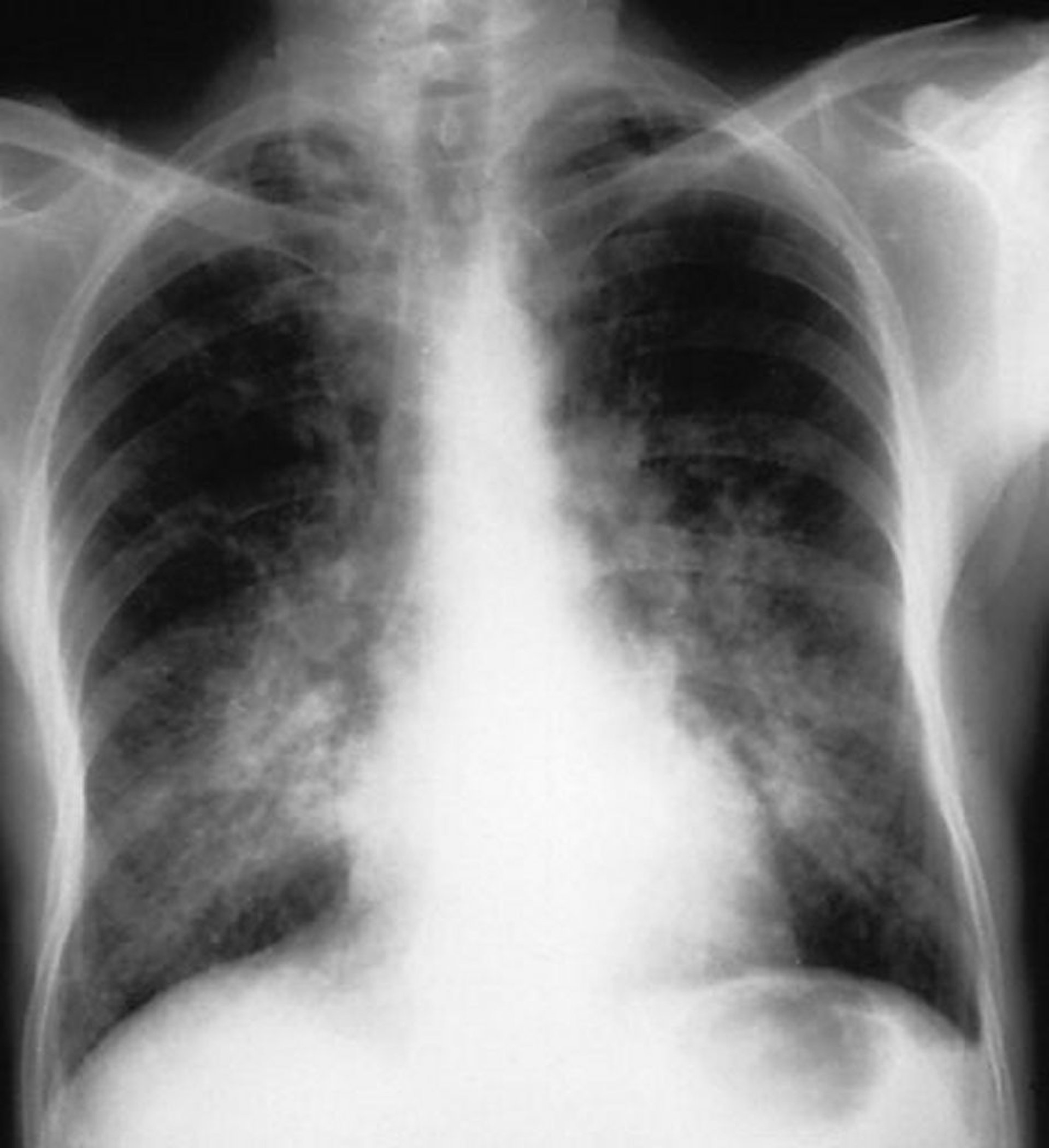
Chest radiograph of bilateral alveolar opacities in a patient with alveolar hemorrhage due to anti-glomerular basement membrane disease.
By permission of the publisher. From Cohen A, Glassock R. In Atlas of Diseases of the Kidney: Glomerulonephritis and Vasculitis. Edited by R Schrier (series editor), RJ Glassock, and AH Cohen. Philadelphia, Current Medicine, 1999.
Diagnosis references
1. Feragalli B, Mantini C, Sperandeo M, et al: The lung in systemic vasculitis: radiological patterns and differential diagnosis. Br J Radiol. 2016;89(1061):20150992. doi:10.1259/bjr.20150992
2. Dammacco F, Battaglia S, Gesualdo L, Racanelli V: Goodpasture's disease: a report of ten cases and a review of the literature. Autoimmun Rev. 2013;12(11):1101-1108. doi:10.1016/j.autrev.2013.06.014
Treatment of Anti-Glomerular Basement Membrane Disease
Plasma exchange
Glucocorticoids and cyclophosphamide
Sometimes, rituximab (in refractory cases)
Supportive care
The mainstay of therapy is immediate initiation of plasma exchange to rapidly remove circulating anti-GBM antibodies, combined with high-dose glucocorticoids and cyclophosphamide (1). Empiric immunosuppressant therapy is sometimes initiated before diagnostic confirmation because of the rapidity of disease progression after onset. Plasma exchange is typically performed for 2 to 3 weeks using 4-L exchanges to remove anti-GBM antibodies. Glucocorticoids (eg, methylprednisolone 1 g IV once a day for 3 doses followed by an oral prednisone taper) are typically administered over 6 to 12 months in addition to cyclophosphamide (eg, 2 mg/kg orally once a day for 3 months and sometimes up to 6 months) to prevent the generation of new antibodies. Therapy can be tapered when improvement in pulmonary and kidney function plateaus.
Data from case-reports or case-series suggests that rituximab may be beneficial in some patients who have severe adverse effects, fail to respond to, or decline cyclophosphamide as treatment (1).
Additional supportive care measures may be required in patients with pulmonary hemorrhage or fluid overload due to kidney failure. Endotracheal intubation and mechanical ventilation are recommended for patients with impending respiratory failure. Patients with significant renal impairment may require dialysis or kidney transplantation.
Treatment reference
1. Kidney Disease: Improving Global Outcomes (KDIGO) Glomerular Diseases Work Group: KDIGO 2021 Clinical Practice Guideline for the Management of Glomerular Diseases. Kidney Int. 2021;100(4S):S1-S276. doi:10.1016/j.kint.2021.05.021
Prognosis for Anti-Glomerular Basement Membrane Disease
Anti-GBM disease is often rapidly progressive and can be fatal if prompt recognition and treatment are delayed. Prognosis is good when treatment is initiated before the onset of respiratory or renal failure.
Immediate survival in patients with pulmonary hemorrhage and respiratory failure is linked to airway control.
Long-term morbidity is related to the degree of renal impairment at diagnosis. In one retrospective cohort study of predictors of clinical outcomes in 43 patients with anti-GBM disease, oligoanuria was the strongest predictor of patient and renal survival; the percentage of glomerular crescents on renal biopsy was the only pathologic parameter associated with poor renal outcomes (1). Another multicenter cohort study of 71 patients with anti-GBM disease that evaluated longitudinal outcomes over 25 years found that the presence of 100% crescents on renal biopsy predicted the need for long-term hemodialysis (2). Patients with severe renal failure requiring hemodialysis are less likely to recover kidney function and may eventually require kidney transplantation.
Relapse is rare and is more commonly associated with patients who are also positive for ANCA (3).
In patients with end-stage renal disease who receive kidney transplantation, disease can recur in the graft.
Prognosis references
1. Alchi B, Griffiths M, Sivalingam M, Jayne D, Farrington K: Predictors of renal and patient outcomes in anti-GBM disease: clinicopathologic analysis of a two-centre cohort. Nephrol Dial Transplant. 2015;30(5):814-821. doi:10.1093/ndt/gfu399
2. Levy JB, Turner AN, Rees AJ, Pusey CD: Long-term outcome of anti-glomerular basement membrane antibody disease treated with plasma exchange and immunosuppression. Ann Intern Med. 2001;134(11):1033-1042. doi:10.7326/0003-4819-134-11-200106050-00009
3. McAdoo SP, Tanna A, Hrušková Z, et al: Patients double-seropositive for ANCA and anti-GBM antibodies have varied renal survival, frequency of relapse, and outcomes compared to single-seropositive patients. Kidney Int. 2017;92(3):693-702. doi:10.1016/j.kint.2017.03.014
Key Points
Patients with anti-GBM disease may have both pulmonary hemorrhage and glomerulonephritis or either one separately.
Pulmonary findings can be mild or nonspecific.
Serum is tested for anti-glomerular basement membrane antibodies.
In patients with glomerulonephritis, a renal biopsy should be obtained.
Diagnose and treat anti-GBM disease before organ failure develops whenever possible.
Treatment is with plasma exchange, a glucocorticoid, and cyclophosphamide.
Drug Information for the Topic