Hypertrophy or inflammation of the adenoids is common among children. Symptoms include nasal obstruction, sleep disturbances, recurrent rhinitis/sinusitis, and middle ear effusions with hearing loss. Diagnosis is enhanced by flexible fiberoptic nasopharyngoscopy and lateral neck radiography. Treatment often includes nasal saline rinse, intranasal glucocorticoids, antibiotics, and, for significant nasal obstruction or persistent recurrent rhinitis/sinusitis, acute otitis media or middle ear effusion, adenoidectomy.
The adenoids are a rectangular mass of lymphatic tissue in the posterior nasopharynx. They are largest in children age 2 to 6 years.
Adenoidal enlargement (also called adenoid hypertrophy) is a common cause of anatomic nasopharyngeal obstruction in young children. In one global meta-analysis of pediatric patients aged 6 months to 17 years of age, all of whom had adenoid hypertrophy confirmed by endoscopic evaluation, the prevalence of adenoid hypertrophy in a randomly collected representative sample of the general population was approximately 34%, but was higher (approximately 42 to 70%) in convenience samples of children who had presented to otolaryngology clinics (1).
Adenoid hypertrophy may be physiologic or secondary to viral or bacterial infections, allergies, irritants, and, possibly inflammation such as that caused by gastroesophageal reflux. Other risk factors include ongoing exposure to people with bacterial or viral infection (eg, to multiple children at a childcare center). Severe hypertrophy can obstruct the eustachian tubes (causing otitis media) and/or posterior choanae (causing sinusitis or obstructive sleep apnea).
Chronic adenoiditis can lead to the development of chronic or recurrent nasopharyngitis, rhinosinusitis, and epistaxis. Chronic adenoidal hypertrophy is a recognized cause of obstructive sleep apnea in children.
General reference
1. Pereira L, Monyror J, Almeida FT, et al. Prevalence of adenoid hypertrophy: A systematic review and meta-analysis. Sleep Med Rev. 2018;38:101-112. doi:10.1016/j.smrv.2017.06.001
Symptoms and Signs of Adenoid Hypertrophy
Although patients with adenoid hypertrophy may not complain of symptoms, they typically have chronic mouth breathing (because of nasopharyngeal obstruction) and a hyponasal voice quality. Other symptoms include, snoring, sleep disturbances, halitosis, recurrent acute otitis media, conductive hearing loss (secondary to recurrent otitis media or persistent middle ear effusions).
Children with significant adenoid hypertrophy can occasionally develop a characteristic, vertically elongated face (adenoid facies) including a high-arched palate, dental crowding, and a short upper lip.
Diagnosis of Adenoid Hypertrophy
Flexible nasopharyngoscopy
Lateral imaging of the neck
The diagnosis of adenoid hypertrophy is suspected in children and adolescents with characteristic symptoms of nasopharyngeal obstruction (eg, mouth breathing, snoring), persistent middle ear effusions, or recurrent acute otitis media or rhinosinusitis.
Similar symptoms and signs of adenoid hypertrophy in a male adolescent may result from a juvenile nasopharyngeal angiofibroma. Children with velopharyngeal insufficiency (eg, due to velocardiofacial syndrome) may have hypernasal speech (ie, sounding as if too much air escapes through the nose) that must be differentiated from the hyponasal speech (ie, as with a congested nose) of adenoid hypertrophy (see Differential Diagnosis).
The standard for office assessment of the nasopharynx is flexible nasopharyngoscopy. Sleep tape recording, often used to document snoring, is not as accurate or specific. Polysomnography (sleep study) may help define the severity of any sleep disturbance or obstructive sleep apnea due to chronic obstruction; the degree of severity of obstructive sleep apnea may be classified on the basis of the apnea-hypopnea index (AHI) as mild, moderate, and severe (1).
Lateral neck radiography is useful in assessing adenoid size, especially when a child cannot tolerate an endoscopic examination. In conjunction with clinical assessment, lateral neck radiography offers high sensitivity and specificity for evaluating the degree of adenoid hypertrophy (2). CT or MRI may be considered in children when the index of suspicion for angiofibroma or cancer is high.

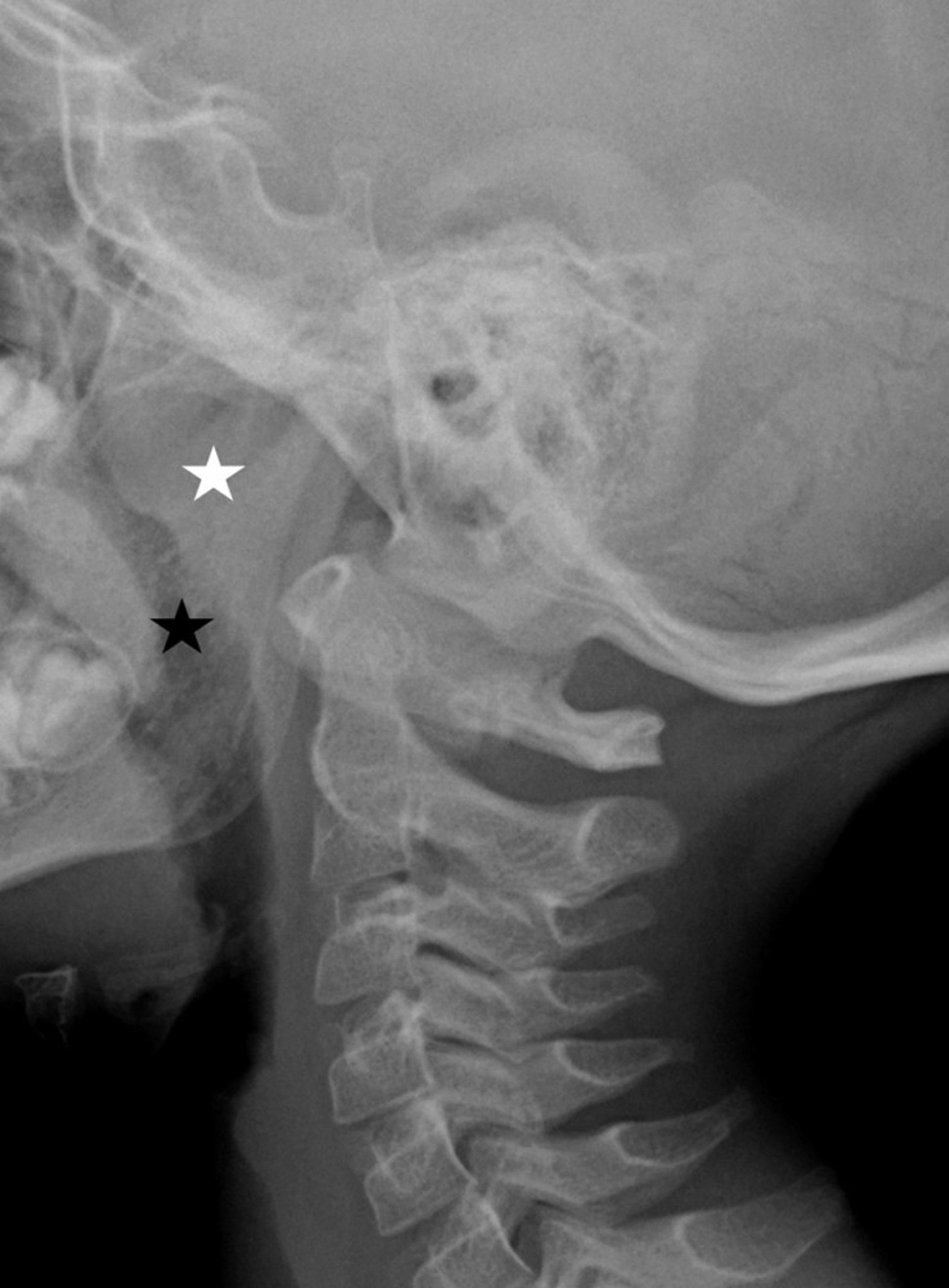
This radiograph shows large adenoids (white star) causing narrowing of the airway (black star).
© Springer Science+Business Media
Differential Diagnosis
Key differential diagnoses of adenoid hypertrophy include:
Allergic rhinitis
Nasal polyposis
Acute/chronic sinusitis
Nasal foreign bodies
Juvenile nasopharyngeal angiofibroma (especially in a male adolescent)
Diagnosis references
1. Marcus CL, Brooks LJ, Draper KA, et al. Diagnosis and management of childhood obstructive sleep apnea syndrome. Pediatrics. 2012;130(3):e714-e755. doi:10.1542/peds.2012-1672
2. Dykewicz MS, Wallace DV, Amrol DJ, et al. Rhinitis 2020: A practice parameter update. J Allergy Clin Immunol. 2020;146(4):721-767. doi:10.1016/j.jaci.2020.07.007
Adenoid Hypertrophy
Medical management
Sometimes surgical management (eg, adenoidectomy)
Treatment of underlying etiology
The treatment of adenoid hypertrophy includes both medical and surgical approaches. The choice of approach depends on the severity of symptoms (ie, degree of hypertrophy), presence of complications, and patient age. Treatment approaches must also take into consideration the associated underlying etiology.
Medical management is primarily with Intranasal glucocorticoids, which have demonstrated efficacy in adenoid hypertrophy (1, 2). The use of intranasal glucocorticoids and antihistamines is associated with a reduction in the need for surgery in selected patients (3). These agents are also beneficial in the treatment of associated underlying allergy (eg, allergic rhinitis), sinusitis, and nasal polyps. Limited evidence suggests that leukotriene antagonists (primarily montelukast) may improve symptoms (eg, mouth breathing, snoring) related to adenoid hypertrophy; relevant boxed warnings must be discussed with patients and caregivers prior to initiating treatment (4).
Surgical removal of the adenoids (adenoidectomy) is generally performed when there is obstructive sleep apnea, abnormal dentofacial growth (due to malocclusion), or if there is any suspicion of malignancy (5). Adenoidectomy may be performed with or without tonsillectomy and tympanostomy tube placement. For example, in children with persistent middle ear effusions or frequent otitis media, adenoidectomy is often performed concurrently with tympanostomy tube placement to limit recurrence (6). If children are > 4 years and require tympanostomy tubes, particularly if performed on a repeated basis (eg, for otitis media with effusion), adenoidectomy is often performed concurrent with tube placement (7). Adenotonsillectomy is also recommended for younger children with recurrent tonsillitis or peritonsillar abscesses. Although it requires general anesthesia, adenoidectomy usually can be performed on an outpatient basis with recovery in 48 to 72 hours.
Adenoidectomy is contraindicated in patients with velopharyngeal insufficiency, which can be associated with submucosal cleft palate and bifid uvula because adenoidectomy can precipitate or worsen hypernasal speech.
Adenoidectomy is generally considered a safe surgical procedure with a low risk of postoperative complications (including hemorrhage) and mortality (8).
An underlying bacterial infection (adenoiditis manifested as halitosis) should be treated with antibiotics. If obstructive sleep apnea is evident on polysomnography, medical management or home bilevel positive airway pressure (BiPAP) or continuous positive airway pressure (CPAP) devices may be required.
Treatment references
1. Dykewicz MS, Wallace DV, Amrol DJ, et al. Rhinitis 2020: A practice parameter update. J Allergy Clin Immunol. 2020;146(4):721-767. doi:10.1016/j.jaci.2020.07.007
2. Ripp AT, Kallenberger EM, Nguyen SA, et al. Topical nasal steroids for adenoid hypertrophy in children: A systematic review and meta-analysis. Int J Pediatr Otorhinolaryngol. 2025;198:112580. doi:10.1016/j.ijporl.2025.112580
3. Hong H, Chen F, Zheng X, et al. Decreased frequency of adenoidectomy by a 12-week nasal budesonide treatment. Ther Clin Risk Manag. 2017;13:1309-1316. Published 2017 Oct 3. doi:10.2147/TCRM.S144659
4. Alanazi F, Alruwaili M, Alanazy S, et al. Efficacy of montelukast for adenoid hypertrophy in paediatrics: A systematic review and meta-analysis. Clin Otolaryngol. 2024;49(4):417-428. doi:10.1111/coa.14169
5. Randall DA. Current Indications for Tonsillectomy and Adenoidectomy. J Am Board Fam Med. 2020;33(6):1025-1030. doi:10.3122/jabfm.2020.06.200038
6. Mitchell RB, Archer SM, Ishman SL, et al: Clinical practice guideline: Tonsillectomy in children (update)-Executive Summary. Otolaryngol Head Neck Surg 160 (2):187–205, 2019, doi: 10.1177/0194599818807917
7. MacKeith S, Mulvaney CA, Galbraith K, et al. Adenoidectomy for otitis media with effusion (OME) in children. Cochrane Database Syst Rev. 2023;10(10):CD015252. Published 2023 Oct 23. doi:10.1002/14651858.CD015252.pub2
8. Gerhardsson H, Stalfors J, Sunnergren O. Postoperative morbidity and mortality after adenoidectomy: A national population-based study of 51 746 surgeries. Int J Pediatr Otorhinolaryngol. 2022;163:111335. doi:10.1016/j.ijporl.2022.111335
Drug Information for the Topic