Chronic suppurative otitis media is a persistent, chronically draining (> 6 weeks), suppurative perforation of the tympanic membrane. Symptoms include painless otorrhea with conductive hearing loss. Complications include development of aural polyps, cholesteatoma, and other infections. Treatment requires complete cleaning of the ear canal, careful removal of granulation tissue, and application of topical glucocorticoids and antibiotics. Systemic antibiotics and surgery are reserved for severe cases.
Chronic suppurative otitis media is chronic inflammatory condition affecting the middle ear that is characterized by otorrhea and a perforated tympanic membrane.
Epidemiology of Chronic Suppurative Otitis Media
In one meta-analysis, the pooled average global prevalence of chronic suppurative otitis media was 3.8%, with the majority of cases occurring in resource-limited settings (1). Chronic suppurative otitis media is uncommon in resource-rich settings. For example, one large retrospective study of claims data in the United States reported a prevalence of chronic suppurative otitis media of 0.46% (2).
Chronic suppurative otitis media predominantly occurs in young children, with the highest prevalence in those aged 0 to 10 years; there is a slight male predominance (2)
Epidemiology references
1. Onifade A, Katolo HW, Mookerjee S, et al. Epidemiology of Chronic Suppurative Otitis Media: Systematic Review To Estimate Global Prevalence. J Epidemiol Glob Health. 2025;15(1):55. Published 2025 Apr 3. doi:10.1007/s44197-025-00396-9
2. Gupta A, Thai A, Santa Maria PL. Epidemiology of Chronic Suppurative Otitis Media in the United States. Ann Otol Rhinol Laryngol. 2024;133(8):741-749. doi:10.1177/00034894241257103
Etiology of Chronic Suppurative Otitis Media
Chronic suppurative otitis media can result from acute otitis media, eustachian tube obstruction, mechanical trauma (such as with cotton swabs), thermal or chemical burns, blast injuries, or iatrogenic causes (eg, after tympanostomy tube placement). Risk is increased in patients with craniofacial abnormalities (eg, Down syndrome, cri du chat syndrome, cleft lip and/or cleft palate, 22q11.2 deletion [also called velocardiofacial syndrome, Shprintzen syndrome, Shprintzen-Goldberg syndrome, and DiGeorge syndrome]).
Chronic suppurative otitis media may be exacerbated after an upper respiratory infection or by water entering the middle ear through a tympanic membrane perforation during bathing or swimming. Chronic exposure to air pollution and poor hygiene related to living in a low-resource community can also exacerbate symptoms.
Infections often are caused by gram-negative bacilli or Staphylococcus aureus, resulting in painless, purulent, sometimes foul-smelling otorrhea. Persistent chronic suppurative otitis media may result in destructive changes in the middle ear (such as necrosis of the long process of the incus) or aural polyps (granulation tissue prolapsing into the ear canal through the tympanic membrane perforation). Aural polyps are a serious sign, almost invariably suggesting cholesteatoma. In immunocompromised patients (eg, patients with diabetes), Pseudomonas infections are common.
A cholesteatoma can be a nidus of infection in the middle ear, leading to complications such as chronic suppurative otitis media.
Symptoms and Signs of Chronic Suppurative Otitis Media
Chronic suppurative otitis media usually manifests with conductive hearing loss and otorrhea. Pain is uncommon unless an associated osteitis of the temporal bone occurs. The tympanic membrane is perforated and draining, and the auditory canal is macerated and may be littered with granulation tissue.

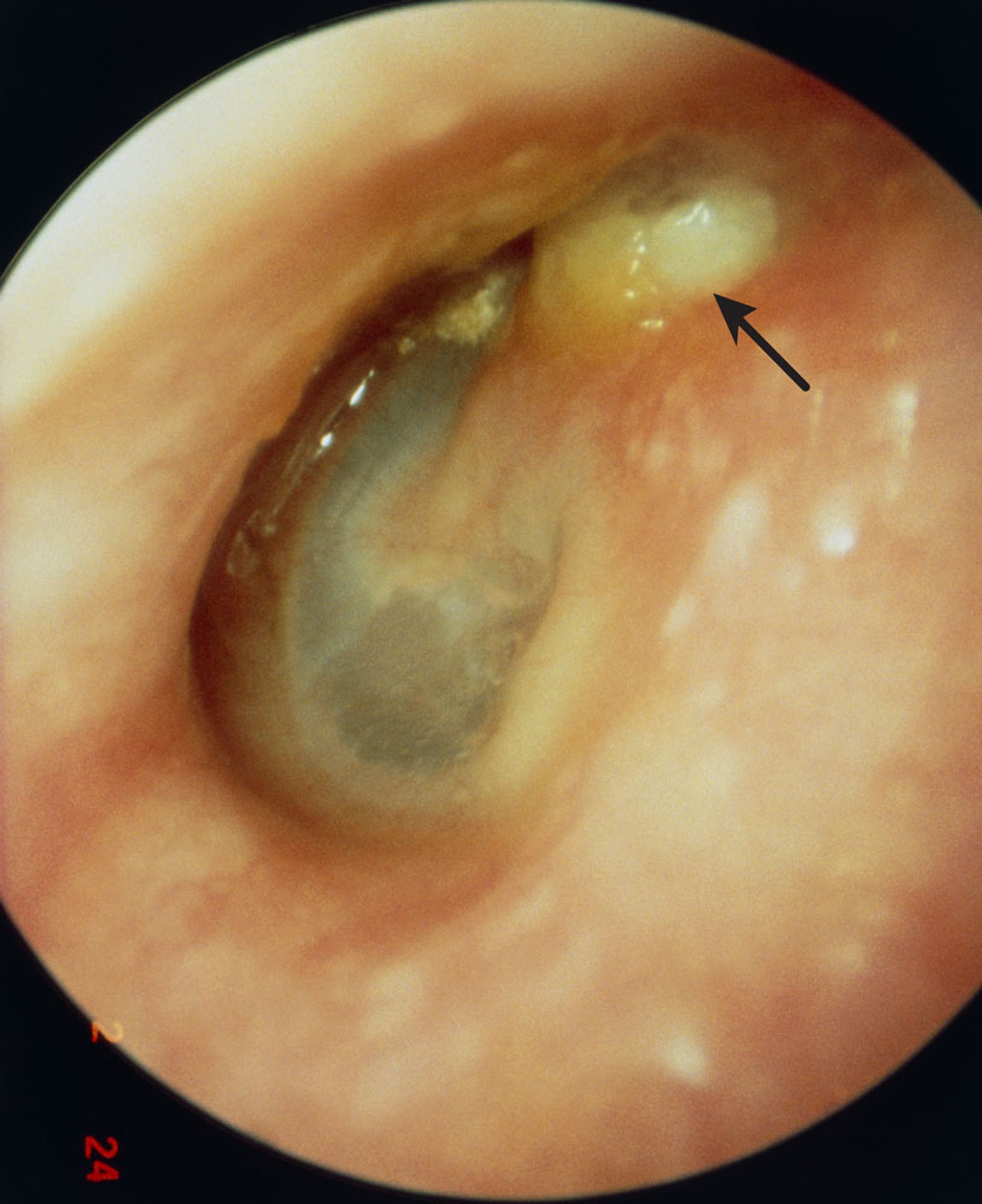
In this image, the view along the external ear canal shows a large cholesteatoma (white mass on left superior to the short process of the malleus; arrow), resulting in a perforation of the tympanic membrane.
PROFESSOR TONY WRIGHT, INSTITUTE OF LARYNGOLOGY & OTOLOGY/SCIENCE PHOTO LIBRARY
Diagnosis of Chronic Suppurative Otitis Media
History and physical examination (including otoscopy)
Sometimes imaging
Audiometry
The diagnosis of chronic suppurative otitis media is usually clinical. Ear cleaning of discharge to directly visualize the tympanic membrane and middle ear mucosa may be required. Samples of the discharge may be cultured.
When cholesteatoma or other complications are suspected (as in a febrile patient or one with vertigo or otalgia), a CT or MRI is performed. These tests may show intratemporal or intracranial processes (eg, labyrinthitis, ossicular or temporal bone erosion, abscesses). If patients have persistent or recurrent granulation tissue, biopsies should be done to exclude a neoplasm.
Treatment of Chronic Suppurative Otitis Media
Topical antibiotic drops
Removal of granulation tissue
Surgery for cholesteatomas
The management of chronic suppurative otitis media typically involves ear cleaning of discharge combined with topical (otic) antibiotics (1). Dry ear precautions are required unless patients are being treated with antibiotic ear drops. Dry ear precautions include occluding the external canal (eg, using a cotton ball lathered with petroleum jelly) while bathing and showering and avoiding swimming.
Four to 5 drops of topical ciprofloxacin (or ofloxacin) solution are instilled in the affected ear 2 times a day for 14 days. Ear drops that contain aminoglycosides (eg, neomycin, tobramycin) or polymyxin should not be prescribed for patients with a perforated tympanic membrane or patients with a tympanostomy tube because of potential ototoxicity.
When granulation tissue is present, it may be removed with microinstruments or cauterization with silver nitrate sticks. Ciprofloxacin and dexamethasone is then instilled into the ear canal for 7 to 14 days. Alternatively, ciprofloxacin and dexamethasone can be given for 10 to 14 days without debridement. When granulation tissue persists or continues to recur in spite of adequate local treatment, a biopsy to exclude a neoplasm should be considered.
Severe exacerbations require systemic antibiotic therapy with amoxicillin 250 to 500 mg orally every 8 hours for 10 days or a third-generation cephalosporin; if needed, antibiotics are subsequently modified based on culture results and response to therapy.
Tympanoplasty is indicated for patients with marginal or attic perforations and chronic central tympanic membrane perforations. A disrupted ossicular chain may be repaired during tympanoplasty as well.
Cholesteatomas must be removed surgically.
Treatment reference
1. Bhutta MF, Leach AJ, Brennan-Jones CG. Chronic suppurative otitis media. Lancet. 2024;403(10441):2339-2348. doi:10.1016/S0140-6736(24)00259-9
Key Points
Chronic suppurative otitis media is a persistent perforation of the tympanic membrane with chronic suppurative drainage.
The middle ear structures are often damaged; less commonly, intratemporal or intracranial structures are affected.
Initially, treat with topical antibiotics.
If patients have severe exacerbations, treat with systemic antibiotics.
Surgery is needed for certain types of perforation and damaged ossicles and to remove any cholesteatomas if present.
Drug Information for the Topic