Cutaneous larva migrans is the skin manifestation of hookworm infestation. Diagnosis is clinical. Treatment is oral or topical antihelminthic therapy.
Cutaneous larva migrans is a parasitic skin disease caused by Ancylostoma species, most commonly dog or cat hookworms Ancylostoma caninum or Ancylostoma braziliense (1).
Hookworm ova in dog or cat feces develop into infective larvae when left in warm moist ground or sand (2). Zoonotic transmission to humans occurs when skin directly contacts contaminated soil or sand and larvae penetrate unprotected skin, usually of the feet, legs, buttocks, or back. Larvae in the skin normally do not develop into adult worms. Although there have been rare reports of eosinophilic enteritis associated with A. caninum infections, it is not clear whether these are due either deeper migration of cutaneous larvae or inadvertent consumption of infective larvae (3).

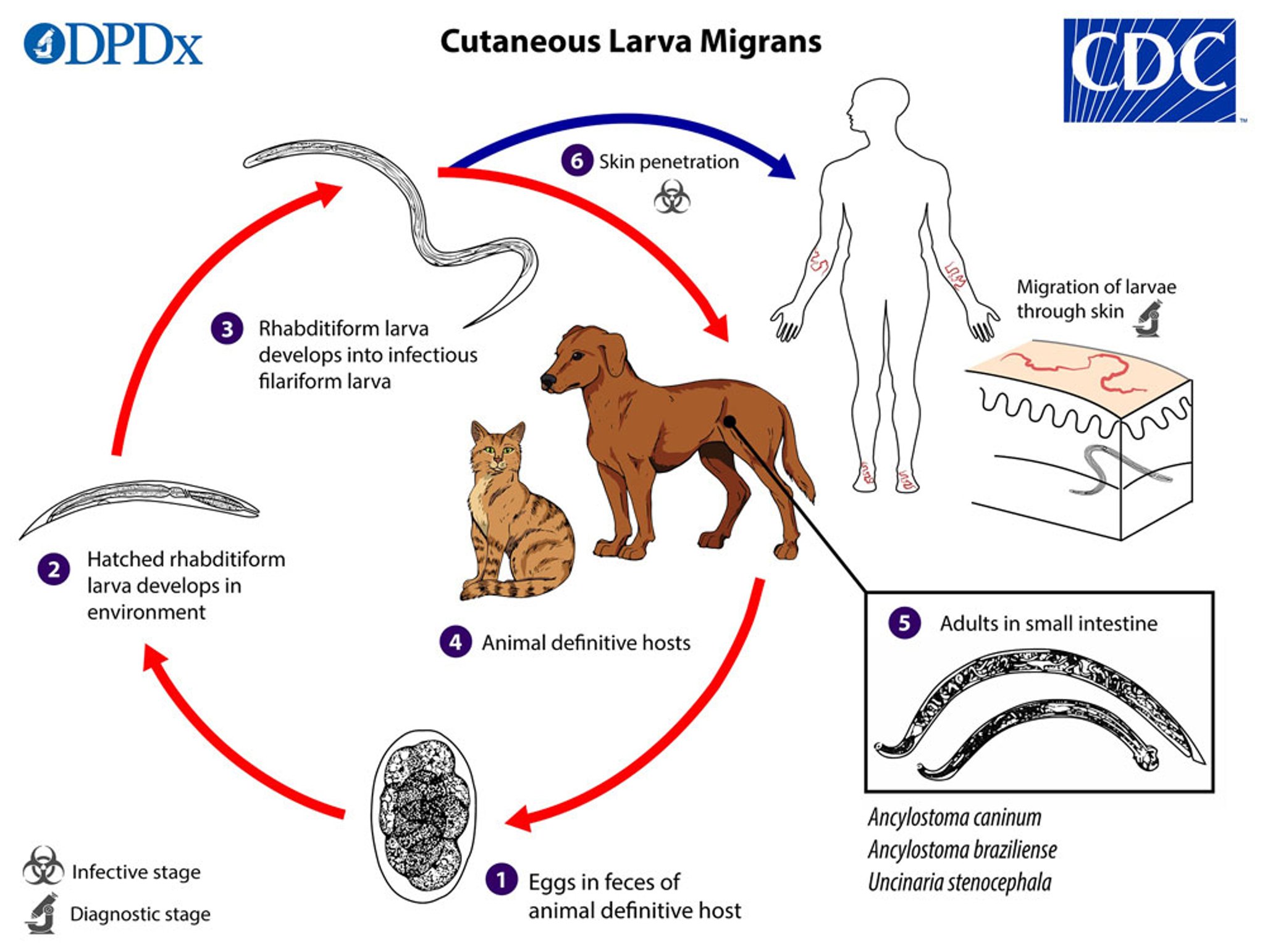
Mature hookworms reproduce in the small intestine of animal definitive hosts, and eggs are passed in the host’s stool.
Under favorable conditions (moisture, warmth, shade), larvae hatch in 1 to 2 days. The released rhabditiform larvae grow in the feces and/or the soil.
After 5 to 10 days (and 2 molts), the larvae become filariform (third-stage) larvae that are infective. These infective larvae can survive 3 to 4 weeks in favorable environmental conditions.
Once the larvae have contact with the animal host, they penetrate the skin and are carried through the blood vessels to the heart and then to the lungs where they penetrate into the pulmonary alveoli, ascend the bronchial tree to the pharynx, and are swallowed.
The larvae reach the small intestine where they mature into adults. Adult worms live in the lumen of the small intestine where they attach to the intestinal wall. Some larvae become arrested in the larval developmental stage in the tissues and serve as the source of infection for puppies and kittens via transmammary (and possibly transplacental) routes.
Humans become infected when filariform larvae penetrate the skin. With most species, the larvae cannot mature further in the human host and migrate aimlessly within the epidermis, sometimes as much as several centimeters a day. Some larvae may become arrested in deeper tissue after skin migration.
Image from the Centers for Disease Control and Prevention, Global Health, Division of Parasitic Diseases and Malaria.
Cutaneous larva migrans occurs worldwide, most commonly in tropical or subtropical environments, but it is increasingly reported in temperate regions. Emergence of this condition in previously naive countries is thought to be due to changes in travel patterns and to climate change (4, 5).
Infections in cutaneous larva migrans are different from parasitic skin infestations caused by Schistosoma species, which most commonly manifests as irritant dermatitis around the site of cercarial (immature parasite stage) penetration. See Dermatitis Caused by Avian and Animal Schistosomes.
For information on related Ancylostoma species causing human infection, see Hookworm Infection. For details on veterinary disease, see Hookworms in Small Animals.

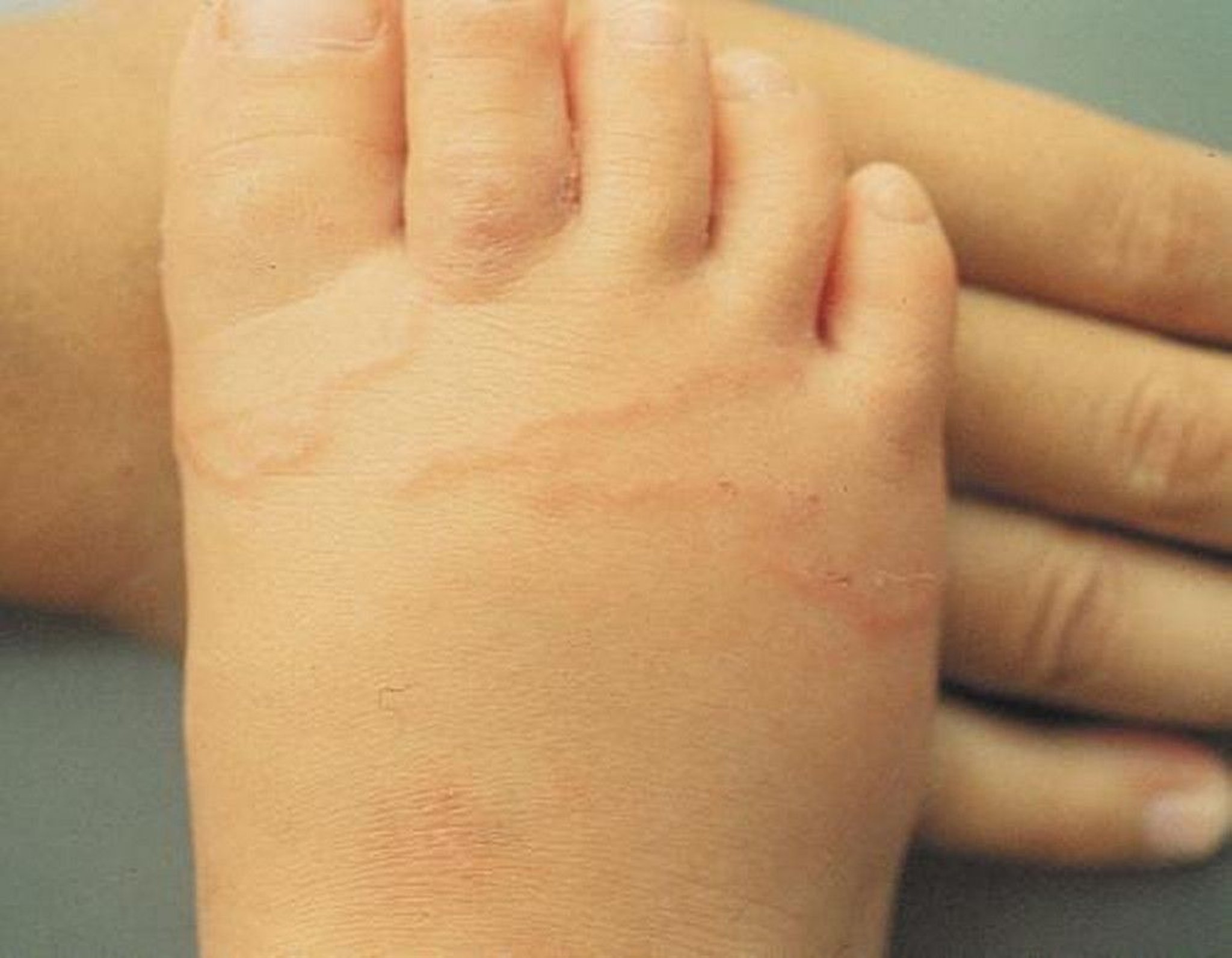
This photo shows a rash on a foot caused by the burrowing larvae of animal hookworms. The movement of the larvae beneath the skin causes distinct patterns of erythema and raised serpiginous tracts accompanied by intense pruritus.
© Springer Science+Business Media

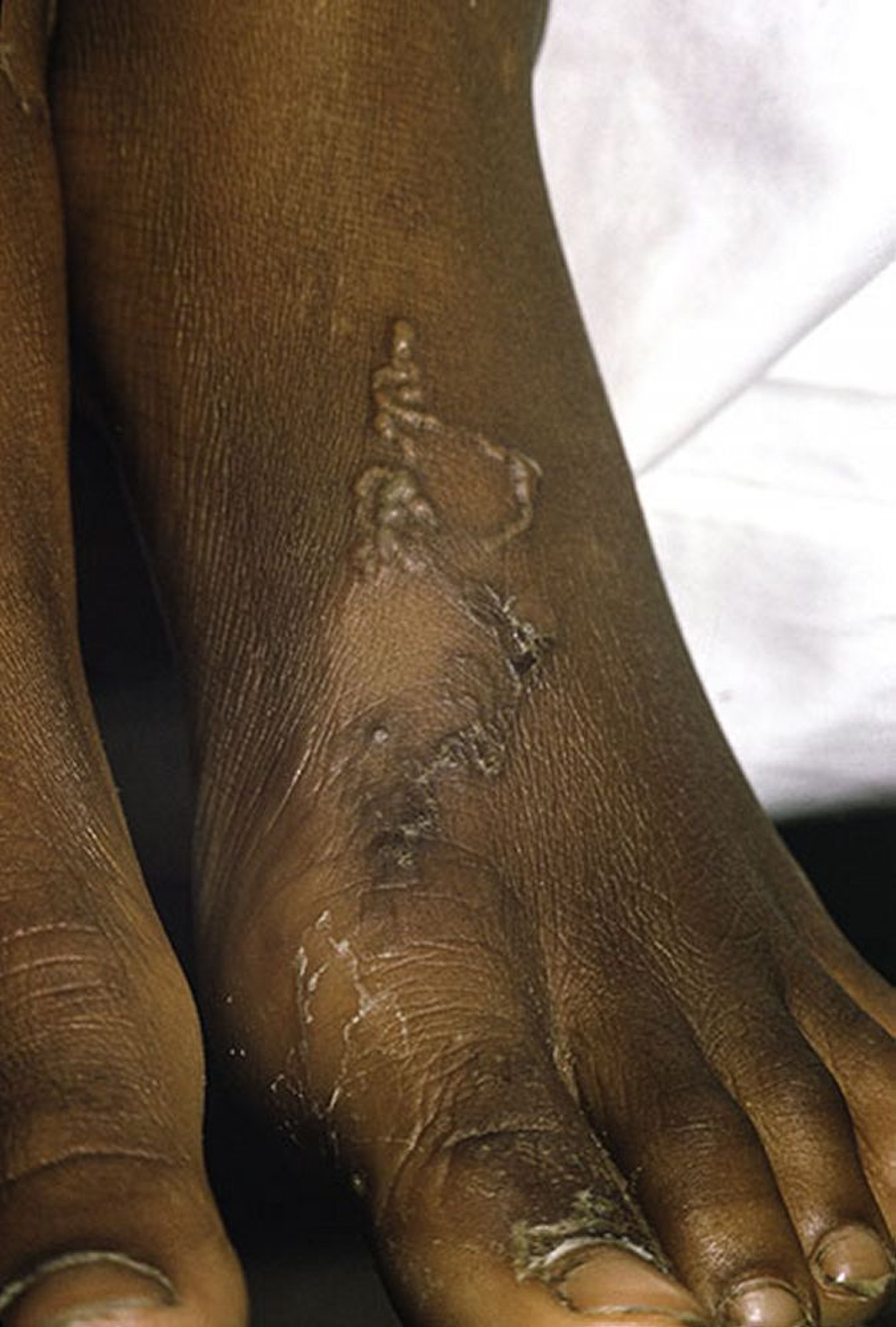
This photo shows a superficial, raised, serpiginous tract on the dorsal aspect of the foot.
Photo courtesy of Karen McKoy, MD.
Cutaneous larva migrans causes intense pruritus. Signs are erythema and papules at the site of entry, followed by a winding, serpiginous subcutaneous trail of reddish brown inflammation in the upper dermis (1). The serpiginous tracks are often migratory, spreading up to a few centimeters daily. Patients may also develop papules and vesicles resembling folliculitis, called hookworm folliculitis.
Cutaneous larva migrans may be complicated by a self-limiting pulmonary reaction called Löffler syndrome (patchy pulmonary infiltrates and peripheral blood eosinophilia) (6).
Diagnosis of cutaneous larva migrans is by history and appearance on physical examination. Laboratory tests are generally not helpful. Eosinophilia is uncommon.
General references
1. U.S. Centers for Disease Control and Prevention (CDC). Hookworm (Extraintestinal). Accessed October 16, 2025.
2. Bowman DD, Montgomery SP, Zajac AM, et al. Hookworms of dogs and cats as agents of cutaneous larva migrans. Trends Parasitol. 2010;26(4):162-167. doi:10.1016/j.pt.2010.01.005
3. U.S. Centers for Disease Control and Prevention (CDC). Clinical Features of Zoonotic Hookworm. February 15, 2024. Accessed October 16, 2025.
4. Ahmed A, Hemaida MA, Hagelnur AA, et al. Sudden emergence and spread of cutaneous larva migrans in Sudan: A case series calls for urgent actions. IDCases 32:e01789, 2023. doi: 10.1016/j.idcr.2023.e01789
5. Palaniappan V, Gopinath H, Karthikeyan K. Cutaneous larva migrans. Clin Exp Dermatol. Published online August 7, 2025. doi:10.1093/ced/llaf375
6. Podder I, Chandra S, Gharami RC. Loeffler's syndrome following cutaneous larva migrans: An uncommon sequel. Indian J Dermatol 61(2):190–192, 2016. doi: 10.4103/0019-5154.177753
Treatment of Cutaneous Larva Migrans
Oral or topical antihelminthic therapy
Although the infection usually resolves spontaneously after a few weeks, discomfort and the risk of secondary bacterial infection warrant treatment.
Treatment consists of antihelminthic therapy with oral or topical agents.
Oral medications are generally preferred because they are generally well-tolerated and easier to use and obtain than topical agents. Oral ivermectin and albendazole are effective treatment options and likely more effective than mebendazole (1).
Topical thiabendazole (tiabendazole in some regions) 10 to 15% liquid or cream (compounded) for up to 1 week can be used as an alternative (2). Topical albendazole 10% ointment (compounded) may also be used but data on efficacy are limited.
Treatment references
1. López-Neila D, Salvador F, Martínez-Campreciós J, et al. Imported Cutaneous Larva Migrans: Epidemiological, Clinical, and Therapeutic Aspects Analyzed in a Referral Tropical Medicine Unit in Barcelona. Am J Trop Med Hyg. 2025;113(1):81-85. Published 2025 May 6. doi:10.4269/ajtmh.24-0856
2. Heukelbach J, Feldmeier H. Epidemiological and clinical characteristics of hookworm-related cutaneous larva migrans. Lancet Infect Dis. 2008;8(5):302-309. doi:10.1016/S1473-3099(08)70098-7
Drug Information for the Topic