Alopecia areata is typically sudden patchy nonscarring hair loss in patients with no obvious skin or systemic disorder. Diagnosis is typically by inspection, although sometimes a skin biopsy is necessary. Treatment is with combinations of medications applied topically, taken orally, or injected into the scalp and can include glucocorticoids, anthralin, minoxidil, topical immunotherapy (ie, diphenylcyclopropenone), or systemic immunosuppressants.
(See also Alopecia.)

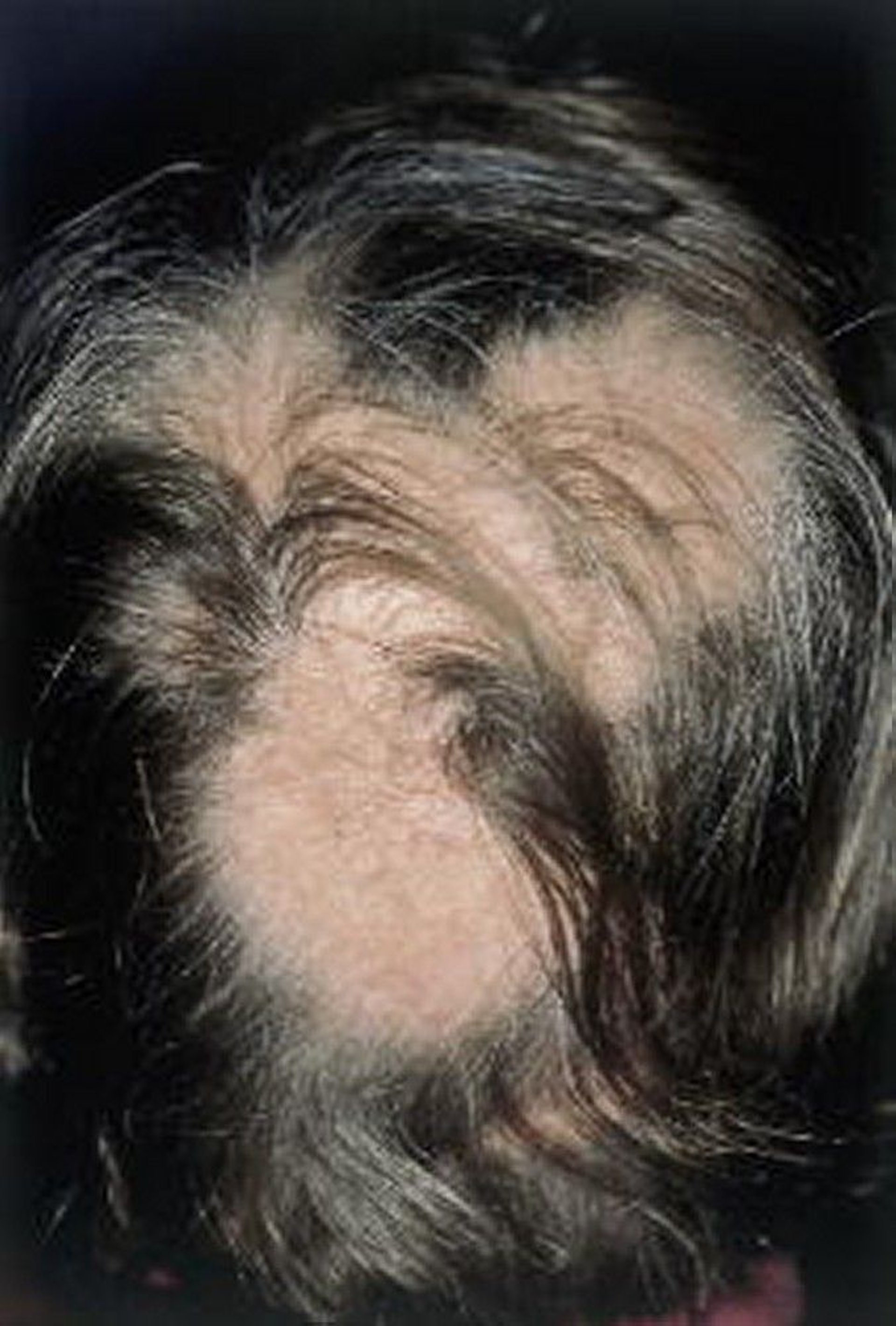
This photo shows patchy loss of scalp hair in alopecia areata.
© Springer Science+Business Media

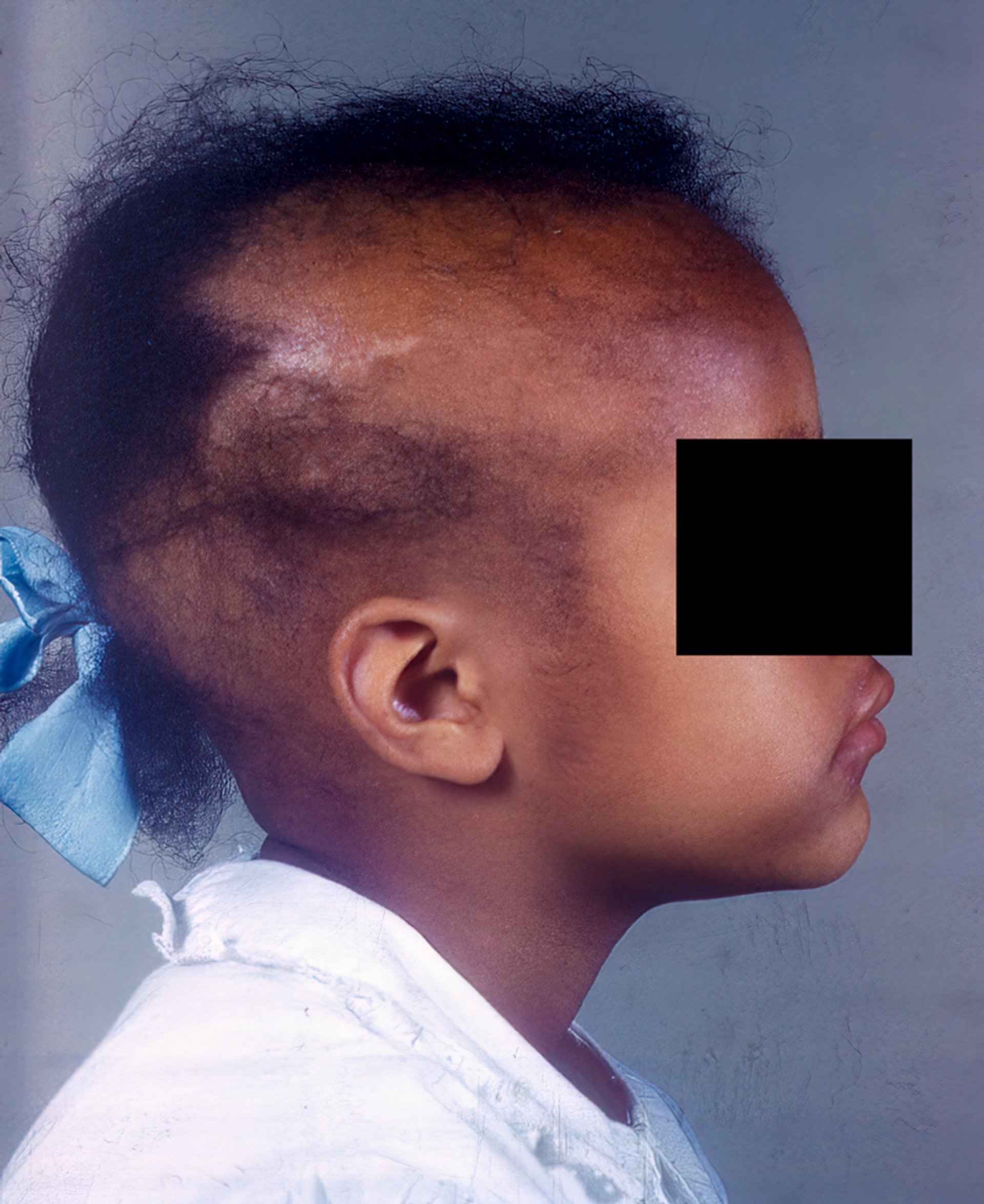
This photo shows oval patches of hair loss consistent with alopecia areata.
Photo courtesy of Karen McKoy, MD.
The scalp and beard are most frequently affected, but any hairy area may be involved. Hair loss may affect the entire scalp (alopecia totalis) or most or all of the body (alopecia universalis). Alopecia areata is thought to be an autoimmune disorder affecting genetically susceptible people exposed to unclear environmental triggers. It occasionally coexists with autoimmune vitiligo or thyroiditis.
Diagnosis of Alopecia Areata
Examination
Diagnosis of alopecia areata is by inspection. Alopecia areata typically manifests as discrete circular patches of hair loss characterized by short broken hairs at the margins that resemble exclamation points. Nails are sometimes pitted, display longitudinal ridging, or display trachyonychia, a roughness of the nail also seen in lichen planus. Red lunula may also be seen.
Differential diagnosis includes tinea capitis, trichotillomania, traction alopecia, lupus, and secondary syphilis. If findings are equivocal, further testing can be pursued with potassium hydroxide preparation, fungal culture, screening for syphilis, or biopsy. Patients with clinical findings suggesting associated autoimmune diseases (particularly thyroid disease) are tested for those diseases.
Biopsy is occasionally necessary.
Treatment of Alopecia Areata
Glucocorticoids
Sometimes topical anthralin
Sometimes minoxidil
Sometimes topical immunotherapy
Sometimes Janus kinase inhibitors (baricitinib, ritlecitinib, deuruxolitinib) or methotrexate
Rarely, photochemotherapy or psoralen plus ultraviolet A (PUVA)
Use of hairpieces and camouflage techniques
If therapy is considered, intralesional glucocorticoid injection is the treatment of choice in adults. Triamcinolone acetonide suspension (typically in doses of 0.1 to 3 mL of 2.5 to 5 mg/mL concentration every 4 to 8 weeks) can be injected intradermally if the lesions are small. Potent topical glucocorticoids (eg, clobetasol propionate 0.05% foam, gel, or ointment 2 times a day for approximately 4 weeks) can be used; however, they often do not penetrate to the depth of the hair bulb where the inflammatory process is located. Oral glucocorticoids are effective, but hair loss often recurs after cessation of therapy and adverse effects limit use.
Topical anthralin cream (0.5 to 1% applied for 10 to 20 minutes daily then washed off; contact time titrated as tolerated up to 1 hour/day) may be used to stimulate a mild irritant reaction.
Induction of allergic contact dermatitis using diphenylcyclopropenone or squaric acid dibutylester (topical immunotherapy) leads to hair growth due to unknown mechanisms, but this treatment is best reserved for patients with diffuse involvement who have not responded to other therapies.
Oral minoxidil or topical minoxidil 5% foam or solution may be useful as monotherapy or as adjuvant treatment (1, 2).
Baricitinib, ritlecitinib, and deuruxolitinib are Janus kinase (JAK) inhibitors that may be used for the treatment of severe alopecia areata in adolescents and adults (3, 4, 5, 6, 7). Testing for the CYP2C9 gene before treatment with deuruxolitinib is mandatory prior to starting deuruxolitinib to avoid toxicity (8).
Oral methotrexate has been successfully used for the treatment of alopecia totalis and alopecia universalis in both adult and pediatric populations. Doses range from 15 to 25 mg weekly. Methotrexate can also be used in combination with oral glucocorticoids. Its use is typically reserved for refractory alopecia areata in patients who fail standard therapy (1, 9).
Systemic and topical PUVA (psoralen and ultraviolet A light therapy) have been used with limited success in patients who fail conventional therapy. However, this is a less favored treatment option because of high relapse rates, lack of randomized controlled trials, and increased risk of cancer with PUVA.
Hairpieces and camouflage techniques can be used to mask the effects of hair loss.
Treatment references
1. Strazzulla LC, Wang EHC, Avila L, et al: Alopecia areata: An appraisal of new treatment approaches and overview of current therapies. J Am Acad Dermatol 78(1):15-24, 2018. doi: 10.1016/j.jaad.2017.04.1142
2. Kalil L, Valido K, Peterson D, et al. Oral minoxidil treatment of alopecia areata. J Am Acad Dermatol. 2025;93(4):1099-1101. doi:10.1016/j.jaad.2025.05.1446
3. King B, Ohyama M, Kwon O, et al. Two phase 3 trials of baricitinib for alopecia areata. N Engl J Med. 2022;386(18):1687-1699. doi: 10.1056/NEJMoa2110343
4. Ko JM, Mayo TT, Bergfeld WF, et al. Clinical outcomes for uptitration of baricitinib therapy in patients with severe alopecia areata: A pooled analysis of the BRAVE-AA1 and BRAVE-AA2 trials. JAMA Dermatol. 2023;159(9):970-976. doi: 10.1001/jamadermatol.2023.2581
5. King BA, Craiglow BG. Janus kinase inhibitors for alopecia areata. J Am Acad Dermatol. 2023;89(2S):S29-S32. doi: 10.1016/j.jaad.2023.05.049
6. King B, Zhang X, Harcha WG, et al, Efficacy and safety of ritlecitinib in adults and adolescents with alopecia areata: A randomised, double-blind, multicentre, phase 2b-3 trial. Lancet, 2023;401(10387):1518-1529. doi: 10.1016/S0140-6736(23)00222-2. Erratum in: Lancet. 2023;401(10392):1928.
7. Gupta AK, Wang T, Polla Ravi S, et al. Systematic review of newer agents for the management of alopecia areata in adults: Janus kinase inhibitors, biologics and phosphodiesterase-4 inhibitors. J Eur Acad Dermatol Venereol. 2023;37(4):666-679. doi:10.1111/jdv.18810
8. Fung S. Deuruxolitinib: New Approval. Clin Drug Investig. 2026;46(8):925-930. doi:10.1007/s40261-026-01568-6
9. Meah N, Wall D, York K. The Alopecia Areata Consensus of Experts (ACE) study: Results of an international expert opinion on treatments for alopecia areata. J Am Acad Dermatol. 2020;83(1):123-130. doi: 10.1016/j.jaad.2020.03.004
Prognosis for Alopecia Areata
Alopecia areata may spontaneously regress, become chronic, or spread diffusely. Risk factors for chronicity include extensive involvement, onset before adolescence, and involvement of the peripheral temporal and occipital scalp (ophiasis subtype) (1). Relapse rates are high, especially after discontinuation of treatment (2).
Prognosis references
1. Strazzulla LC, Wang EHC, Avila L, et al. Alopecia areata: Disease characteristics, clinical evaluation, and new perspectives on pathogenesis. J Am Acad Dermatol. 2018;78(1):1-12. doi: 10.1016/j.jaad.2017.04.1141
2. Khandelwal S, Lakshminarayanan S, Jaisankar TJ, et al. Clinical Profile and Predictors of Relapse in Patients with Alopecia Areata: A Follow-Up Study. Indian J Dermatol. 2024;69(4):344-346. doi:10.4103/ijd.ijd_1060_21
Drug Information for the Topic