Rotator cuff injuries are the most common shoulder injuries. (For fractures of the upper arm bone, see Upper Arm Fractures. See also Overview of Sports Injuries.)
Anatomy of a Shoulder Joint

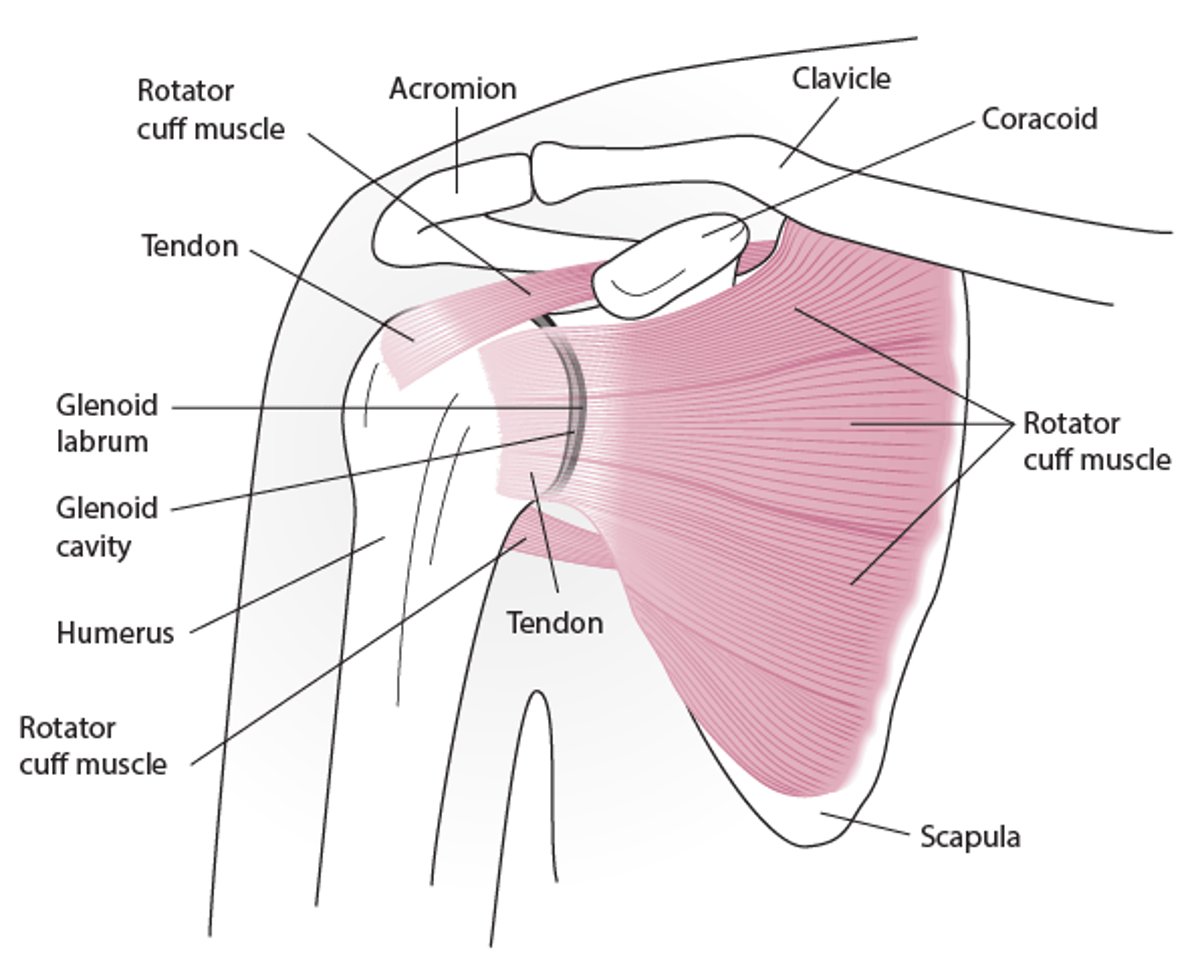
The shoulder is a ball-and-socket joint (so is the hip joint). The ball at the top (head) of the upper arm bone (humerus) fits into the socket of the shoulder blade (scapula), and the ball-and-socket joint allows the arm to move in all directions. The rotator cuff consists of the muscles that attach the shoulder blade to the head of the humerus. The rotator cuff strengthens the shoulder joint and helps rotate the upper arm.
The glenoid labrum is a lip of strong connective tissue at the rim of the socket of the shoulder joint. The labrum helps keep the ball securely in the socket.
Doctors can often diagnose the cause of a shoulder injury based on the physical examination. However, sometimes x-rays or magnetic resonance imaging (MRI) are needed.
Many shoulder injuries resolve with rest followed by rehabilitation exercises. Nonsteroidal anti-inflammatory drugs (NSAIDs, such as ibuprofen) may also be used for short-term pain relief. If pain persists, the person should be referred to a specialist to determine if additional treatment (for example, steroid [sometimes also called glucocorticoid or corticosteroid] injection or surgery) is needed.

1. Lie on stomach with involved arm hanging off edge of bed with thumb pointed out away from body.
2. Keep elbow straig
Courtesy of Tomah Memorial Hospital, Department of Physical Therapy, Tomah, WI; Elizabeth C.K. Bender, MSPT, ATC, CSCS; and Whitney Gnewikow, DPT, ATC.

1. Lie on uninvolved side with pillow between arm and body on the involved side.
2. Bend involved elbow to 90°.
3. Sque
Courtesy of Tomah Memorial Hospital, Department of Physical Therapy, Tomah, WI; Elizabeth C.K. Bender, MSPT, ATC, CSCS; and Whitney Gnewikow, DPT, ATC.

1. Lie on stomach with involved arm down off edge of table and thumb pointed out away from body.
2. Squeeze shoulder bl
Courtesy of Tomah Memorial Hospital, Department of Physical Therapy, Tomah, WI; Elizabeth C.K. Bender, MSPT, ATC, CSCS; and Whitney Gnewikow, DPT, ATC.

1. Lie on stomach on bed with involved arm out to the side, off edge of bed and elbow bent to 90° with thumb toward the
Courtesy of Tomah Memorial Hospital, Department of Physical Therapy, Tomah, WI; Elizabeth C.K. Bender, MSPT, ATC, CSCS; and Whitney Gnewikow, DPT, ATC.

1. Begin with arm at side, keep elbow straight and thumb up.
2. Move arm forward approximately 30°.
3. In this positi
Courtesy of Tomah Memorial Hospital, Department of Physical Therapy, Tomah, WI; Elizabeth C.K. Bender, MSPT, ATC, CSCS; and Whitney Gnewikow, DPT, ATC.

1. Place one end of elastic band to a secure object at waist level.
2. Place pillow or towel roll between elbow and bod
Courtesy of Tomah Memorial Hospital, Department of Physical Therapy, Tomah, WI; Elizabeth C.K. Bender, MSPT, ATC, CSCS; and Whitney Gnewikow, DPT, ATC.

1. Place one end of elastic band to a secure object at waist level.
2. Place pillow or towel roll between elbow and bod
Courtesy of Tomah Memorial Hospital, Department of Physical Therapy, Tomah, WI; Elizabeth C.K. Bender, MSPT, ATC, CSCS; and Whitney Gnewikow, DPT, ATC.

1. Hold weight in hand on involved side.
2. Slightly bend hips and knees and support upper body with other hand placed
Courtesy of Tomah Memorial Hospital, Department of Physical Therapy, Tomah, WI; Elizabeth C.K. Bender, MSPT, ATC, CSCS; and Whitney Gnewikow, DPT, ATC.


1. Lie on stomach with involved arm hanging off edge of bed with thumb pointed out away from body.
2. Keep elbow straight and extend arm to trunk level while squeezing the scapula down and back.
3. Return to starting position.
4. Do 3 sets of 10 repetitions.
5. Add light weight as tolerated.
Courtesy of Tomah Memorial Hospital, Department of Physical Therapy, Tomah, WI; Elizabeth C.K. Bender, MSPT, ATC, CSCS; and Whitney Gnewikow, DPT, ATC.

1. Lie on uninvolved side with pillow between arm and body on the involved side.
2. Bend involved elbow to 90°.
3. Squeeze the shoulder blade toward spine and downward.
4. Move forearm up by rotating at the shoulder, so the back of the hand is up toward the ceiling.
5. Slowly return to start position and repeat.
6. Do 3 sets of 10 repetitions, 1 time a day.
7. Add light weight as tolerated.
Courtesy of Tomah Memorial Hospital, Department of Physical Therapy, Tomah, WI; Elizabeth C.K. Bender, MSPT, ATC, CSCS; and Whitney Gnewikow, DPT, ATC.

1. Lie on stomach with involved arm down off edge of table and thumb pointed out away from body.
2. Squeeze shoulder blade toward spine and downward.
3. Lift arm upward to shoulder level.
4. Lower arm toward the floor and repeat.
5. Do 3 sets of 10 repetitions, 1 time a day.
6. Special instructions
a. Do not let shoulder blade move when lifting arm.
b. Keep thumb facing up toward the ceiling.
Courtesy of Tomah Memorial Hospital, Department of Physical Therapy, Tomah, WI; Elizabeth C.K. Bender, MSPT, ATC, CSCS; and Whitney Gnewikow, DPT, ATC.

1. Lie on stomach on bed with involved arm out to the side, off edge of bed and elbow bent to 90° with thumb toward the body.
2. Squeeze shoulder blade toward spine and downward.
3. Rotate forearm upward.
4. Return to start position and repeat.
5. Do 3 sets of 10 repetitions, 1 time a day.
6. Special instructions
a. Do not let shoulder blade move when lifting forearm.
Courtesy of Tomah Memorial Hospital, Department of Physical Therapy, Tomah, WI; Elizabeth C.K. Bender, MSPT, ATC, CSCS; and Whitney Gnewikow, DPT, ATC.

1. Begin with arm at side, keep elbow straight and thumb up.
2. Move arm forward approximately 30°.
3. In this position raise arm up staying in a pain-free range.
4. Return to starting position.
5. Do 3 sets of 10 repetition, 1 time a day.
6. Add light weight as tolerated.
Courtesy of Tomah Memorial Hospital, Department of Physical Therapy, Tomah, WI; Elizabeth C.K. Bender, MSPT, ATC, CSCS; and Whitney Gnewikow, DPT, ATC.

1. Place one end of elastic band to a secure object at waist level.
2. Place pillow or towel roll between elbow and body on involved side.
3. Grasp band in involved hand, with elbow bent to 90° and thumb up.
4. Externally rotate arm, then slowly return to start position.
5. Do 3 sets of 10 repetitions, 1 time a day.
6. Special instructions
a. Start with least resistance band.
b. Keep arm at side and elbow flexed at 90°.
Courtesy of Tomah Memorial Hospital, Department of Physical Therapy, Tomah, WI; Elizabeth C.K. Bender, MSPT, ATC, CSCS; and Whitney Gnewikow, DPT, ATC.

1. Place one end of elastic band to a secure object at waist level.
2. Place pillow or towel roll between elbow and body on involved side.
3. Grasp band with involved hand, with elbow bent to 90° and thumb up.
4. Internally rotate arm (pull hand inward across body), then slowly return to start position.
5. Do 3 sets of 10 repetitions, 1 time a day.
6. Special instructions
a. Start with least resistance band.
b. Keep arm at side and elbow flexed at 90°.
Courtesy of Tomah Memorial Hospital, Department of Physical Therapy, Tomah, WI; Elizabeth C.K. Bender, MSPT, ATC, CSCS; and Whitney Gnewikow, DPT, ATC.

1. Hold weight in hand on involved side.
2. Slightly bend hips and knees and support upper body with other hand placed on table or bed.
3. Bend elbow to 90° and raise elbow to shoulder height by retracting (squeezing) the scapula.
4. Return to start position.
5. Do 3 sets of 10 repetitions, 1 time a day.
6. Special instructions
a. Start with 1 to 2 pound (0.5 to 1 kg) weight (ie, a soup can).
Courtesy of Tomah Memorial Hospital, Department of Physical Therapy, Tomah, WI; Elizabeth C.K. Bender, MSPT, ATC, CSCS; and Whitney Gnewikow, DPT, ATC.
Drug Information for the Topic