Bullous pemphigoid is an autoimmune disease that causes blistering of the skin.
Bullous pemphigoid is an autoimmune disorder that occurs when the immune system attacks the skin and causes blistering.
People develop large, itchy blisters with areas of inflamed skin.
Doctors can diagnose bullous pemphigoid by examining skin samples under a microscope and checking for certain antibody deposits.
Treatment involves steroids (sometimes also known as glucocorticoids or corticosteroids) and medications that suppress the immune system.
(See also Overview of Blistering Disorders.)
The body's immune system makes special cells that protect the body against harmful foreign invaders such as bacteria and viruses. Some of these cells respond to invaders by producing proteins called antibodies. Antibodies target and attach to the invaders and attract other cells in the immune system to destroy them. In an autoimmune disorder, the body’s immune system mistakenly attacks the body’s own tissues—in this case, the skin. The antibodies that are produced mistakenly target the tissues as invaders, which makes them susceptible to destruction.
Bullous pemphigoid occurs more often in people over age 60 but can occur in children. It is a less serious disease than pemphigus vulgaris (which also causes blistering), is not usually fatal, and does not result in widespread peeling of skin. It can involve a large portion of the skin, however, and can be very uncomfortable.
Although the cause of bullous pemphigoid is unknown, physical causes (such as radiation therapy for breast cancer and ultraviolet radiation), skin disorders (such as psoriasis, lichen planus, and some infections), and certain other disorders (such as diabetes, rheumatoid arthritis, ulcerative colitis, and multiple sclerosis) may trigger an autoimmune attack on the skin. Bullous pemphigoid has also been associated with the use of some medications:
Vildagliptin
Linagliptin
Durvalumab
Nivolumab
Pembrolizumab
Furosemide
Spironolactone
Sulfasalazine
Risperidone
Quetiapine
Penicillin
Penicillamine
Etanercept
Symptoms of Bullous Pemphigoid
Itching is often the first symptom of bullous pemphigoid. Blisters may not appear for several years. Before blisters appear, large, raised areas may develop, sometimes looking like hives. The immune system eventually forms antibodies directed against the skin, resulting in large, tense, and very itchy blisters surrounded by areas of normal-appearing skin or red, inflamed skin. The blisters usually do not burst, but those that do often rapidly heal.
Blisters commonly develop on the parts of the body that are able to flex, such as the backs of the knees, the underarms, the insides of the elbows, and the groin. They sometimes develop on areas of skin that have been injured, the anus or genitals, the lower legs, and on areas where an artificial opening to the outside of the body (such as a stoma in the abdomen) exists. A rare form of bullous pemphigoid affects the hands and feet and can look like a form of hand and foot dermatitis. Blisters in the mouth are rare.

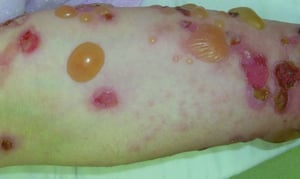
This photo shows blisters, sores, and crusts on the arm of a person with bullous pemphigoid.
This photo shows blisters, sores, and crusts on the arm of a person with bullous pemphigoid.
© Springer Science+Business Media

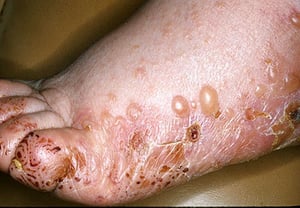
Blisters, some of which have broken and become crusted, and red, swollen skin are seen on the foot. These findings are typical of bullous pemphigoid.
Blisters, some of which have broken and become crusted, and red, swollen skin are seen on the foot. These findings are
Photo provided by Thomas Habif, MD.

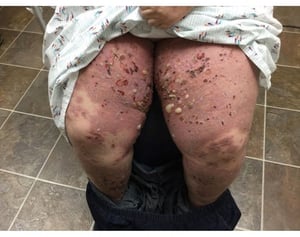
This photo shows broken and unbroken blisters on red and inflamed skin on the legs of a person who has bullous pemphigoid.
This photo shows broken and unbroken blisters on red and inflamed skin on the legs of a person who has bullous pemphigo
Photo courtesy of Daniel M. Peraza, MD.

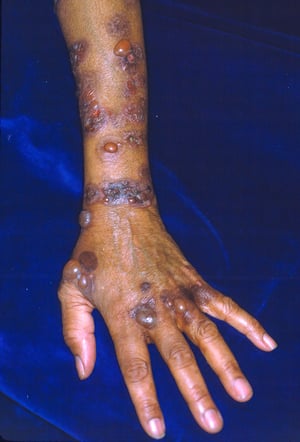
This photo shows tense fluid-filled blisters, erosions (raw patches where blisters have peeled off), and dark spots in affected areas on the arm of a person with bullous pemphigoid.
This photo shows tense fluid-filled blisters, erosions (raw patches where blisters have peeled off), and dark spots in
Photo courtesy of Karen McKoy, MD.
This photo shows blisters, sores, and crusts on the arm of a person with bullous pemphigoid.
This photo shows blisters, sores, and crusts on the arm of a person with bullous pemphigoid.
© Springer Science+Business Media
Blisters, some of which have broken and become crusted, and red, swollen skin are seen on the foot. These findings are typical of bullous pemphigoid.
Blisters, some of which have broken and become crusted, and red, swollen skin are seen on the foot. These findings are
Photo provided by Thomas Habif, MD.
This photo shows broken and unbroken blisters on red and inflamed skin on the legs of a person who has bullous pemphigoid.
This photo shows broken and unbroken blisters on red and inflamed skin on the legs of a person who has bullous pemphigo
Photo courtesy of Daniel M. Peraza, MD.
This photo shows tense fluid-filled blisters, erosions (raw patches where blisters have peeled off), and dark spots in affected areas on the arm of a person with bullous pemphigoid.
This photo shows tense fluid-filled blisters, erosions (raw patches where blisters have peeled off), and dark spots in
Photo courtesy of Karen McKoy, MD.
Diagnosis of Bullous Pemphigoid
A doctor's evaluation
Skin biopsy
Blood tests
Doctors usually recognize bullous pemphigoid by its characteristic blisters. However, it is not always easy to distinguish it from pemphigus vulgaris and other blistering conditions, such as severe poison ivy.
Bullous pemphigoid is diagnosed with certainty by examining under a microscope a sample of skin taken from in and around a blister (skin biopsy). Sometimes doctors use special chemical stains that allow antibody deposits to be seen under the microscope (called an immunofluorescence assay). Doctors differentiate bullous pemphigoid from pemphigus vulgaris and other blistering disorders by noting the layers of skin involved and the particular appearance of antibody deposits.
Blood testing of certain antibodies can help doctors confirm the diagnosis of bullous pemphigoid.
Treatment of Bullous Pemphigoid
Steroids (sometimes also known as glucocorticoids or corticosteroids) (in cream or pill form)
Sometimes other medications, including immunosuppressants for people with severe disease
Initially, doctors give people potent steroid creams, such as clobetasol, to apply directly to the skin. These creams may reduce the need for medications taken by mouth. People who have blisters on large portions of skin often need the steroid prednisone taken by mouth, which is gradually reduced (tapered) after several weeks. Most people are symptom-free after 2 to 10 months, but treatment may need to be continued for several years before it can be stopped completely.
In order to limit long-term exposure to steroids, doctors often use other medications to control the condition. For example, sometimes the combination of nicotinamide and either minocycline or doxycycline is used successfully to treat bullous pemphigoid. There is also an injectable medication (dupilumab) that is often very effective for treating bullous pemphigoid, but it can be difficult to obtain due to cost and some people prefer to avoid an injectable drug. Other medications that suppress the immune system, such as methotrexate, azathioprine, mycophenolate mofetil, rituximab, omalizumab, or cyclophosphamide, are given to people with severe disease that does not respond to other treatment.
Although some skin care, such as keeping the affected areas clean to prevent infection and perhaps wearing loose-fitting clothes, may be needed, most people do not require hospitalization for intensive skin care treatment.
Prognosis for Bullous Pemphigoid
Bullous pemphigoid is a chronic disease. Although medications are helpful, they may cause side effects.
With treatment, symptoms typically go away within months, but treatment is sometimes needed for several years.
More Information
The following English language resource may be useful. Please note that The Manual is not responsible for the content of this resource.
Drug Information for the Topic