The skin of the eyelids is a common site for benign and malignant growths.
Xanthelasma

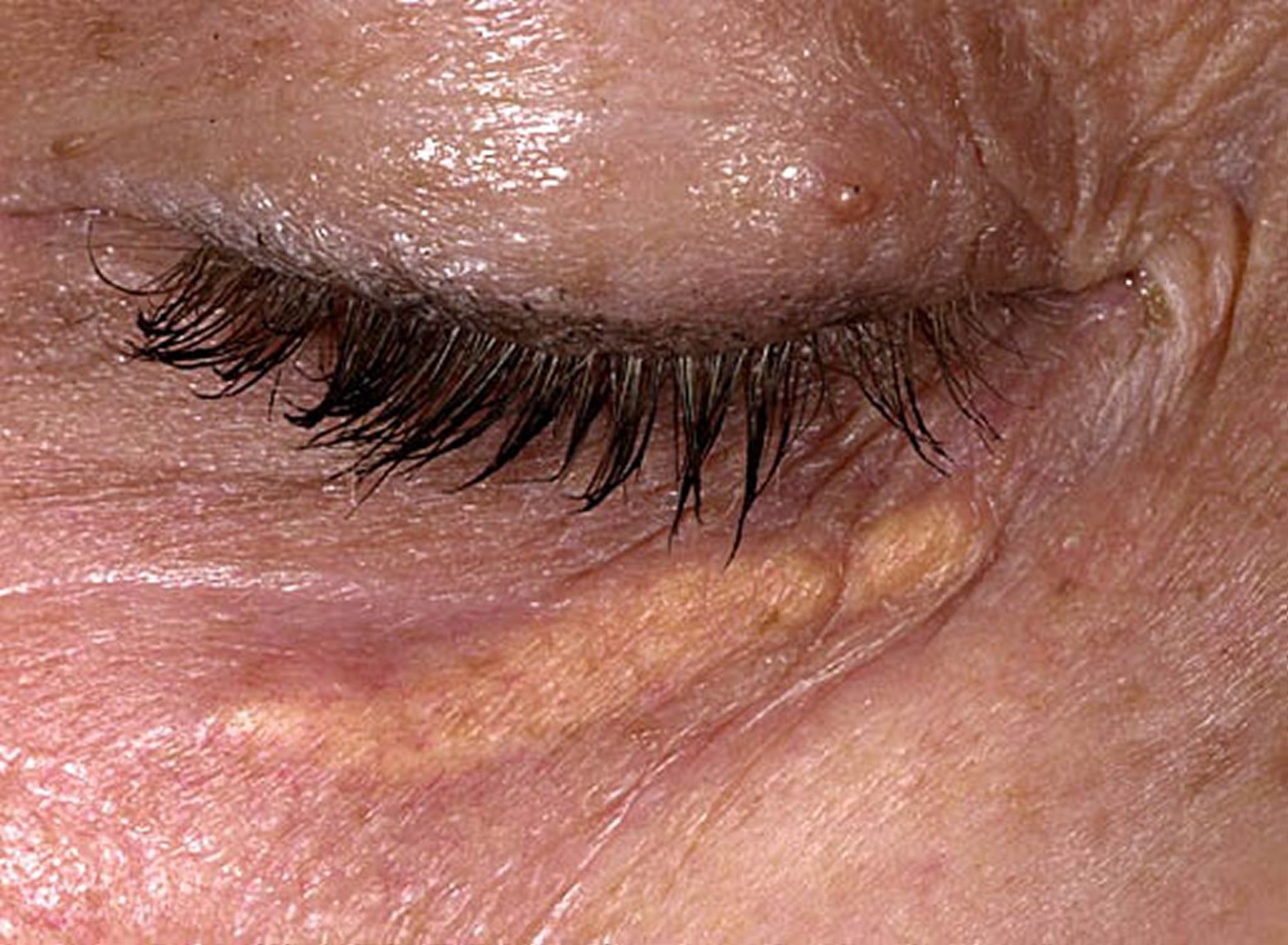
A xanthelasma is a slightly raised, yellow-white, well-circumscribed plaque that typically appears along the nasal aspect of one or both eyelids.
Image provided by Thomas Habif, MD.
Xanthelasma is a common, benign deposit of yellow-white flat plaques of lipid material that occur subcutaneously on the upper and lower eyelids. Some patients with xanthelasmas also have dyslipidemias although the association is unclear (1, 2). Diagnosis is by appearance. No treatment is necessary, although xanthelasmas can be removed for cosmetic reasons, and underlying dyslipidemias should be treated.
Basal cell carcinoma

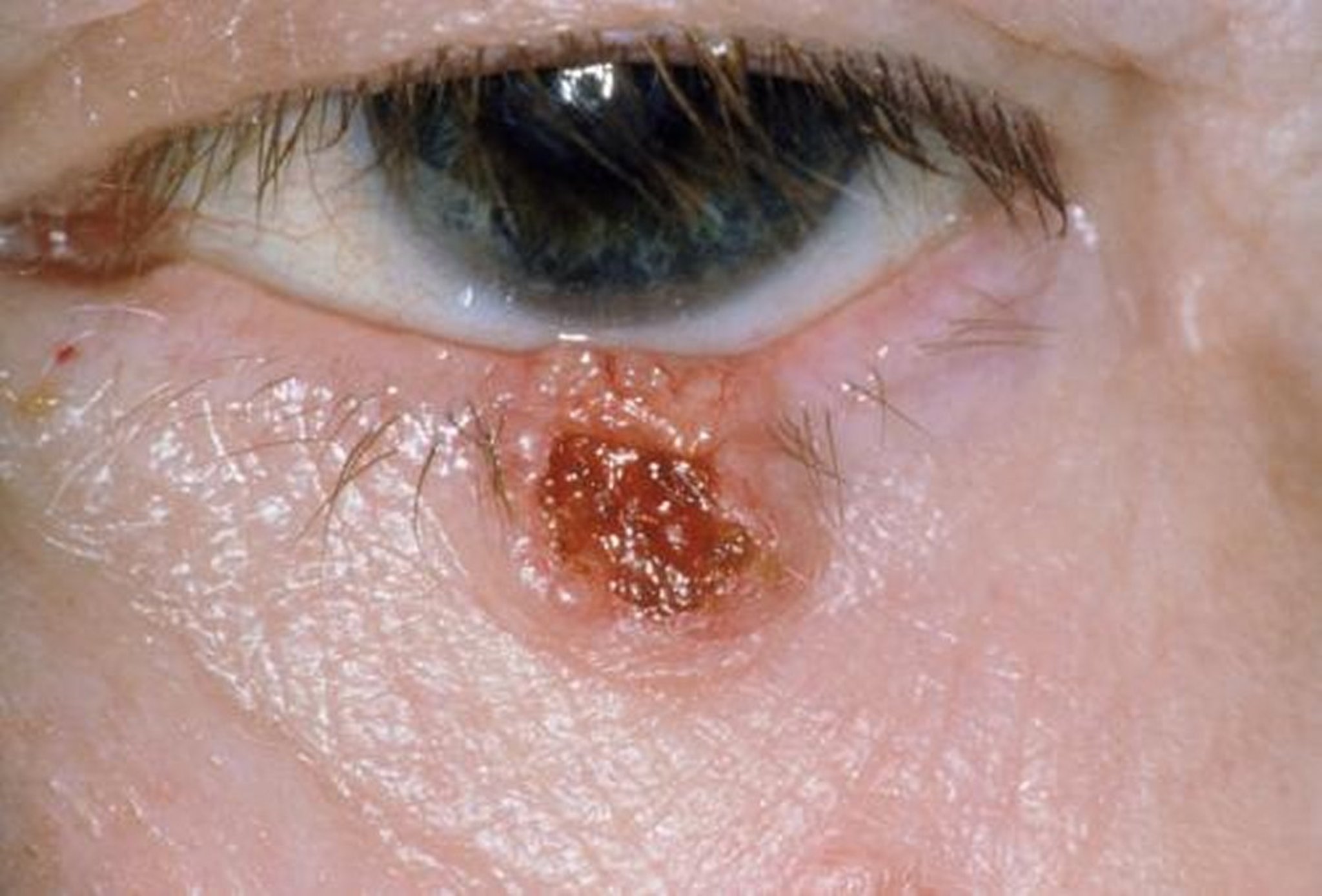
This photo shows a rounded, erythematous, and ulcerated basal cell carcinoma on the lower eyelid. The loss of lashes of the lower lid is common in patients with eyelid cancers.
RALPH C. EAGLE, JR/SCIENCE PHOTO LIBRARY
Basal cell carcinoma frequently occurs at the lower eyelid margin and classically is associated with loss of eyelashes as shown, at the inner canthus, and on the upper cheek. Metastasis is rare. Biopsy establishes the diagnosis.
Treatment is surgical excision using conventional techniques or by Mohs surgery. For locally advanced or metastatic basal cell carcinoma, treatment with small-molecule inhibitors of the Hedgehog signaling pathway (eg, vismodegib or sonidegib) may be considered in selected patients to avoid resection of the globe and disfiguring surgery (Treatment is surgical excision using conventional techniques or by Mohs surgery. For locally advanced or metastatic basal cell carcinoma, treatment with small-molecule inhibitors of the Hedgehog signaling pathway (eg, vismodegib or sonidegib) may be considered in selected patients to avoid resection of the globe and disfiguring surgery (3, 4).
Other malignant growths
Other types of malignant growths are less common; they include squamous cell carcinoma, sebaceous gland carcinoma, and melanoma. Eyelid growths may simulate chronic blepharitis or chronic chalazion. Therefore, chronic blepharitis, chronic chalazion, or similar lesions should be biopsied if the patient is unresponsive to initial treatment.
General references
1. Lustig-Barzelay Y, Kapelushnik N, Goldshtein I, et al. Association Between Xanthelasma Palpebrarum with Cardiovascular Risk and Dyslipidemia: A Case Control Study. Ophthalmology. 2025 Feb;132(2):164-169. doi: 10.1016/j.ophtha.2024.07.033.8.
2. Chang HC, Sung CW, Lin MH. Serum lipids and risk of atherosclerosis in xanthelasma palpebrarum: A systematic review and meta-analysis. J Am Acad Dermatol. 2020 Mar;82(3):596-605. doi: 10.1016/j.jaad.2019.08.082. Epub 2019 Sep 6. PMID: 31499151.
3. Allen RC: Surgical management of periocular cancers: High- and low-risk features drive treatment. Curr Oncol Rep 19(9):57, 2017. doi: 10.1007/s11912-017-0618-1
4. Wladis EJ, Aakalu VK, Vagefi MR, et al. Oral Hedgehog Inhibitor, Vismodegib, for Locally Advanced Periorbital and Orbital Basal Cell Carcinoma: A Report by the American Academy of Ophthalmology. Ophthalmology. 2024 Nov;131(11):1339-1344. doi: 10.1016/j.ophtha.2024.06.007. E. Oral Hedgehog Inhibitor, Vismodegib, for Locally Advanced Periorbital and Orbital Basal Cell Carcinoma: A Report by the American Academy of Ophthalmology. Ophthalmology. 2024 Nov;131(11):1339-1344. doi: 10.1016/j.ophtha.2024.06.007. E