Canaliculitis is infection or inflammation of the canaliculus. Symptoms and signs include unilateral mucopurulent discharge, tearing, red eye (especially medially), and mild tenderness over the involved side. Diagnosis is usually clinical. Treatment usually requires surgery to remove canalicular concretions and infected material, often combined with supportive measures (eg, warm compresses) and antibiotics.
Анатомія слізної системи

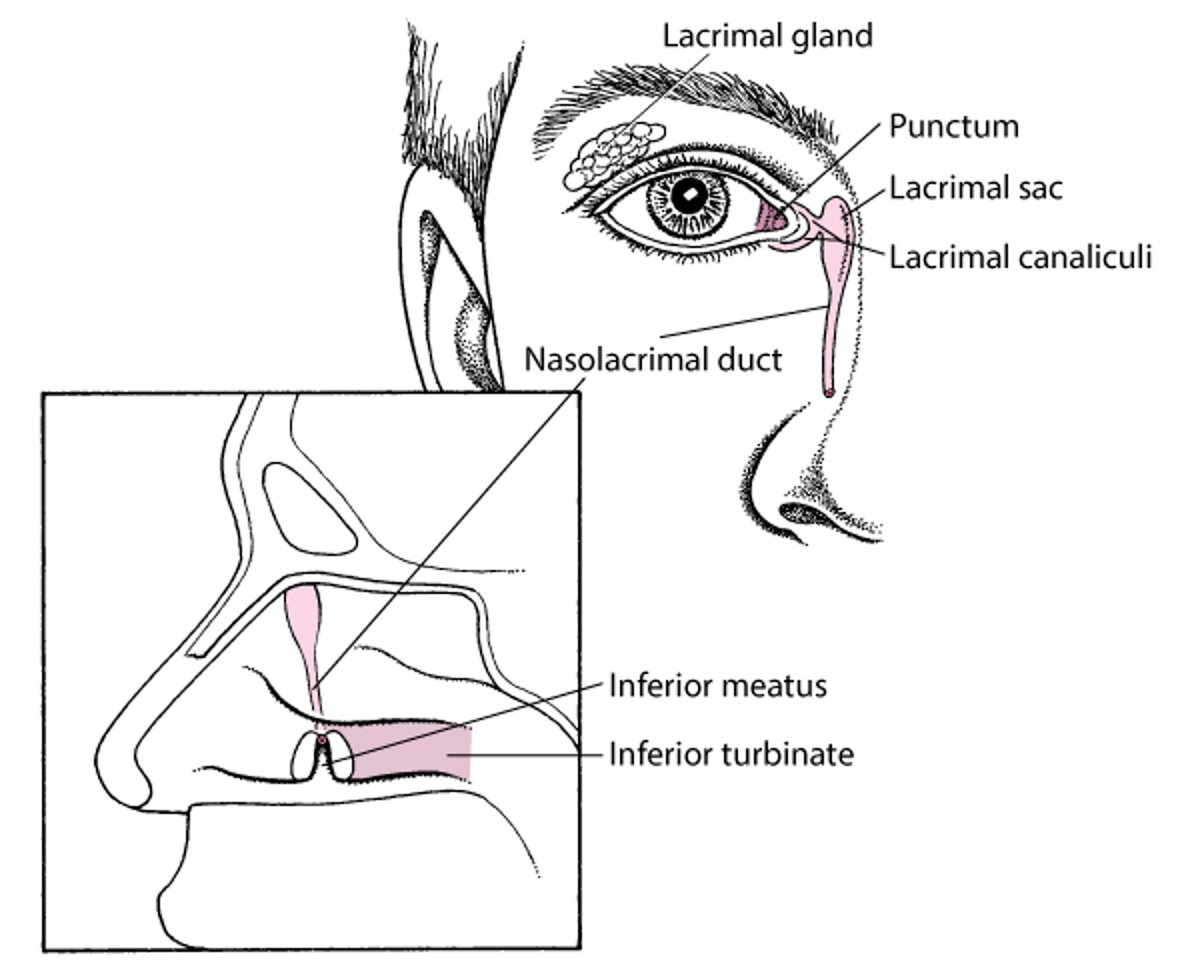
Etiology of Canaliculitis
The most common cause of canaliculitis is infection with Actinomyces israelii, a gram-positive bacillus with fine branching filaments, but other bacteria, fungi (eg, Candida albicans), and viruses (eg, herpes simplex) may be causative (1). An increasingly common cause of canaliculitis is a retained punctal plug (inserted as treatment for dry eyes) that has migrated into the canaliculus from the punctum.
Довідковий матеріал щодо етіології
1. Freedman JR, Markert MS, Cohen AJ. Primary and secondary lacrimal canaliculitis: a review of literature. Surv Ophthalmol. 2011 Jul-Aug;56(4):336-47. doi: 10.1016/j.survophthal.2010.12.001. Epub 2011 May 28.
Symptoms and Signs of Canaliculitis
Symptoms and signs are tearing, discharge, red eye (especially medially), and mild tenderness over the involved side.
Diagnosis of Canaliculitis
History and physical examination alone
Diagnosis is suspected based on symptoms and signs, expression of turbid secretions with pressure over the lacrimal sac and canaliculus, and a gritty sensation caused by necrotic material that can be felt during probing of the lacrimal system.


In this photo, mucopurulent discharge is expressed through the punctum with palpation over the erythematous canaliculus.
Photo courtesy of Richard C. Allen, MD, PhD.
Canaliculitis can be differentiated from dacryocystitis. In canaliculitis, the punctum and canaliculus are erythematous and swollen; in dacryocystitis, the punctum and canaliculus are normal, but an erythematous, swollen, tender mass is located in or near the lacrimal sac.
Treatment of Canaliculitis
Supportive measures (eg, warm compresses)
Antibiotics
Surgery to remove concretions or foreign bodies
Treatment of canaliculitis is warm compresses, irrigation of the canaliculus with antibiotic solution, and removal of any concretions or foreign bodies, which usually requires surgery (often performed in the office with a local anesthetic) (1). Antibiotic selection is usually empiric with a first-generation cephalosporin or penicillinase-resistant synthetic penicillin but may be guided by culture of irrigation samples. Surgical canaliculotomy is usually curative.
Довідковий матеріал щодо лікування
1. Freedman JR, Markert MS, Cohen AJ: Primary and secondary lacrimal canaliculitis: A review of literature. Surv Ophthalmol 56(4):336-347, 2011. doi: 10.1016/j.survophthal.2010.12.001
Ключові моменти
Common causes of canaliculitis are infection or retained punctal plug.
Patients often have tearing, discharge, red eye (especially medially), and mild tenderness over the involved side.
On examination, secretions may be expressed when pressure is applied to the lacrimal sac and canaliculus and a gritty sensation is felt by the patient when the lacrimal system is probed.
Treatment includes supportive measures, such as warm compresses, and antibiotics, but surgery is usually necessary.