Pseudoxanthoma elasticum is a rare genetic disorder characterized by calcification of the elastic fibers of the skin, retina, and cardiovascular system. Diagnosis is clinical, histopathologic, and genetic. There is no curative treatment. Intravitreal injections of angiogenesis-blocking antibodies may be given for angioid streaks. Lipid-lowering therapy and cardiovascular risk reduction are important.
Pseudoxanthoma elasticum is caused by mutations in the ABCC6 gene that are inherited in both autosomal dominant and autosomal recessive forms. The ABCC6 gene product is a transmembrane transporter protein that probably plays a role in cellular detoxification. The lack of function of this protein leads to ectopic mineralization, which is the hallmark of pseudoxanthoma elasticum.
Characteristic cutaneous papular lesions begin in childhood and are primarily of cosmetic concern. They appear as small yellowish papules that typically occur on the neck and axillae and flexural surfaces. Elastic tissues become calcified and fragmented, leading to disruption of the involved organ systems (1):
Ocular system: Angioid streaks of the retina, retinal hemorrhages, and gradual vision loss
Cardiovascular system: Premature atherosclerosis with subsequent intermittent claudication, hypertension, angina, myocardial infarction, and mitral valve prolapse
Vascular fragility: Gastrointestinal hemorrhage and small-vessel bleeding with subsequent anemia

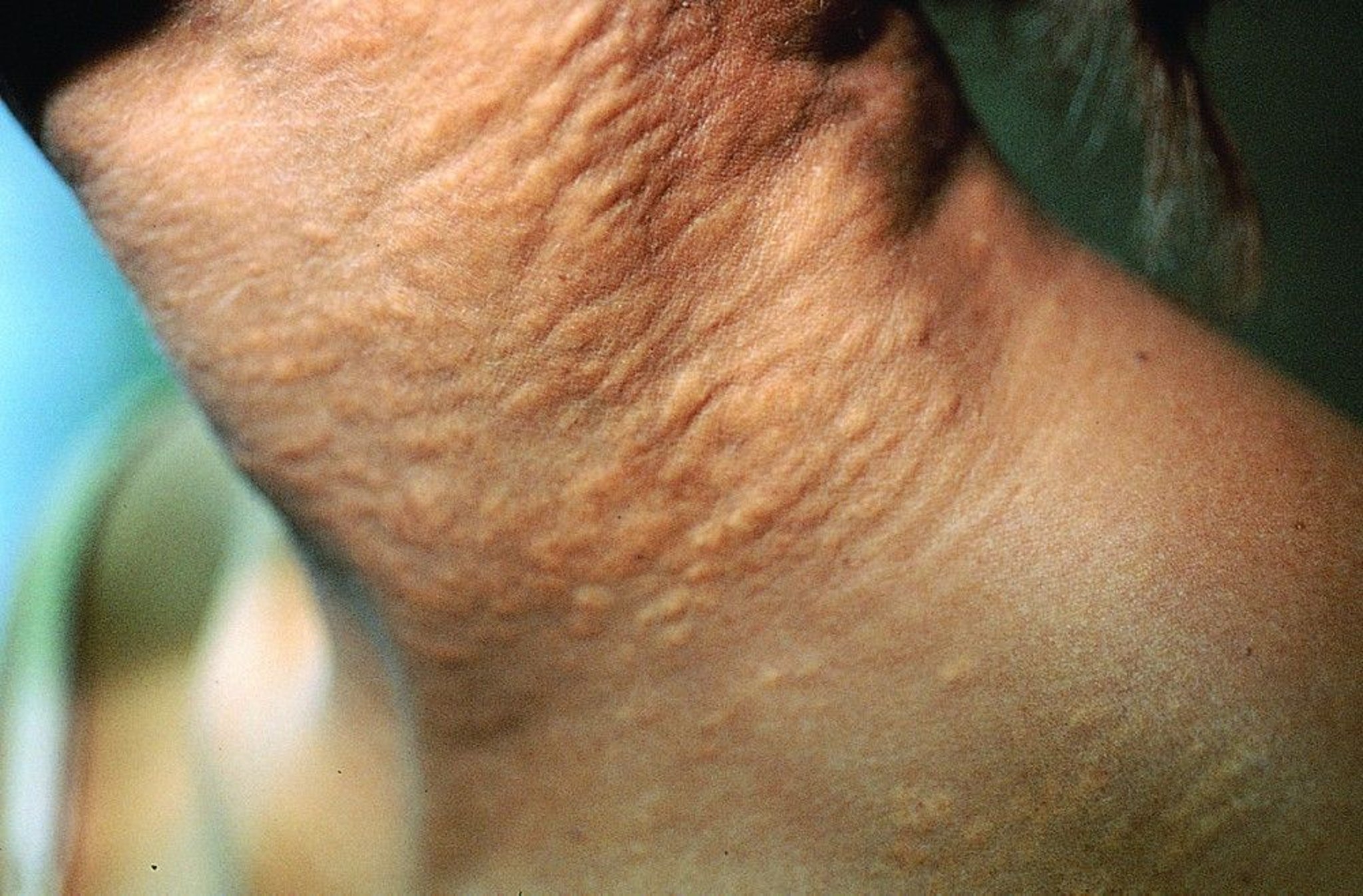
This photo shows yellowish papules along the side of the neck in a patient with pseudoxanthoma elasticum, giving a "plucked chicken" appearance.
© Springer Science+Business Media

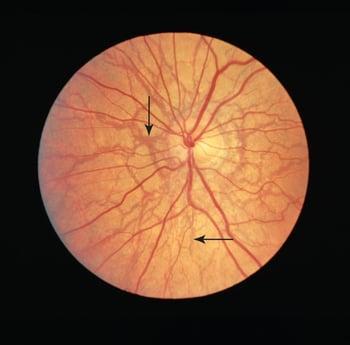
Red retinal blood vessels are seen entering the retina from the yellow optic disc (center right). Beneath these blood vessels are dark, wavy, branching striae called angioid streaks (arrows).
General reference
1. Brokamp G, Mori M, Faith EF. Pseudoxanthoma Elasticum. JAMA Dermatol. 2022;158(1):100. doi:10.1001/jamadermatol.2021.4059
Diagnosis of Pseudoxanthoma Elasticum
Clinical evaluation
Histopathologic and genetic confirmation
Diagnosis of pseudoxanthoma elasticum is based on clinical, histologic, and genetic findings. Skin biopsy shows calcification and fragmentation of elastic fibers. Genetic testing can detect the causative mutation.
Laboratory and imaging studies are performed for associated conditions, eg, complete blood count for anemia resulting from GI bleeding, lipid panel, coronary CT for prevention/detection of coronary artery disease, and cerebrovascular and brain imaging to detect cerebrovascular disease and stroke.
Differential diagnosis includes calcium fertilizer exposure, extended penicillamine use, localized acquired pseudoxanthoma elasticum (related to obesity, hypertension, and multiparity), or pseudoxanthoma-like disorder with coagulation deficiencies.
Treatment of Pseudoxanthoma Elasticum
Cardiovascular risk reduction including lipid-lowering medication
Angiogenesis-blocking antibodies for angioid streaks
Intravitreal injections of angiogenesis-blocking antibodies (eg, bevacizumab) show promise as a treatment option for retinal angioid streaks (1).
Otherwise, there is no specific treatment, and the aim is to prevent complications. People should avoid medications that may cause stomach or intestinal bleeding, such as aspirin, other nonsteroidal anti-inflammatory drugs, and anticoagulants (2). Blood lipid levels should be well controlled to reduce risk of premature atherosclerosis and associated vascular complications. People with pseudoxanthoma elasticum should avoid contact sports because of the risk of retinal hemorrhage. Patients should have follow-up ophthalmologic and cardiovascular evaluations.
Patients with pseudoxanthoma elasticum who become pregnant should undergo retinal examination to evaluate for choroidal neovascularization; if present, elective cesarean section should be considered (2, 3). Otherwise, the disease does not seem to affect pregnancy, and pregnancy does not affect disease course.
Complications may limit life span and impact quality of life.
Treatment references
1. Raming K, Pfau M, Herrmann P, Holz FG, Pfau K. Anti-VEGF Treatment for Secondary Neovascularization in Pseudoxanthoma Elasticum - Age of Onset, Treatment Frequency, and Visual Outcome. Am J Ophthalmol. 2024;265:127-136. doi:10.1016/j.ajo.2024.03.026
2. Terry SF, Uitto J. Pseudoxanthoma Elasticum. 2001 Jun 5 [Updated 2020 Jun 4]. In: Adam MP, Feldman J, Mirzaa GM, et al., editors. GeneReviews® [Internet]. Seattle (WA): University of Washington, Seattle; 1993-2025.
3. Bercovitch L, Leroux T, Terry S, Weinstock MA. Pregnancy and obstetrical outcomes in pseudoxanthoma elasticum. Br J Dermatol. 2004;151(5):1011-1018. doi:10.1111/j.1365-2133.2004.06183.x
Drug Information for the Topic