
Creutzfeldt-Jakob disease (CJD) is the most common human prion disease. It occurs worldwide and has several forms and subtypes. CJD symptoms include dementia, myoclonus, and other central nervous system deficits; death usually occurs between 4 months and 2 years after onset, depending on the CJD form and subtype. Treatment is supportive.
Creutzfeldt-Jakob disease has 3 forms (1):
Sporadic (sCJD)
Familial
Acquired
sCJD is the most common type, accounting for about 85% of cases (2). sCJD typically affects people > 40 years (median, about 65 years).
Familial CJD occurs in about 5 to 15% of cases. Inheritance is almost universally autosomal dominant; age at onset is usually earlier than that in sCJD, and on average disease duration can be longer depending on the specific mutation.


Acquired CJD probably accounts for < 1% of cases. It has occurred after the ingestion of beef contaminated by prions (in variant CJD [vCJD]). Iatrogenic CJD (iCJD) has been acquired via use of cadaveric corneal or dural transplants, stereotactic intracerebral electrodes, and growth hormone or gonadotropins prepared from human pituitary glands (3). Variant CJD has been demonstrated to be iatrogenically transmitted through exposure to blood, but no epidemiologic data suggest that other forms of CJD (or other prion diseases) are transmitted in this manner (4). About half of iCJD cases involve some changes similar to those of Alzheimer disease (5).
Variant CJD (vCJD)
vCJD is a rare acquired form of CJD. Primarily, vCJD occurs after ingestion of beef from cattle with bovine spongiform encephalopathy (BSE), also called mad cow disease.
In vCJD, symptoms develop at a younger average age (< 30 years) than in sCJD. The incubation period (time between ingestion of contaminated beef and development of symptoms) is believed to be at least 10 years (6).
Most cases have occurred in the United Kingdom, where the annual number of new cases of vCJD peaked in 2000 and has steadily declined with only 2 cases after 2011. As of 2023, there were a total of 233 cases worldwide, with most cases occurring in the United Kingdom (6).
In the early 1980s, contaminated tissue (probably from sheep infected with scrapie or cattle infected with BSE) introduced the scrapie prion protein (PrPSc) into cattle feed. Hundreds of thousands of cattle developed BSE. Despite widespread exposure, relatively few people who ate meat from affected cattle developed vCJD.
Because the incubation period in BSE is long, a connection between BSE and contaminated feed was not recognized in the United Kingdom until BSE had become an epidemic. The BSE epidemic came under control after a massive slaughter of cattle and after changes in the rendering procedures, which drastically reduced contamination of meat by nervous system tissue.
Two cases of vCJD resulting from blood transfusion have been documented in the United Kingdom, occurring before 1999 (7). In the United Kingdom, about 1/2000 people may carry vCJD (based on examination of a large number of appendix tissue samples) but have no symptoms (8); these people may transmit the disease if they donate blood or have a surgical procedure. Whether there is a latent pool of people who have received contaminated blood transfusions and who are thus at risk of later development of vCJD is unclear. However, blood donor referral criteria related to vCJD may have further reduced the very low risk of vCJD transmission by blood transfusion. Most countries, including the United States and the United Kingdom, have since rescinded blood donation deferral polices related to vCJD risk.
Although no case of vCJD originating in North America has been reported, BSE has been reported in North American cattle (6 in the United States and 20 in Canada [9]).
General references
1. Gambetti P, Kong Q, Zou W, et al. Sporadic and familial CJD: Classification and characterisation. Br Med Bull. 66(1):213-239, 2003. doi: https://doi.org/10.1093/bmb/66.1.213
2. Ladogana A, Puopolo M, Croes EA, et al. Mortality from Creutzfeldt-Jakob disease and related disorders in Europe, Australia, and Canada. Neurology. 64(9):1586-1591, 2005. doi: 10.1212/01.WNL.0000160117.56690.B2
3. Ritchie DL, Barria MA, Peden, AH, et al.UK Iatrogenic Creutzfeldt-Jakob disease: Investigating human prion transmission across genotypic barriers using human tissue-based and molecular approaches. Acta Neuropathol. 133(4):579-595, 2017. doi: 10.1007/s00401-016-1638-x
4. Crowder LA, Dodd RY, Schonberger LB. Absence of evidence of transfusion transmission risk of Creutzfeldt-Jakob disease in the United States: Results from a 28-year lookback study. Transfusion. 64(6):980-985, 2024. doi: 10.1111/trf.17837
5. Cali I, Cohen ML, Haik S, et al. Iatrogenic Creutzfeldt-Jakob disease with amyloid-β pathology: An international study. Acta Neuropathol Commun. 6(1):5, 2018. doi: 10.1186/s40478-017-0503-z
6. Centers for Disease Control and Prevention. Clinical Overview of Variant Cruetzfeldt-Jakob Disease. November 12, 2024. Accessed April 28, 2026.
7. Ludlam CA, Turner ML. Managing the risk of transmission of variant Creutzfeldt Jakob disease by blood products. Br J Haematol. 2006;132(1):13-24. doi:10.1111/j.1365-2141.2005.05796.x
8. Gill ON, Spencer Y, Richard-Loendt A, et al. Prevalence in Britain of abnormal prion protein in human appendices before and after exposure to the cattle BSE epizootic. Acta Neuropathol. 139(6):965-976, 2020. doi: 10.1007/s00401-020-02153-7
9. Centers for Disease Control and Prevention (CDC). Bovine Spongiform Encephalopathy (BSE). May 10, 2024. Accessed April 27, 2026.
Symptoms and Signs of Creutzfeldt-Jakob Disease
Most patients with Creutzfeldt-Jakob disease present with memory loss and confusion, which eventually develop in all patients (1); about a quarter of patients present with incoordination and ataxia, which often develop early in the disease. Myoclonus provoked by noise or other sensory stimuli (startle myoclonus) often develops in the middle to late stages of disease. People with vCJD present with psychiatric symptoms (eg, anxiety, depression), rather than memory loss. Later symptoms are similar in both forms.
Although dementia, ataxia, and myoclonus are most characteristic, other neurologic abnormalities (eg, hallucinations, seizures, neuropathy, various movement disorders) can occur.
Ocular disturbances (eg, visual field defects, diplopia, dimness or blurring of vision, visual agnosia) are common in sCJD.
Symptoms and signs reference
1. Appleby BS, Appleby KK, Crain BJ, et al. Characteristics of established and proposed sporadic Creutzfeldt-Jakob disease variants. Arch Neurol. 66(2):208-215, 2009. doi: 10.1001/archneurol.2008.533
Diagnosis of Creutzfeldt-Jakob Disease
Diffusion-weighted MRI
Markers in cerebrospinal fluid (CSF)
Periodic sharp wave complexes (PSWC) on electroencephalogram (EEG)
Exclusion of other disorders
Creutzfeldt-Jakob disease should be considered in older patients with rapidly progressive dementia, especially if accompanied by myoclonus or ataxia. However, other disorders can mimic CJD and must be considered; they include
Central nervous system (CNS) vasculitis
Rapidly progressive Alzheimer disease
Hashimoto encephalopathy (an autoimmune encephalopathy that is characterized by high thyroid antibody levels and that responds to glucocorticoids)
Intravascular lymphoma (a rare lymphoma)
Encephalitis that affects the limbic system, brain stem, and cerebellum
Intoxication with lithium or bismuth
CJD is suspected in symptomatic younger patients when they have been exposed to prion-contaminated beef in the United Kingdom or other at-risk countries or who have a family history of CJD (familial CJD). Rarely, sCJD develops in young patients, but other diseases must be excluded.
Diagnosis of CJD may be difficult.
The best noninvasive diagnostic test for CJD is
Diffusion-weighted MRI
It can detect evolving areas of hyperintensity (bright areas) in the cortical ribbon and/or basal ganglia, which strongly suggest CJD. Diffusion-weighted imaging (DWI) is the most sensitive MRI sequence for identifying these findings (1).

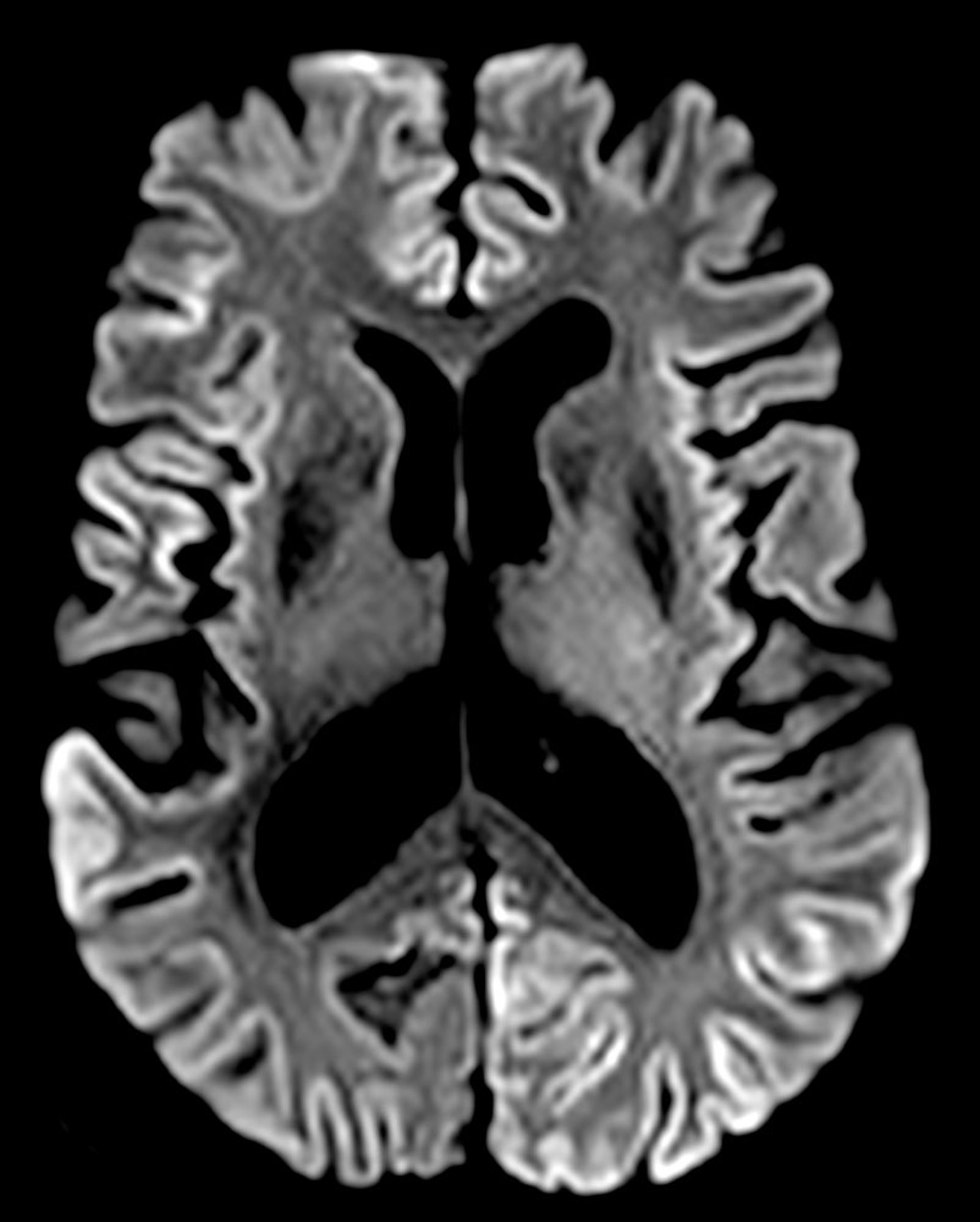
This diffusion-weighted MRI scan shows hyperintensity in the cortical ribbon of the cortices in a patient with prion disease.
Brian Appleby, MD
Proteins 14-3-3, brain-specific enolase, and tau are commonly increased in CSF but are not specific for CJD. A CSF test, called real-time quaking-induced conversion (RT-QuIC), amplifies and detects minimal amounts of prion activity in CSF; this test, more accurate than previous CSF tests, has a sensitivity of about 90% and a specificity of about 99% for prion diseases (2). A similar test can reliably detect evidence of vCJD by identifying prions in urine.
EEG can sometimes be helpful in diagnosis. Results are positive in about 65% of patients with CJD (3); EEG shows characteristic periodic sharp waves, but this pattern typically occurs late in the disease, may be transient, and does not occur in all cases of CJD.

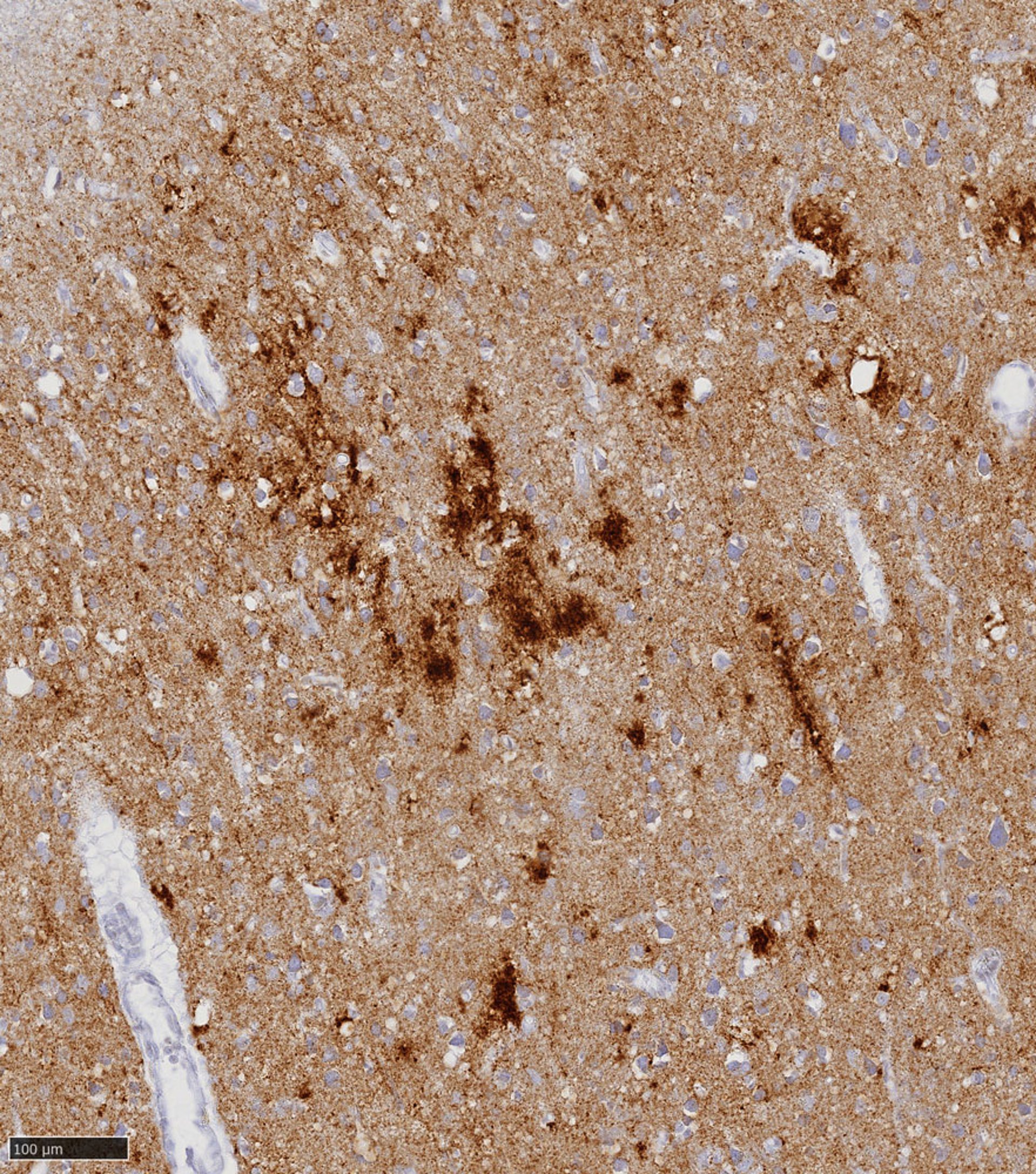
This image of immunohistochemical staining of the frontal cortex of a patient with sporadic Creutzfeldt-Jakob disease shows prion protein deposition (3F4 antibody).
Brian Appleby, MD
Brain biopsy is usually unnecessary and is only recommended if conditions other than prion diseases are being considered.
Diagnosis references
1. Bizzi A, Pascuzzo R, Blevins J, et al. Evaluation of a new criterion for detecting prion disease with diffusion magnetic resonance imaging. JAMA Neurol. 77(9):1141-1149, 2020. doi: 10.1001/jamaneurol.2020.1319
2. Foutz A, Appleby BS, Hamlin C, et al. Diagnostic and prognostic value of human prion detection in cerebrospinal fluid. Ann Neurol. 81(1):79-92, 2017. doi: 10.1002/ana.24833
3. Figgie MP Jr, Appleby BS. Clinical use of improved diagnostic testing for detection of prion disease. Viruses. 13(5):789, 2021. doi: 10.3390/v13050789
Treatment of Creutzfeldt-Jakob Disease
Supportive care
There is only supportive treatment for symptoms associated with CJD.
Prognosis for Creutzfeldt-Jakob Disease
Death typically occurs within 6 months, with survival shorter in older patients (1). Life expectancy in vCJD is longer (averaging 1.5 years).
Prognosis reference
1. Yaqub A, Menart AC, Hansen BE, Ikram MA. Life Expectancy for Patients With Sporadic Creutzfeldt-Jakob Disease. JAMA Neurol. 2025;82(10):1073-1075. doi:10.1001/jamaneurol.2025.2495
Prevention of Creutzfeldt-Jakob Disease
Because there is no effective treatment, prevention of transmissible CJD is essential.
Workers handling fluids and tissues from patients suspected of having CJD must wear gloves and avoid mucous membrane exposure (eg, universal precautions). Skin contaminated by central nervous system tissue can be disinfected by applying 4% sodium hydroxide for 5 to 10 minutes, followed by extensive washing with water.
Steam autoclaving at 132° C for 1 hour or immersion in sodium hydroxide 1 N (normal) or 10% sodium hypochlorite solution for 1 hour is recommended for materials that come in contact with central nervous system tissues of patients with suspected or confirmed CJD. Standard methods of sterilization (eg, exposure to formalin) are ineffective.
The US Department of Agriculture (USDA) currently carries out BSE surveillance.
Key Points
Creutzfeldt-Jakob disease (CJD) is the most common human prion disease; the sporadic form accounts for about 85% of cases.
Acquired CJD, which probably accounts for < 1% of CJD cases, can result from ingesting beef contaminated by prions (in variant CJD [vCJD]) or can be acquired iatrogenically (in iatrogenic CJD [iCJD]).
Most cases of vCJD have occurred in the United Kingdom (178 cases as of May 2022, with only 2 since 2011); 55 cases have occurred in all other European and non-European countries as of March 2026.
Most patients with CJD present with memory loss and confusion, which eventually develop in all patients; about 25% present with incoordination and ataxia.
Consider CJD in patients with rapidly progressive dementia, especially if they also have myoclonus or ataxia, and suspect it in patients who have been exposed to prion-contaminated beef or who have a family history of CJD.
Do diffusion-weighted MRI to check for areas of hyperintensity in the cortical ribbon and/or basal ganglia, which strongly suggest CJD; also consider doing an RT-QuIC test on CSF.
Death typically occurs within 6 months, but life expectancy in vCJD is longer, averaging 1.5 years.
Steam autoclaving or immersing contaminated materials in sodium hydroxide or sodium hypochlorite is recommended to prevent spread.
Drug Information for the Topic