Progressive supranuclear palsy is a rare, degenerative central nervous system disorder that progressively impairs voluntary eye movements and causes bradykinesia, muscular rigidity with progressive axial dystonia, pseudobulbar palsy, and dementia. Diagnosis is based on history and physical examination. Treatment focuses on relieving symptoms.
The cause of progressive supranuclear palsy is unknown.
Neurons in the basal ganglia and brain stem degenerate; neurofibrillary tangles containing an abnormally phosphorylated tau protein are present.
Symptoms and Signs of Progressive Supranuclear Palsy
Symptoms of progressive supranuclear palsy usually begin in late middle age.
The first symptom may be
Difficulty looking up or down without moving the neck or difficulty climbing up and down stairs
Voluntary eye movements, particularly downward gaze, become difficult, but vertical reflex eye movements triggered by passive head movement (neck flexion, extension) are unaffected.
Movements are slowed, muscles become rigid, and axial dystonia develops. Patients tend to fall backward.
Dysphagia, dysarthria with emotional lability (pseudobulbar palsy), depression, and disordered sleep are common. Resting tremor may develop.
Dementia eventually occurs. Many patients become incapacitated within approximately 5 years and die within approximately 10 years (1).
Progressive supranuclear palsy has several different clinical types based on the predominant symptoms or signs at diagnosis, although other features may develop as disease progresses (2):
PSP with Richardson syndrome (PSP-RS): Classic progressive supranuclear palsy with progressive supranuclear ophthalmoplegia and severe balance problems (the most common form, in ≥ 70% of cases)
PSP with predominant parkinsonism (PSP-P): Parkinsonian type of progressive supranuclear palsy, which has a modest response to levodopa, resulting in transient, slight improvement
PSP with ocular motor dysfunction (PSP-OM): Characterized by oculomotor abnormalities (eg, vertical supranuclear gaze palsy)
PSP with progressive gait freezing (PSP-PGF): Characterized by progressive gait freezing
PSP with predominant speech and language disorder (PSP-SL): Characterized by progressive nonfluent aphasia or speech or language disorders
PSP with predominant frontal presentation (PSP-F): Characterized by frontotemporal degeneration with cognitive impairment or behavioral change
PSP with predominant corticobasal syndrome (PSP-CBS): Characterized by corticobasal syndrome, causing profound asymmetric symptoms (eg, apraxia, dystonia, alien limb phenomena)
PSP with predominant primarily lateral sclerosis (PSP-PLS): Characterized by motoneuron symptoms related to primary lateral sclerosis
PSP with predominant cerebellar ataxia (PSP-C): Characterized by cerebellar signs
PSP with predominant postural instability (PSP-PI): Characterized by postural instability
In forms other than Richardson syndrome (ie, in nonclassical forms [called atypical parkinsonism]), ophthalmoplegia may be delayed by years.
The different clinical types of progressive supranuclear palsy have different characteristics (eg, parkinsonian features, corticobasal syndrome, speech problems, frontotemporal degenerative signs, akinesia, freezing of gait).
Symptoms and signs references
1. Cosseddu M, Benussi A, Gazzina S, et al. Natural history and predictors of survival in progressive supranuclear palsy. J Neurol Sci. 2017;382:105-107. doi:10.1016/j.jns.2017.09.043
2. Höglinger GU, Respondek G, Stamelou M, et al. Clinical diagnosis of progressive supranuclear palsy: The movement disorder society criteria. Mov Disord. 2017;32(6):853-864. doi:10.1002/mds.26987
Diagnosis of Progressive Supranuclear Palsy
History and physical examination
Diagnosis of progressive supranuclear palsy is based on the history and physical examination (1).
MRI is usually done to exclude other disorders. In advanced cases, MRI shows a characteristic decrease in midbrain size that is best seen on midsagittal views and that causes the midbrain to be shaped like a hummingbird or emperor penguin. On axial views, the midbrain may resemble a morning glory (2).

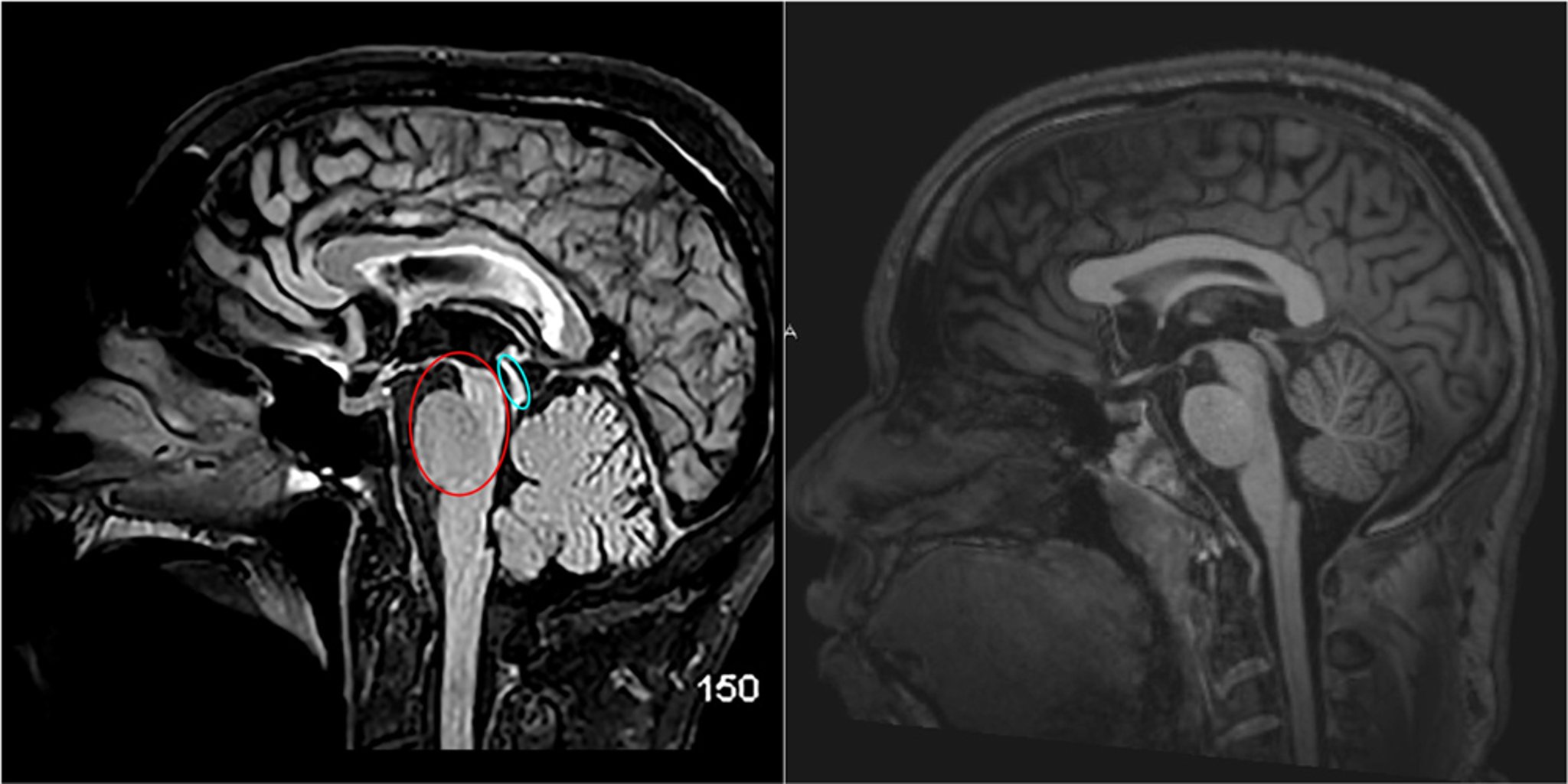
This sagittal T2-FLAIR (fluid-attenuating inversion recovery) MRI scan (left) shows typical findings in progressive supranuclear palsy (one of the Parkinson plus syndromes) with prominent midbrain atrophy, resulting in the hummingbird sign (red circle), in addition to atrophy of the upper tectal plate (blue circle).
A normal sagittal MRI scan of the brain is shown for comparison (right).
Left image: Living Art Enterprises/SCIENCE PHOTO LIBRARY
Right image: © 2017 Elliot K. Fishman, MD.
Diagnosis references
1. Höglinger GU, Respondek G, Stamelou M, et al. Clinical diagnosis of progressive supranuclear palsy: The movement disorder society criteria. Mov Disord. 2017;32(6):853-864. doi:10.1002/mds.26987
2. Adachi M, Kawanami T, Ohshima H, Sugai Y, Hosoya T. Morning glory sign: a particular MR finding in progressive supranuclear palsy. Magn Reson Med Sci. 2004;3(3):125-132. doi:10.2463/mrms.3.125
Treatment of Progressive Supranuclear Palsy
Supportive care
Treatment of PSP focuses on relieving symptoms; antiparkinsonian medications may be used, but they relieve symptoms less effectively than they do in patients with Parkinson disease. Physical and occupational therapy may help improve mobility and function and reduce the risk of falls.
Because patients with PSP have a poor prognosis, they and their families are encouraged to discuss advance directives early. Expected decline in PSP involves early cognitive impairment with dysphagia. Aspiration is a common cause of death.
Key Points
The first symptom of classic progressive supranuclear palsy may be difficulty looking up or down without moving the neck or difficulty climbing up and down stairs.
The different clinical types of progressive supranuclear palsy have different characteristics (eg, parkinsonian features, corticobasal syndrome, speech problems, frontotemporal degenerative signs, akinesia, freezing of gait).
Diagnose based on symptoms, but do MRI to exclude other disorders.
Focus on relieving symptoms; consider levodopa and/or amantadine to relieve rigidity, and prescribe physical and occupational therapy.
Drug Information for the Topic