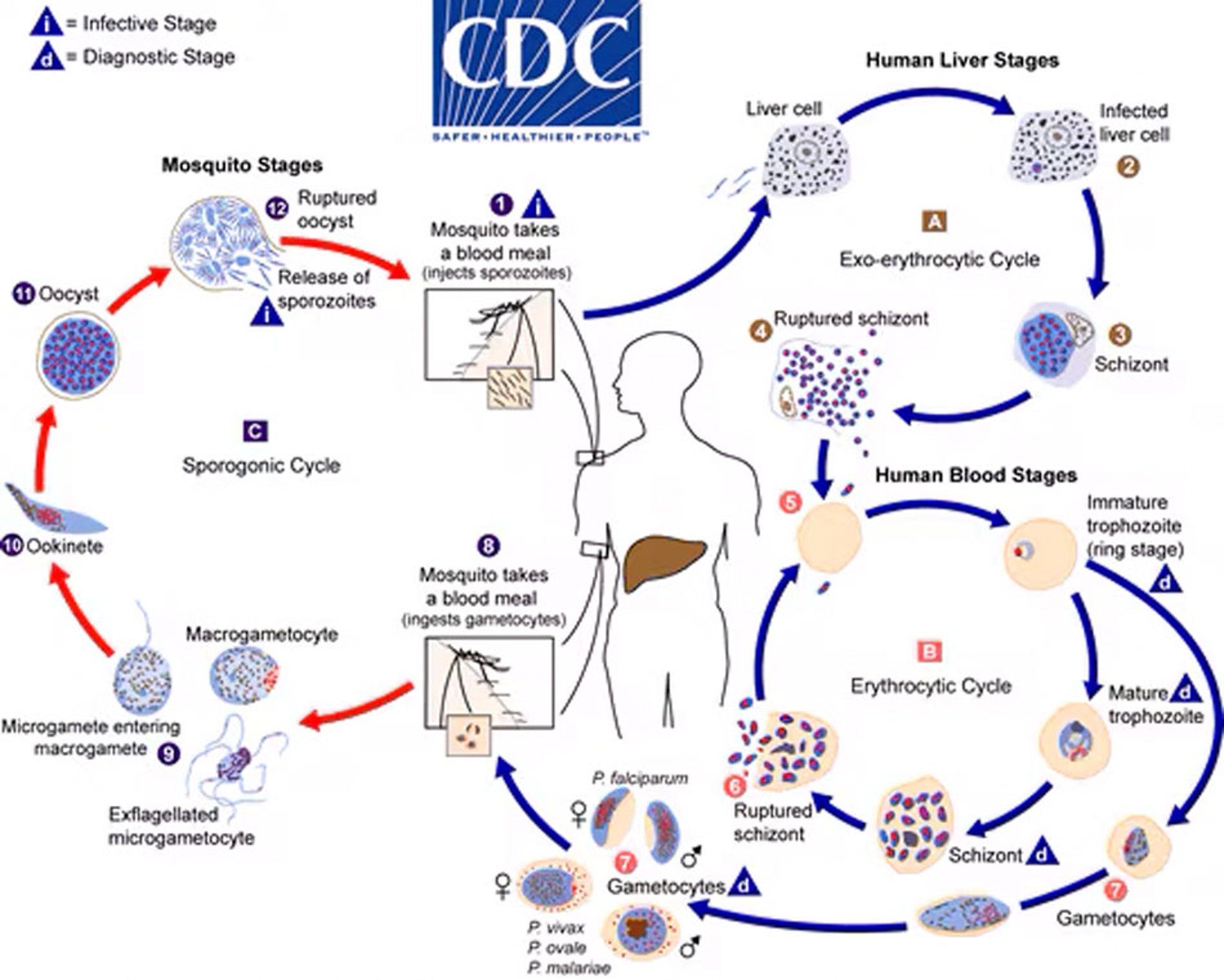
Plasmodium Life Cycle
1. During a blood meal, a malaria-infected female Anopheles mosquito inoculates Plasmodium sporozoites into a human host.
2–4. Sporozoites infect liver cells and mature into schizonts, which rupture and release merozoites. After this initial replication in the liver (exoerythrocytic schizogony [A]), the parasites undergo asexual multiplication in the erythrocytes (erythrocytic schizogony [B]).
5. Merozoites infect erythrocytes. From erythrocytes, two pathways are possible.
6. In one pathway, the ring stage trophozoites mature into schizonts, which rupture and release more merozoites.
7. In the other pathway, some parasites differentiate into sexual erythrocytic stages (gametocytes).
8. The gametocytes, male (microgametocytes) and female (macrogametocytes), are ingested by an Anopheles mosquito during a blood meal.
9. The parasites’ multiplication in the mosquito is known as the sporogonic cycle (C). While in the mosquito’s gut, the microgametes penetrate the macrogametes and generate zygotes.
10–11. The zygotes in turn become motile and elongated (ookinetes), which invade the midgut wall of the mosquito where they develop into oocysts.
12. The oocysts grow, rupture, and release sporozoites, which make their way to the mosquito’s salivary glands. Inoculation of the sporozoites into a new human host perpetuates the malaria life cycle.
Image from the Centers for Disease Control and Prevention Image Library.