A hamstring strain is a partial tear of the hamstring muscles most commonly at the musculotendinous junction.
Hamstring strains are common among runners. Athletes at risk include those with poor flexibility of the hamstring muscles, inadequate pre-participation warm-up, and previous injury (1). Older athletes are also at higher risk. As with any muscle strain, the amount of force that caused the muscle to tear determines the degree of injury.
Hamstring Muscles
The hamstrings are 3 posterior thigh muscles: the semimembranosus, the semitendinosus, and the biceps femoris. |

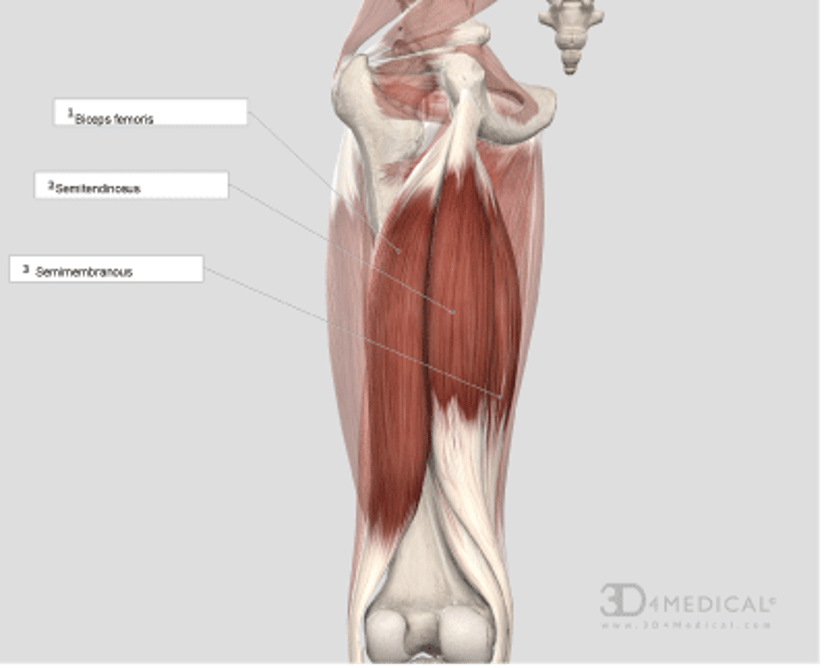
General reference
1. Allahabadi S, Salazar LM, Obioha OA, et al. Hamstring Injuries: A Current Concepts Review: Evaluation, Nonoperative Treatment, and Surgical Decision Making. Am J Sports Med. 2024;52(3):832-844. doi:10.1177/03635465231164931
Symptoms and Signs of Hamstring Strain
Strains of the hamstring muscles can manifest as an acute painful area in the posterior thigh when sprinting or running or develop more slowly, usually because of inadequate flexibility training.
Diagnosis of Hamstring Strain
History and physical examination
The diagnosis is confirmed by finding hamstring pain with knee flexion against resistance as well as on palpation of the posterior thigh. In mild strains, tenderness and mild swelling are present. In more severe strains, ecchymosis, moderate to severe swelling, and poor muscle function caused by pain and weakness are present.
Treatment of Hamstring Strain
Rest, ice, and compression
Stretching, then strengthening exercises
Ice and compression with use of a thigh sleeve should begin as soon as possible. Nonsteroidal anti-inflammatory drugs (NSAIDs) and analgesics are prescribed as necessary, and crutches may be required initially if walking is painful.
Once pain begins to resolve, patients should begin gentle hamstring stretching. When the pain has completely resolved, gradual strengthening of the quadriceps and hamstrings is begun.
Only when satisfactory strength has been achieved should patients resume running. Athletes must be made aware that recovery from hamstring injury can often take up to several months, depending on the severity.

1. Stand with feet about hip width apart.
2. Toes should point forward to stay aligned with the knees.
3. Keeping core
Courtesy of Tomah Memorial Hospital, Department of Physical Therapy, Tomah, WI; Elizabeth C.K. Bender, MSPT, ATC, CSCS; and Whitney Gnewikow, DPT, ATC.

1. Lie on back, hold behind the involved knee to pull it gently toward the chest.
2. Gently extend the knee to straight
Courtesy of Tomah Memorial Hospital, Department of Physical Therapy, Tomah, WI; Elizabeth C.K. Bender, MSPT, ATC, CSCS; and Whitney Gnewikow, DPT, ATC.

1. Lie on back with both knees bent and feet on floor/table.
2. Perform abdominal and gluteus maximus contraction and l
Courtesy of Tomah Memorial Hospital, Department of Physical Therapy, Tomah, WI; Elizabeth C.K. Bender, MSPT, ATC, CSCS; and Whitney Gnewikow, DPT, ATC.

1. Once the inflammatory phase has subsided and the patient is able to perform knee flexion without pain:
2. Lie on sto
Courtesy of Tomah Memorial Hospital, Department of Physical Therapy, Tomah, WI; Elizabeth C.K. Bender, MSPT, ATC, CSCS; and Whitney Gnewikow, DPT, ATC.


1. Stand with feet about hip width apart.
2. Toes should point forward to stay aligned with the knees.
3. Keeping core tight, move buttocks backward, similar to beginning to sit in a chair, and squat down until the thighs are almost parallel with the floor.
4. Return to start position and repeat.
5. Perform 3 sets of 10 repetitions, 1 time every other day.
6. Special Instructions
a. Keep weight on outside of foot and heels.
b. Start with a partial squat and increase as you become familiar with the movement.
c. Add weight only as tolerated. Start with 1 to 2 pounds (0.5 to 1 kg [ie, a soup can]).
Courtesy of Tomah Memorial Hospital, Department of Physical Therapy, Tomah, WI; Elizabeth C.K. Bender, MSPT, ATC, CSCS; and Whitney Gnewikow, DPT, ATC.

1. Lie on back, hold behind the involved knee to pull it gently toward the chest.
2. Gently extend the knee to straighten the leg.
3. Hold exercise for 30 seconds.
4. Perform 1 set of 4 repetitions, 3 times a day.
5. Repeat on the other leg.
Courtesy of Tomah Memorial Hospital, Department of Physical Therapy, Tomah, WI; Elizabeth C.K. Bender, MSPT, ATC, CSCS; and Whitney Gnewikow, DPT, ATC.

1. Lie on back with both knees bent and feet on floor/table.
2. Perform abdominal and gluteus maximus contraction and lift buttocks off floor.
3. Keep legs in neutral position.
4. Return to start position.
5. Perform 3 sets of 10 repetitions, 1 time a day.
6. Special Instructions
a. Maintain neutral spine.
b. For added resistance place a band just above the knees. Start with least resistance band.
Courtesy of Tomah Memorial Hospital, Department of Physical Therapy, Tomah, WI; Elizabeth C.K. Bender, MSPT, ATC, CSCS; and Whitney Gnewikow, DPT, ATC.

1. Once the inflammatory phase has subsided and the patient is able to perform knee flexion without pain:
2. Lie on stomach.
3. Begin with knee straight.
4. Bend knee through available range that is pain free.
5. Slowly return to starting position.
6. Perform 3 sets of 10 repetitions, 1 time a day.
7. Special Instructions
a. Start with least resistance, adding weight as tolerated. Band resistance can also be used.
b. Focus on eccentric lowering phase with a count of 4 to lower and extend knee to starting position and a count of 2 for knee flexion.
Courtesy of Tomah Memorial Hospital, Department of Physical Therapy, Tomah, WI; Elizabeth C.K. Bender, MSPT, ATC, CSCS; and Whitney Gnewikow, DPT, ATC.