Heterophyiasis is infection with the intestinal fluke Heterophyes heterophyes, which is acquired by eating infected raw or undercooked fish from freshwater or brackish water.


Flukes are parasitic flatworms that infect various parts of the body (eg, blood vessels, gastrointestinal tract, lungs, liver) depending on the species.
Heterophyes heterophyes is endemic in East Asia, the Middle East (especially Sudan and Egypt) and southeastern Europe.
Heterophyiasis is acquired by eating infected raw or undercooked fish from freshwater or brackish water containing metacercariae (encysted stage) (1). After ingestion, metacercariae excyst and attach to the mucosa of the small intestine. There, they develop into adults, growing to about 1.0 to 1.7 mm by 0.3 to 0.4 mm. Flukes may penetrate the mucosa and deposit eggs that pass through lymphatics into the bloodstream. Circulation of the eggs and deposition in the heart and other organs has been reported.
Infection with Metagonimus yokogawai, a related trematode, has been reported after eating raw or undercooked freshwater or brackish fish in Far Eastern Russia, Korea, Japan, China, Taiwan, the Balkan states, Israel, and Spain. Intestinal infection with Nanophyetus salmincola has been reported in the Pacific Northwest region of the United States (Washington, Oregon, and Northern California) and British Columbia, Canada, after ingestion of raw or undercooked salmon (2).

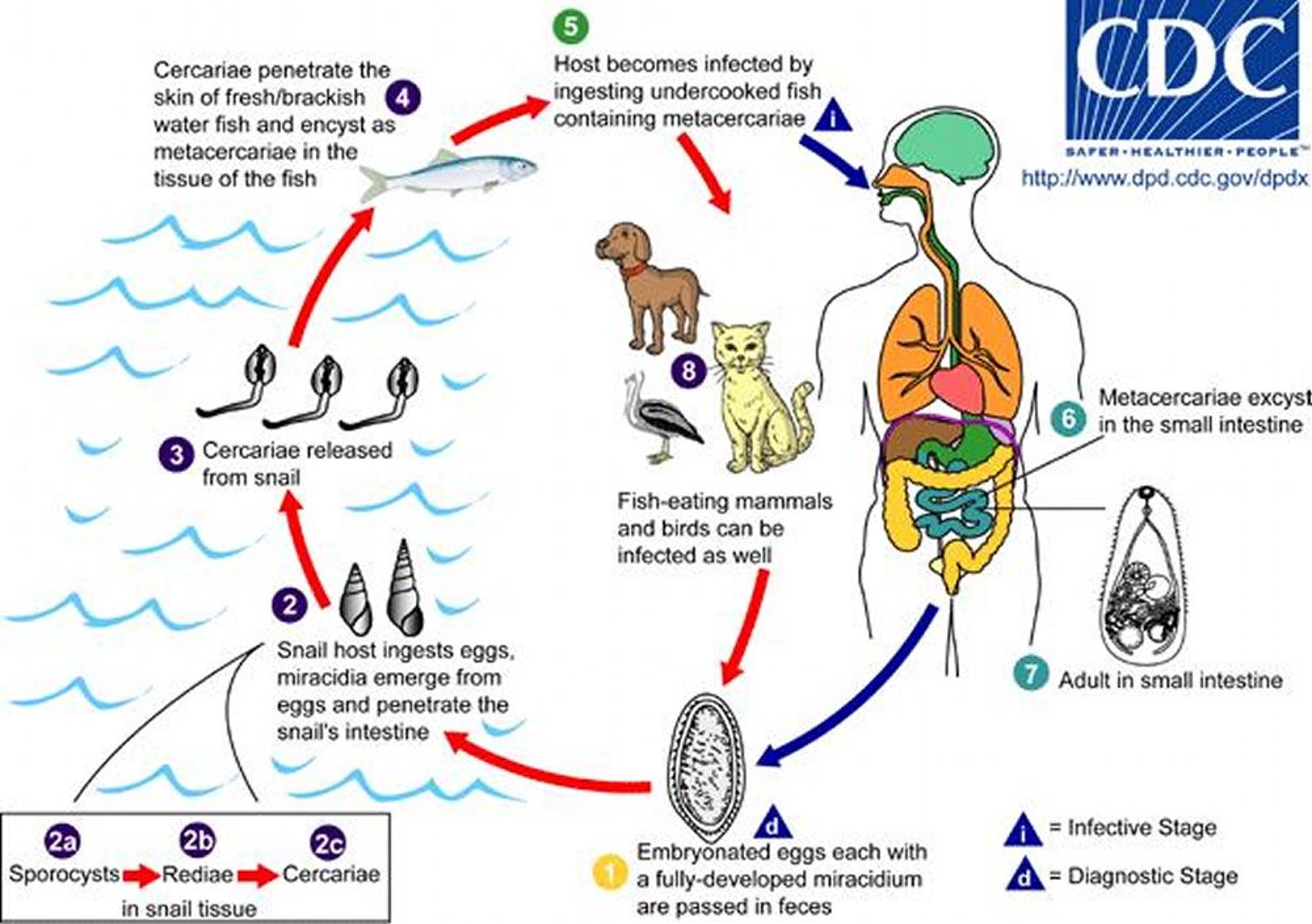
1. In the host, the adult worm releases embryonated eggs; each egg contains a fully developed miracidium. The eggs are passed in the host's feces.
2. After ingestion by a snail (first intermediate host), the eggs hatch and release miracidia, which penetrate the snail's intestine. Miracidia develop into sporocysts, then rediae, and then cercariae. Many cercariae are produced from each redia.
3. Cercariae are released from the snail.
4. The cercariae encyst as metacercariae in tissues of a freshwater or brackish-water fish (second intermediate host).
5. The definitive host becomes infected by ingesting raw, undercooked, or salted fish containing metacercariae.
6. After ingestion, the metacercariae excyst and attach to the mucosa of the small intestine.
7. There, they mature into adults.
8. In addition to humans, various fish-eating mammals (eg, cats, dogs) and birds can be infected by Heterophyes heterophyes.
Image from the Centers for Disease Control and Prevention Image Library.
Infections are frequently asymptomatic. Symptoms are more common with heavy infections or in immunocompromised patients. Onset of symptoms is typically about 9 days after ingestion of contaminated fish and can include anorexia, nausea, abdominal pain, malabsorption, weight loss, dyspepsia, and diarrhea. Eosinophilia may be present.
Adult flukes can cause abdominal pain and diarrhea.
Diagnosis of heterophyiasis is based on the detection of eggs (colored yellow-brown and measuring about 30 mcm by 15 mcm) in the feces. The eggs of H. heterophyes are indistinguishable from those of M. yokogawai and similar to those of Clonorchis and Opisthorchis.
Treatment of heterophyiasis is with praziquantel orally 3 times a day for 1 day for H. heterophyes, M. yokogawai, and N. salmincola.
Prevention involves not eating raw or undercooked fish that may contain these intestinal flukes.
References
1. Centers for Disease Control and Prevention: DPDx–Laboratory Identification of Parasites of Public Health Concern: Heterophyiasis. January 3, 2018. Accessed July 11, 2025.
2. Fritsche TR, Eastburn RL, Wiggins LH, Terhune CA Jr. Praziquantel for treatment of human Nanophyetus salmincola (Troglotrema salmincola) infection. J Infect Dis. 1989;160(5):896-899. doi:10.1093/infdis/160.5.896
Drug Information for the Topic