Taenia solium infection (taeniasis) is an intestinal infection with adult tapeworms that follows ingestion of contaminated pork. Adult worms may cause mild gastrointestinal symptoms or passage of a motile segment in the stool. Cysticercosis is infection with larvae of T. solium, which develops after ingestion of ova excreted in human feces. Cysticercosis is usually asymptomatic unless larvae invade the central nervous system, resulting in neurocysticercosis, which can cause seizures and various other neurologic signs. Neurocysticercosis may be recognized on brain imaging studies. Fewer than half of patients with neurocysticercosis have adult T. solium in their intestines and thus eggs or proglottids in their stool. Adult worms can be eradicated with praziquantel or niclosamide. Treatment of symptomatic neurocysticercosis is complicated; it includes corticosteroids, antiseizure drugs, and, in some situations, albendazole or praziquantel. Surgery may be required.
Presentation, diagnosis, and management of intestinal infection with the adult T. solium tapeworm are similar to those of T. saginata (beef tapeworm) infection.
Cysticercosis arises when a human acts as an intermediate host for T. solium. Humans develop cysticercosis via ingestion of T. solium eggs in feces from infected individuals, or ingestion of eggs from their own tapeworm (external autoinfection). Retrograde internal autoinfection of gravid proglottids into the stomach has also been postulated as a mechanism of autoinfection but remains unproven.
Adult tapeworms may reside in the small bowel for years. They reach 2 to 8 m in length and produce up to 1000 proglottids; each contains approximately 50,000 eggs.
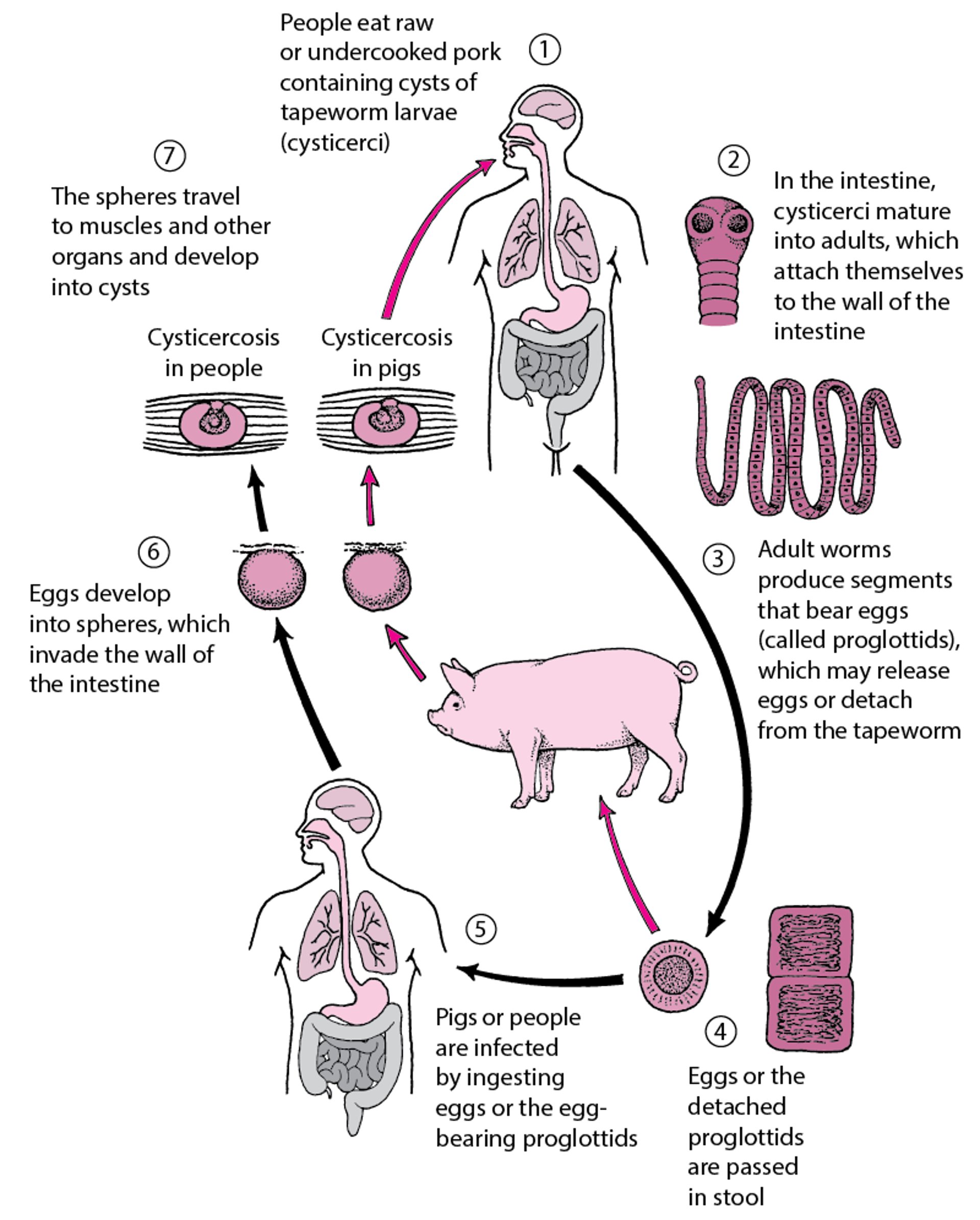
Taenia solium Life Cycle
Humans may develop intestinal infection with adult worms after ingestion of contaminated pork or may develop cysticercosis after ingestion of eggs (making humans intermediate hosts).
|

Taeniasis and cysticercosis occur worldwide. Cysticercosis is prevalent, and neurocysticercosis is a major cause of seizure disorders in Latin America. Cysticercosis is rare in countries with low pork consumption. Infection in the United States or Canada is rare in those who have not traveled abroad, but infection may occur by ingesting ova excreted in stools from people who visited endemic countries and are harboring adult T. solium.

Rarely, Taenia species other than T. solium cause neurocysticercosis.
Symptoms and Signs
Intestinal infection
Humans infected with adult T. solium worms are asymptomatic or have mild gastrointestinal complaints. They may see proglottids in their stool.
Cysticercosis
Viable cysticerci (larval forms) in most organs typically provoke little or no tissue reaction. However, when cysticerci in the central nervous system, eye, or spinal cord begin to degenerate, they release antigens that can trigger a strong inflammatory response. This process usually occurs years after the initial infection. Neurocysticercosis (brain infection) can cause severe symptoms due to both the mass effect of the cysts and the inflammation induced by their degeneration.
Depending on the location and number of cysticerci, patients with neurocysticercosis may present with seizures, signs of increased intracranial pressure, hydrocephalus, focal neurologic signs, altered mental status, headache, or aseptic meningitis.
Cysticerci may also infect the spinal cord, muscles, subcutaneous tissues, and eyes.
Substantial secondary immunity develops after larval infection.
Diagnosis
Microscopic examination of stool for ova and proglottids
CT and/or MRI of the brain and serologic testing for patients with central nervous system symptoms
Intestinal infection with adult T. solium worms can usually be diagnosed by microscopic examination of stool samples and identification of ova and/or proglottids. However, the ova are indistinguishable from those of T. saginata and T. asiatica.
T. solium eggs are present in ~10 to 30% of stool samples from patients with cysticercosis (1–3). Thus, while the presence of intestinal taeniasis can support the diagnosis of neurocysticercosis, a negative result does not exclude neurocysticercosis and a positive stool result is not diagnostic.
Neurocysticercosis is usually diagnosed when CT or MRI is done to evaluate neurologic symptoms. Scans may show solid nodules, cysticerci, calcified cysts, ring-enhancing lesions, or hydrocephalus. The Centers' for Disease Control and Prevention immunoblot assay (using a serum or cerebrospinal fluid specimen) is highly specific and more sensitive than other enzyme immunoassays (particularly when > 2 central nervous system lesions are present; sensitivity is lower when only a single cyst is present). Note that antibody-based assays such as immunoblot do not distinguish between active and inactive infections.
Monoclonal antibody-based antigen detection assays are commercially available in Europe. Antigen detection assays appear to have higher sensitivity for subarachnoid and ventricular neurocysticercosis over parenchymal disease. The sensitivity of antigen detection is improved when cerebrospinal fluid rather than serum is used; however, false-negative results may be common with parenchymal disease (4).
Pearls & Pitfalls
|
Diagnosis references
1. Garcia HH, Del Brutto OH; Cysticercosis Working Group in Peru. Neurocysticercosis: updated concepts about an old disease. Lancet Neurol. 2005;4(10):653-661. doi:10.1016/S1474-4422(05)70194-0
2. Centers for Disease Control and Prevention. Clinical Overview of Taeniasis. May 3, 2024. Accessed September 18, 2025.
3. White AC Jr. Neurocysticercosis: updates on epidemiology, pathogenesis, diagnosis, and management. Annu Rev Med. 2000;51:187-206. doi:10.1146/annurev.med.51.1.187
4. Pineda-Reyes R, White AC Jr. Neurocysticercosis: an update on diagnosis, treatment, and prevention. Curr Opin Infect Dis. 35(3):246-254, 2022. doi:10.1097/QCO.0000000000000831
Treatment
For intestinal infection (without neurocysticercosis): Praziquantel or niclosamide (outside the United States)
For neurocysticercosis: Corticosteroids, antiseizure drugs, and sometimes albendazole or praziquantel and/or surgery
Treatment of intestinal infection
Intestinal infection is treated with praziquantel; alternatively, niclosamide, outside of the United States (1).
A stool sample should be repeated 3 months after therapy is completed to verify cure.
Antiparasitic drugs should be used with caution in patients who also have signs of neurocysticercosis (including previously asymptomatic or unrecognized disease) because killing of cysts in the brain may trigger an inflammatory response associated with seizures or other symptoms.
Treatment of neurocysticercosis
Treatment of neurocysticercosis is complicated. Clinical practice guidelines are available from the Infectious Diseases Society of America and the American Society of Tropical Medicine and Hygiene (2017) (1) and from the World Health Organization (2021) (2).
The initial treatment goals for symptomatic neurocysticercosis are
To reduce inflammation associated with degenerating cysticerci documented by MRI
To prevent seizures if present or if risk is high
To relieve increased intracranial pressure if present
Glucocorticoids (prednisone or dexamethasone ) are used to reduce inflammation and increased intracranial pressure. Recipients of prolonged glucocorticoid therapy should be evaluated for concurrent latent tuberculosis and strongyloidiasis and receive antibiotics to prevent pneumocystis pneumonia (3, 4).
Conventional antiseizure drugs are given to patients who have seizures. These drugs can be used prophylactically in patients at high risk of seizures, particularly those who have multiple degenerating lesions with associated inflammation.
Neurosurgical intervention may be necessary for patients with increased intracranial pressure or intraventricular cysticerci.
Anthelmintic treatment of neurocysticercosis is complicated, and consultation with an expert is recommended. Initiation of antihelminthic therapy is not urgent, and it is critical that antihelminthic therapy be done after inflammation is controlled by glucocorticoids. Choice of treatment depends on the location, number, viability, and size of cysticerci; stage of the disease; and clinical manifestations. Prior to anthelmintic treatment, an ophthalmologic examination should be done to exclude the presence of ocular cysticerci. Antihelminthic drugs should never be administered to patients with uncontrolled increased intracranial pressure because of the potential effect of the typically intense inflammatory reaction.
Not all patients respond to treatment, and not all patients must be treated (cysts may already be dead and calcified, or the potential inflammatory response to treatment may be worse than the disease, as in cysticercal encephalitis when patients have a large number of cysts and widespread brain inflammation).
When anthelmintic treatment is used, albendazole appears to be more effective than praziquantel. The combination of albendazole plus praziquantel has been reported to result in a higher rate of radiographic resolution than albendazole alone in patients with more than 2 parenchymal cysts (5, 6). Albendazole alone or in combination with praziquantel given for ≥ 30 days has been used to treat cysts in the subarachnoid space (racemose cysticercosis), which are less responsive to anthelmintic drugs. Patients receiving prolonged, high-dose treatment with albendazole need to be monitored for bone marrow suppression and drug-related hepatitis. Antihelminthic drugs do not lead to rapid abatement of symptoms. Thus antihelminthics should be given in conjunction with symptomatic management for seizures, inflammation, and/or hydrocephalus. Neuroimaging is repeated at 6-month intervals until the findings have resolved.
Either prednisone or dexamethasone is started a few days before and continued during the course of anthelminthic administration to reduce the inflammation that occurs in response to dying cysts in the brain. Glucocorticoids increase the cerebrospinal fluid (CSF) level of the active metabolite of albendazole but decrease the CSF level of praziquantel. Methotrexate has been used as a steroid-sparing agent in patients requiring more than 2 weeks of anti-inflammatory therapy.
Neither albendazole nor praziquantel should be used in patients with ocular or spinal cord cysticerci due to potential adverse effects of the inflammatory response elicited by dying cysts.
The presence of intraventricular cysticerci is also a relative contraindication for anthelminthic drugs because the resulting inflammatory response elicited by the dying cysts can cause obstructive hydrocephalus.
Surgery may be necessary for obstructive hydrocephalus (due to intraventricular cysticerci including those in the fourth ventricle) or spinal or ocular cysticercosis. Intraventricular cysticerci are removed endoscopically when possible. Ventricular shunts may be needed to reduce increased intracranial pressure.
Treatment references
1. White AC Jr, Coyle CM, Rajshekhar V, et al. Diagnosis and Treatment of Neurocysticercosis: 2017 Clinical Practice Guidelines by the Infectious Diseases Society of America (IDSA) and the American Society of Tropical Medicine and Hygiene (ASTMH). Clin Infect Dis. 2018;66(8):e49-e75. doi:10.1093/cid/cix1084
2. WHO guidelines on management of Taenia solium neurocysticercosis. Geneva: World Health Organization; 2021.
3. Winthrop KL, Baddley JW. Pneumocystis and glucocorticoid use: to prophylax or not to prophylax (and when?); that is the question. Ann Rheum Dis. 77(5):631-633, 2018. doi:10.1136/annrheumdis-2017-212588
4. Park JW, Curtis JR, Moon J, Song YW, Kim S, Lee EB. Prophylactic effect of trimethoprim-sulfamethoxazole for pneumocystis pneumonia in patients with rheumatic diseases exposed to prolonged high-dose glucocorticoids. Ann Rheum Dis. 77(5):644-649, 2018. doi:10.1136/annrheumdis-2017-211796
5. Garcia HH, Gonzales I, Lescano AG, et al. Efficacy of combined antiparasitic therapy with praziquantel and albendazole for neurocysticercosis: a double-blind, randomised controlled trial. Lancet Infect Dis. 2014;14(8):687-695. doi:10.1016/S1473-3099(14)70779-0
6. Garcia HH, Lescano AG, Gonzales I, et al. Cysticidal Efficacy of Combined Treatment With Praziquantel and Albendazole for Parenchymal Brain Cysticercosis. Clin Infect Dis. 2016;62(11):1375-1379. doi:10.1093/cid/ciw134
Prevention
Intestinal T. solium infection can be prevented by cooking whole cuts of pork to ≥ 63° C (≥ 145° F) as measured with a food thermometer placed in the thickest part of the meat, then allowing the meat to rest for 3 minutes before carving or consuming. Ground pork should be cooked to ≥ 71° C (≥ 160° F). Ground pork does not require a rest period.
Identifying and treating carriers of adult T. solium is an important public health measure in preventing cysticercosis. In the United States, transmission has occurred when people who were infected in endemic areas had adult T. solium in their intestines, then contaminated food with their stool. It is very important that food handlers from endemic areas be taught and adhere to good handwashing practices.
When traveling to endemic areas with poor sanitation, people should be careful to avoid foods that might be contaminated by human feces and avoid raw and inadequately cooked pork.
The prevalence of both porcine and human taeniasis has been significantly reduced by the combined use of antihelminthics (oxfendazole for pigs and praziquantel for humans), administration of the porcine vaccine TSOL18, and public health education (1).
Prevention reference
1. Gabriël S, Mwape KE, Hobbs EC, et al. Evidence for potential elimination of active Taenia solium transmission in Africa?. N Engl J Med. 2020;383(4):396-397. doi:10.1056/NEJMc1909955
Key Points
Ingestion of T. solium cysts may cause intestinal infection; ingestion of eggs may result in tissue cysts (cysticercosis), which are particularly problematic when in the brain.
Patients with neurocysticercosis may have seizures, signs of increased intracranial pressure, altered mental status, focal neurologic signs, or aseptic meningitis.
Diagnose intestinal infection with adult worms by identifying proglottids in stool and microscopic examination of stool samples for ova.
Diagnose neurocysticercosis by neuroimaging and serologic testing.
Give praziquantel for intestinal infection.
Consult an expert for neurocysticercosis; typically glucocorticoids are given with antiseizure drugs to patients who have associated seizures or are thought to be at high risk of seizures.
Use of anthelmintics and/or surgery for neurocysticercosis depends on the location, number, and size of cysticerci; stage of the disease; and clinical manifestations.
Drug Information for the Topic