There are 4 main components of male sexual function:
Libido
Erection
Emission/ejaculation
Orgasm
Sexual dysfunction is a problem with any of these components that interferes with interest in or ability to engage in sexual intercourse. Many medications and numerous physical and psychological disorders affect sexual function.
Libido
Libido is the conscious component of sexual function. Decreased libido manifests as a lack of sexual interest or a decrease in the frequency and intensity of sexual thoughts, whether they arise spontaneously or in response to erotic stimuli. Libido is sensitive to testosterone levels as well as to general nutrition, health, and the effects of medications.
Common causes of decreased libido include hypogonadism (testosterone deficiency), chronic kidney disease, relationship problems, depression, stress, and diabetes, among others. Low testosterone levels (< 300 ng/dL in the morning) are very common in middle-aged and older men, with a prevalence of approximately 14% to 21% in men between 40 and 80 years old, and 20 to 50% in men between 60 and 80 years of age and (1, 2, 3, 4). Not all men with low testosterone levels are symptomatic; however, when symptomatic, testosterone deficiency is readily treatable with the use of testosterone replacement therapy (5).
Medications that potentially decrease libido include weak androgen receptor antagonists (eg, spironolactone, cimetidine), luteinizing hormone-releasing hormone agonists (eg, leuprolide, goserelin, buserelin) and antagonists (eg, degarelix) used to treat prostate cancer; antiandrogens used to treat prostate cancer (eg, flutamide, bicalutamide); 5-alpha-reductase inhibitors (eg, finasteride, dutasteride) used to treat benign prostatic hyperplasia; some antihypertensives; and virtually all medications that are active in the central nervous system (eg, selective serotonin reuptake inhibitors [SSRIs], tricyclic antidepressants [TCAs], antipsychotics) (6). Loss of libido due to SSRIs or TCAs may be reversible with the addition of bupropion or trazodone (7, 8).
Libido references
1. Mulligan T, Frick MF, Zuraw QC, et al. Prevalence of hypogonadism in males aged at least 45 years: The HIM study. Int J Clin Pract. 2006;60(7):762-769. doi: 10.1111/j.1742-1241.2006.00992.x
2. Harman SM, Metter EJ, Tobin JD, et al; Baltimore Longitudinal Study of Aging. Longitudinal effects of aging on serum total and free testosterone levels in healthy men. J Clin Endocrinol Metab. 2001;86(2):724-731. doi: 10.1210/jcem.86.2.7219
3. Ahern T, Swiecicka A, Eendebak RJ, et al. Natural history, risk factors and clinical features of primary hypogonadism in ageing men: Longitudinal Data from the European Male Ageing Study. Clin Endocrinol (Oxf). 2016;85(6):891-901. doi:10.1111/cen.13152
4. Tajar A, Forti G, O'Neill TW, et al. Characteristics of secondary, primary, and compensated hypogonadism in aging men: evidence from the European Male Ageing Study. J Clin Endocrinol Metab. 2010;95(4):1810-1818. doi:10.1210/jc.2009-1796
5. Rastrelli G, Guaraldi F, Reismann Y, et al. Testosterone replacement therapy for sexual symptoms. Sex Med Rev. 2019;7(3):464-475. doi: 10.1016/j.sxmr.2018.11.005
6. Balon R: Medications and sexual function and dysfunction. J Lifelong Learning Psychiatry. 7(4). Published online. October 2009.
7. Taylor MJ, Rudkin L, Bullemor-Day P, Lubin J, Chukwujekwu C, Hawton K. Strategies for managing sexual dysfunction induced by antidepressant medication. Cochrane Database Syst Rev. 2013;2013(5):CD003382. Published 2013 May 31. doi:10.1002/14651858.CD003382.pub3
8. Bossini L, Casolaro I, Koukouna D, Cecchini F, Fagiolini A. Off-label uses of trazodone: a review. Expert Opin Pharmacother. 2012;13(12):1707-1717. doi:10.1517/14656566.2012.699523
Erection
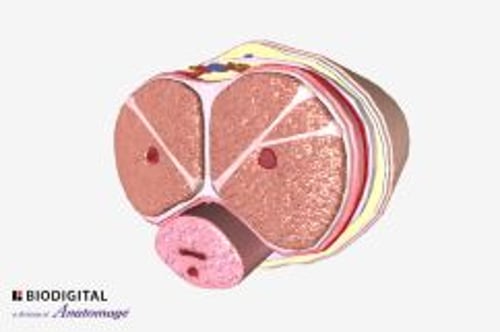
Erection is a neurovascular response to certain psychological and/or tactile stimuli. Higher cortical input and a sacral parasympathetic reflex arc mediate the erectile response. Neural output travels through the cavernous nerves, which traverse the posterolateral aspect of the prostate. Terminating in the penile vasculature, these nonadrenergic, noncholinergic nerves liberate nitric oxide, a gas. Nitric oxide diffuses into penile arterial smooth muscle cells, causing increased production of cyclic guanosine monophosphate (cGMP), which relaxes the arterial smooth muscle and allows more blood to flow into the corpora cavernosa. As the corpora fill with blood, intracavernous pressure increases, which compresses surrounding venules, causing veno-occlusion and decreased venous outflow. The increased inflow of blood and decreased outflow further increase intracavernous pressure, contributing to erection.
There are 2 types of erection that men can experience: psychogenic and reflexogenic. Psychogenic erection occurs as a result of arousal within the patient’s brain from visual/auditory input and fantasy. Reflexogenic erection occurs as a direct result of physical genital stimulation. Although in most men the 2 types of erection coexist and occur simultaneously, it is possible for psychogenic erection to develop in the absence of genital stimulation and for reflexogenic erection to develop in the absence of brain stimulation. These 2 types of erection are mediated by different nerve pathways. Psychogenic erection depends on intact neurological function at spinal cord levels T11 through L2, while reflexogenic erection depends on function at spinal levels S2 through S4. Specific spinal cord injuries can therefore affect erection (1). For example, men with complete spinal cord injury above T11 do not typically experience psychogenic erections, but they can still experience reflexogenic erections in response to direct genital stimulation.
Many factors affect the ability to have an erection (see Erectile Dysfunction).
Erection reference
1. Stoffel JT, Van der Aa F, Wittmann D, et al. Fertility and sexuality in the spinal cord injury patient. World J Urol. 2018;36(10):1577-1585. doi: 10.1007/s00345-018-2347-y
Emission, Ejaculation, and Orgasm
Emission refers to the deposition of pre-ejaculatory fluid into the prostatic urethra.
Ejaculation refers to the actual expulsion of seminal fluid out of the urethral meatus.
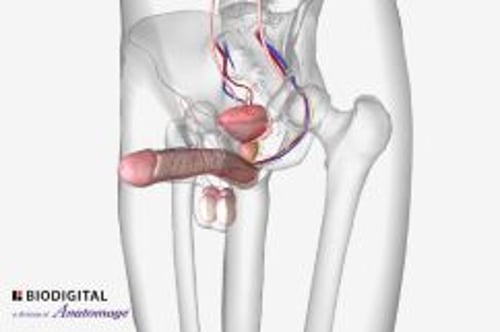
Neural stimulation of the alpha-adrenergic receptors in the male adnexa (eg, penis, testes, perineum, prostate, seminal vesicles) causes contractions of the epididymis, vas deferens, seminal vesicles, and prostate that transport semen to the posterior urethra (emission). Then, rhythmic contractions of the pelvic floor muscles result in pulsatile excretion of the accumulated seminal fluid (ejaculation). At the same time, the neck of the bladder closes, preventing retrograde ejaculation of semen into the bladder.


Image Copyright © Nucleus Medical Media. All rights reserved.
Orgasm, the pleasurable sensation that occurs in the brain, is generally simultaneous with ejaculation. This is also associated with rhythmic, involuntary muscular contractions within the pelvic region. Anorgasmia may be a physical phenomenon due to decreased penile sensation (eg, from neuropathy) or a neuropsychological phenomenon due to psychiatric disorders or psychoactive medications.
Ejaculatory dysfunction
Ejaculatory dysfunction can be broadly classified into 2 types:
Diminished ability to produce ejaculate (retrograde ejaculation, anejaculation)
Abnormal timing of ejaculation (premature ejaculation, delayed ejaculation)
Diminished ability to produce ejaculate is usually due to advanced age, pathology, or iatrogenic causes, while the abnormal timing of ejaculation is more often related to psychological factors.
Retrograde ejaculation is distinguished from true anejaculation by the presence of sperm in a urine sample (indicating that ejaculation occurred), and can have multiple causes. Neuropathy from diabetes mellitus and certain medications such as alpha blockers (eg, tamsulosin for benign prostatic hyperplasia [BPH]) can cause impaired relaxation of the urethral sphincter, and surgical BPH procedures such as transurethral resection of the prostate (TURP) can cause permanent iatrogenic retrograde ejaculation.
Anejaculation can be caused by seminal tract obstruction, neurological dysfunction and spinal cord injury, radiation, or surgery (1). A classic cause of anejaculation is radical prostatectomy for prostate cancer, which results in removal of seminal vesicles and, consequently, elimination of semen production.
Treatment of anejaculation depends on the cause and may include stopping any medications that may be causing the problem and engaging in psychotherapy. Oral medications (eg, pseudoephedrine and/or imipramine) are tailored to the underlying cause but the overall evidence base for the effectiveness of pharmacotherapy is weak (1).
If the goal of therapy is to obtain semen for insemination in the setting of neurologic injury, the man can use a penile vibrator or his doctor can apply an electrical signal to the prostate to activate the nerves responsible for ejaculation (electroejaculation therapy) (2, 3).
There is no treatment when anejaculation is due to removal of the prostate and seminal vesicles. In patients who cannot produce semen, sperm can be directly extracted from the testicles and used for assisted reproduction, such as in vitro fertilization (IVF) or intracytoplasmic sperm injection (ICSI).
Delayed ejaculation is often related to psychological factors, but erectile dysfunction and certain medications (eg, serotonin reuptake inhibitors) can contribute as well. Treatment of underlying erectile dysfunction and psychosexual therapy are the mainstays of treatment. Some medications are used to treat delayed ejaculation (eg, cabergoline and bupropion) despite a lack of clear evidence of their benefit (1, 4). The American Urological Association (AUA) supports testing these patients for testosterone deficiency; however, the evidence is inconclusive on whether or not testosterone replacement therapy is an effective treatment (5).
Premature ejaculation is defined as ejaculation occurring sooner than desired by the man or his partner and causing distress to them both. It is usually caused by sexual inexperience, anxiety, and other psychological factors rather than disease or true penile hypersensitivity. It can be treated successfully with topical anesthetics, sex therapy, pelvic floor physical therapy, or medications (1). First-line medication options include topical penile anesthetics, chronic or on-demand selective serotonin reuptake inhibitors, and tricyclic antidepressants. Second-line medications include tramadol and alpha-1 blockers. A combination of behavioral and pharmacotherapy may be more effective than either alone.
Behavioral techniques are commonly used to treat premature ejaculation (1). They also help reduce the anxiety that often aggravates the problem. Two commonly used techniques train the man to experience high levels of excitement without ejaculating. Both involve self-stimulation of the penis (while masturbating) or stimulation by a partner until the man feels that he will soon ejaculate. When done with a partner, stimulation is at first by hand and later before or during intercourse. In the stop-and-start technique, stimulation is stopped. With the squeeze technique, the man or his partner squeezes for 10 to 20 seconds the part of the penis where the head (glans) meets the shaft, preventing ejaculation and decreasing the strength of the erection. In both techniques, stimulation can resume after about 30 seconds. With practice, more than 95% of men learn to delay ejaculation for 5 to 10 minutes or even longer.
Emission, ejaculation, and orgasm references
1. Shindel AW, Althof SE, Carrier S, et al. Disorders of Ejaculation: An AUA/SMSNA Guideline. J Urol. 2022;207(3):504-512. doi:10.1097/JU.0000000000002392
2. Brackett NL, Ibrahim E, Iremashvili V, et al. Treatment for ejaculatory dysfunction in men with spinal cord injury: an 18-year single center experience. J Urol. 2010;183(6):2304-2308. doi:10.1016/j.juro.2010.02.018
3. Ibrahim E, Brackett NL, Lynne CM. Advances in the management of infertility in men with spinal cord injury. Asian J Androl. 2016;18(3):382-390. doi:10.4103/1008-682X.178851
4. Sadowski DJ, Butcher MJ, Köhler TS. A review of pathophysiology and management options for delayed ejaculation. Sex Med Rev 2016;4(2):167-1676. doi: 10.1016/j.sxmr.2015.10.006
5. Paduch DA, Polzer PK, Ni X, Basaria S. Testosterone Replacement in Androgen-Deficient Men With Ejaculatory Dysfunction: A Randomized Controlled Trial. J Clin Endocrinol Metab. 2015;100(8):2956-2962. doi:10.1210/jc.2014-4434
Drug Information for the Topic