Eosinophilic esophagitis is a chronic immune-mediated disease of the esophagus resulting in eosinophil-predominant inflammation of the esophagus; it can cause reflux-like symptoms, dysphagia, and food impaction. Diagnosis is by endoscopy with biopsy. Treatment includes proton pump inhibitors, topical glucocorticoids, a biologic medication, dietary changes, and sometimes esophageal dilation.
Eosinophilic esophagitis can begin at any time between infancy and young adulthood; it occasionally manifests in older adults (1). It is more common among males.
The cause of eosinophilic esophagitis is likely an immune response to dietary antigens in patients with genetic susceptibility (2); environmental allergens may also play a role. Untreated chronic esophageal inflammation ultimately can lead to esophageal narrowing and strictures.
General references
1. Furuta GT, Katzka DA. Eosinophilic Esophagitis. N Engl J Med. 2015;373(17):1640-1648. doi:10.1056/NEJMra1502863
2. Muir A, Falk GW. Eosinophilic Esophagitis: A Review. JAMA. 2021;326(13):1310-1318. doi:10.1001/jama.2021.14920
Symptoms of Eosinophilic Esophagitis
Infants and children may present with food refusal, vomiting, weight loss, abdominal pain, and/or chest pain.
In adolescents and adults, esophageal food impaction and dysphagia are the most common symptoms (1). Symptoms of gastroesophageal reflux disease (GERD), such as heartburn, may occur.
Patients often also have manifestations of other atopic disorders (eg, asthma, atopic dermatitis, allergic rhinitis).
Symptoms and signs reference
1. Dellon ES, Muir AB, Katzka DA, et al. ACG Clinical Guideline: Diagnosis and Management of Eosinophilic Esophagitis. Am J Gastroenterol. 2025;120(1):31-59. doi:10.14309/ajg.0000000000003194
Diagnosis of Eosinophilic Esophagitis
Endoscopy with biopsy
Sometimes barium swallow or impedance planimetry
The typical patient with eosinophilic esophagitis has dysphagia for solids and a history of atopy. The diagnosis of eosinophilic esophagitis is also considered when reflux symptoms fail to respond to acid-suppression therapy. It should also be considered in adults who present with esophageal food impaction or in adults who have noncardiac chest pain.
Diagnosis requires endoscopy with biopsy showing eosinophilic infiltration (≥ 15 eosinophils/high-powered field), typical symptoms of eosinophilic esophagitis, and evaluation for other similar disorders (1).
The differential diagnosis includes gastroesophageal reflux disease, other eosinophilic gastrointestinal disorders, pill esophagitis, Crohn disease, achalasia, and autoimmune disease.
Although visible abnormalities (eg, linear furrows, strictures, stacked circular rings, loss of vascular markings, white exudates) may be apparent on endoscopy, the appearance can be normal, so biopsies are essential. Because GERD can also cause eosinophilic infiltrates, patients who have mainly reflux symptoms should have biopsies; samples from the proximal and middle esophagus should be processed separately from samples from the distal esophagus.

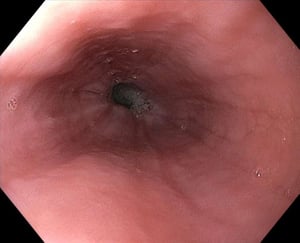
Image provided by Kristle Lynch, MD.

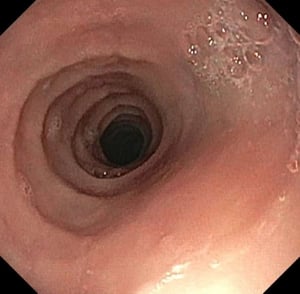
Image provided by Kristle Lynch, MD.

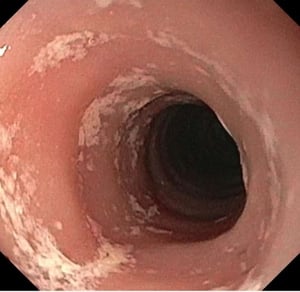
Image provided by Kristle Lynch, MD.
Image provided by Kristle Lynch, MD.
Image provided by Kristle Lynch, MD.
Image provided by Kristle Lynch, MD.
A barium swallow may show stacked circular rings, longitudinal furrows, a narrow-caliber esophagus, or strictures.
Impedance planimetry is occasionally used in patients with significant symptoms to evaluate for subtle strictures.
Testing for food allergies is often performed to identify possible triggers but is of minimal benefit because eosinophilic esophagitis is not thought to be fully IgE-mediated (2).
Diagnosis references
1. Dellon ES, Muir AB, Katzka DA, et al. ACG Clinical Guideline: Diagnosis and Management of Eosinophilic Esophagitis. Am J Gastroenterol. 2025;120(1):31-59. doi:10.14309/ajg.0000000000003194
2. Hirano I, Chan ES, Rank MA, et al. AGA institute and the joint task force on allergy-immunology practice parameters clinical guidelines for the management of eosinophilic esophagitis. Ann Allergy Asthma Immunol. 2020;124(5):416-423. doi:10.1016/j.anai.2020.03.020
Treatment of Eosinophilic Esophagitis
Proton pump inhibitors
Topical glucocorticoids
Dupilumab
Elimination diet
Sometimes esophageal dilation
Initial treatment may include medications or a food elimination diet (1, 2). In adults, first-line medication options include proton pump inhibitors (PPIs) and glucocorticoids. The biologic medication dupilumab may be used in patients who do not respond to other medication therapy. In children, PPIs are often preferred if dietary changes are ineffective (3).
If topical glucocorticoids are chosen, patients may use a multidose inhaler of fluticasone; they puff the medication into their mouth without inhaling and then swallow it. Alternatively, budesonide 1 to 2 mg oral viscous slurry can be taken 30 minutes after breakfast and 30 minutes after dinner. Fluticasone or budesonide is given for at least 8 weeks to determine efficacy. If the patient achieves remission with either of these therapies, they are often continued indefinitely. Maintenance doses of these medications are not well established.
Dupilumab is a biologic given by subcutaneous injection to patients ≥ 1 year of age who weigh at least 15 kg (33 lb) (2). It is a human monoclonal antibody that is an interleukin (IL)-4 receptor alpha antagonist and inhibits IL-4 and IL-13 signaling. Randomized trials have demonstrated that patients with eosinophilic esophagitis who received weekly injections of dupilumab had improved histologic outcomes and reduced symptoms (4, 5).
Elimination diets can be effective for some patients in the management of eosinophilic esophagitis (6, 7). The elemental diet may be successful in both adults and children but is often not practical in adults.
Patients who have significant strictures may need careful esophageal dilation using a balloon or bougie; multiple, careful, progressive dilations are performed to help prevent esophageal perforation.
Additional injection and infusion therapies are being studied for eosinophilic esophagitis.

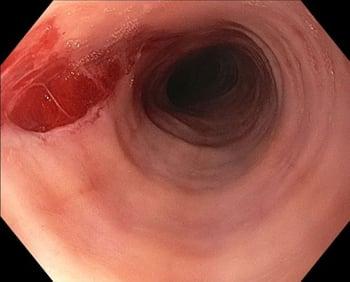
Treatment references
1. Hirano I, Chan ES, Rank MA, et al. AGA institute and the joint task force on allergy-immunology practice parameters clinical guidelines for the management of eosinophilic esophagitis. Ann Allergy Asthma Immunol. 2020;124(5):416-423. doi:10.1016/j.anai.2020.03.020
2. Dellon ES, Muir AB, Katzka DA, et al. ACG Clinical Guideline: Diagnosis and Management of Eosinophilic Esophagitis. Am J Gastroenterol. 2025;120(1):31-59. doi:10.14309/ajg.0000000000003194
3. Navarro P, Feo-Ortega S, Casabona-Francés S, et al. Determinant factors for first-line treatment choice and effectiveness in pediatric eosinophilic esophagitis: an analysis of the EUREOS EoE CONNECT registry. Eur J Pediatr. 2024;183(8):3567-3578. doi:10.1007/s00431-024-05618-z
4. Chehade M, Dellon ES, Spergel JM, et al. Dupilumab for Eosinophilic Esophagitis in Patients 1 to 11 Years of Age. N Engl J Med. 2024;390(24):2239-2251. doi:10.1056/NEJMoa2312282
5. Dellon ES, Rothenberg ME, Collins MH, et al. Dupilumab in Adults and Adolescents with Eosinophilic Esophagitis. N Engl J Med. 2022;387(25):2317-2330. doi: 10.1056/NEJMoa2205982
6. Mayerhofer C, Kavallar AM, Aldrian D, et al. Efficacy of Elimination Diets in Eosinophilic Esophagitis: A Systematic Review and Meta-analysis. Clin Gastroenterol Hepatol. 2023;21(9):2197-2210.e3. doi: 10.1016/j.cgh.2023.01.019
7. Hirano I, Chan ES, Rank MA, et al. AGA Institute and the Joint Task Force on Allergy-Immunology Practice Parameters Clinical Guidelines for the Management of Eosinophilic Esophagitis. Gastroenterology. 2020;158(6):1776-1786. doi:10.1053/j.gastro.2020.02.038
Drug Information for the Topic