Achalasia is a neurogenic esophageal motility disorder characterized by impaired esophageal peristalsis and a lack of lower esophageal sphincter relaxation during swallowing. Symptoms are slowly progressive dysphagia, usually to both liquids and solids, and regurgitation of undigested food. Evaluation typically includes manometry, barium swallow, and endoscopy. Treatments include dilation, botulinum toxin injection, surgical myotomy, and peroral endoscopic myotomy.
Achalasia occurs at all ages but usually begins in adulthood, with a mean age at diagnosis of > 50 years (1). It is thought to be caused by a loss of ganglion cells in the myenteric plexus of the esophagus, resulting in denervation of esophageal muscle. Etiology of the denervation is unknown, but viral and autoimmune causes are suspected, and certain tumors may cause achalasia either by direct obstruction or as a paraneoplastic process (1). Chagas disease, which causes destruction of autonomic ganglia, may also result in achalasia.
Increased pressure at the lower esophageal sphincter (LES) causes obstruction with secondary dilation of the esophagus. Esophageal retention of undigested food and liquid is common.
General reference
1. Mittal R, Vaezi MF. Esophageal Motility Disorders and Gastroesophageal Reflux Disease. N Engl J Med. 2020;383(20):1961-1972. doi:10.1056/NEJMra2000328
Symptoms and Signs of Achalasia
Onset is insidious, and progression is gradual over months or years. Dysphagia for both solids and liquids is the major symptom. Heartburn occurs in up to approximately 40% of patients (1, 2). Nocturnal regurgitation of undigested food is also common and may cause cough and pulmonary aspiration, leading to aspiration pneumonia or, chronically, bronchiectasis. Chest pain is less common but may occur with swallowing or spontaneously.
Mild to moderate weight loss occurs; when weight loss is pronounced, particularly in older adults whose symptoms of dysphagia developed rapidly, pseudoachalasia secondary to a tumor of the gastroesophageal junction should be considered.
Symptoms and signs references
1. Khashab MA, Vela MF, Thosani N, et al. ASGE guideline on the management of achalasia. Gastrointest Endosc. 2020;91(2):213-227.e6. doi:10.1016/j.gie.2019.04.231
2. Vaezi MF, Pandolfino JE, Yadlapati RH, Greer KB, Kavitt RT. ACG Clinical Guidelines: Diagnosis and Management of Achalasia. Am J Gastroenterol. 2020;115(9):1393-1411. doi:10.14309/ajg.0000000000000731
Diagnosis of Achalasia
High resolution esophageal manometry
Sometimes barium swallow
Sometimes upper endoscopy
Sometimes functional lumen imaging probe (FLIP)
Symptoms of achalasia are similar to those of gastroesophageal reflux disease (GERD), so all patients who do not respond to an initial trial of acid suppressive treatment for suspected GERD should be evaluated for achalasia (1).
High resolution esophageal manometry is the preferred diagnostic test for achalasia. This test shows incomplete relaxation of the LES with an elevated median integrated relaxation pressure in the supine or upright position and the complete absence of peristalsis (2). Manometry is used to classify achalasia into one of 3 subtypes. Subtypes can guide the choice of treatment (1) and differ in prognosis.
Subtypes of achalasia are (1):
Type I achalasia (classic achalasia): Swallowing results in no change in esophageal pressure
Type II achalasia: Swallowing increases pressure in the entire esophagus
Type III achalasia (spastic achalasia): Swallowing often results in lumen-obliterating contractions


This endoscopic view shows a closed sphincter in the esophagus of a patient with achalasia. Achalasia is failure of smooth muscle fibers to relax, which can cause the lower esophageal sphincter to remain closed (as seen here).
GASTROLAB/SCIENCE PHOTO LIBRARY

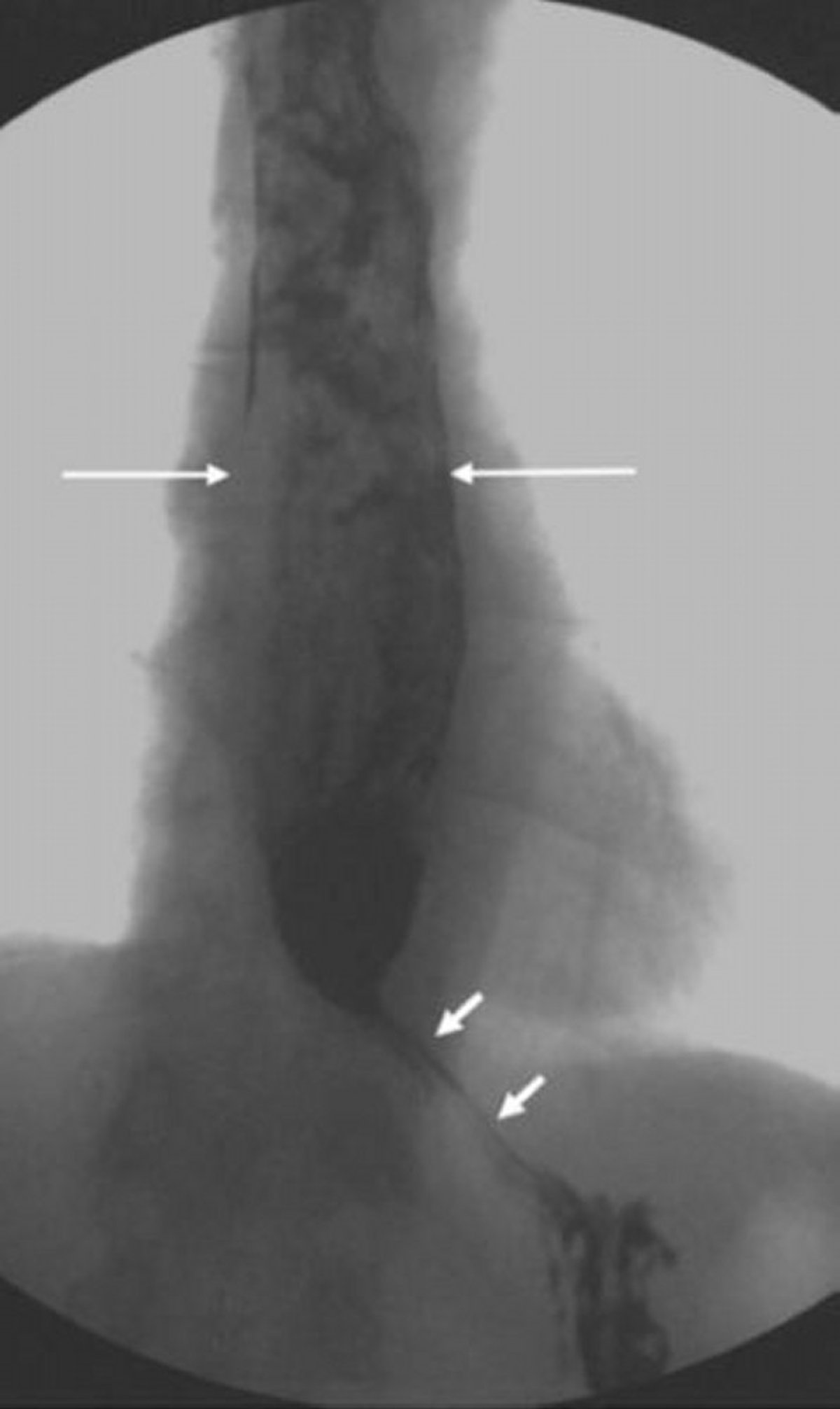
This image shows achalasia with proximal esophageal dilatation and incomplete lower esophageal sphincter relaxation. Note the inhomogeneous appearance of the material within the dilated esophagus due to undigested food that did not pass into the stomach (long arrows). In severe achalasia, only small quantities of contrast medium are able to pass through a beaklike esophagogastric junction (short arrows).
© Springer Science+Business Media
Barium swallow is a complementary test that is often performed during the initial phase of testing when the cause of dysphagia is unknown because manometry is more invasive. Barium swallow may show absence of progressive peristaltic contractions during swallowing. Typically, the esophagus is dilated, often enormously, but is narrowed and beaklike at the LES.
Esophagoscopy is often performed. Findings include upstream esophageal dilation and chronic stasis changes in the mucosa but no obstructing lesion. The LES may be closed. A classic "pop" is often felt when the esophagoscope passes into the stomach.
Functional lumen imaging probe (FLIP) is a high-resolution impedance system that assesses cross-sectional area and simultaneous pressure (distensibility) (3).FLIP, when available, is useful in diagnosing achalasia and may help in equivocal cases where manometry fails to diagnose achalasia despite a high clinical suspicion (1). Guidelines recommend its use in the diagnosis and management of achalasia (4, 5). Additionally, in patients undergoing interventions for achalasia (eg, surgery, peroral endoscopic myotomy), measurement of esophagogastric junction distensibility during and after the intervention may show clinical response to interventions and can help guide therapy.
When manometry shows elevated median integrated relaxation pressure in multiple positions with some intact peristalsis and increased intrabolus pressurization in a patient with symptoms of chest pain or dysphagia, barium swallow and/or FLIP should be ordered to evaluate for clinically significant esophagogastric junction outlet obstruction, which can be an early achalasia variant.
Achalasia must be differentiated from a peptic stricture, particularly in patients with systemic sclerosis, in whom esophageal manometry may also show aperistalsis. Systemic sclerosis is usually accompanied by a history of Raynaud phenomenon and symptoms of gastroesophageal reflux disease (GERD) due to low resting LES pressure.
Symptoms similar to those of achalasia (ie, pseudoachalasia) may be due to cancer at the gastroesophageal junction, which can be diagnosed by CT of the chest and abdomen or by endoscopic ultrasound with biopsy.
Diagnosis references
1. Vaezi MF, Pandolfino JE, Yadlapati RH, et al. ACG Clinical Guidelines: Diagnosis and Management of Achalasia. Am J Gastroenterol. 2020;115(9):1393-1411. doi: 10.14309/ajg.0000000000000731
2. Yadlapati R, Kahrilas PJ, Fox MR, et al. Esophageal motility disorders on high-resolution manometry: Chicago classification version 4.0©. Neurogastroenterol Motil. 2021;33(1):e14058. doi:10.1111/nmo.14058
3. Carlson DA, Lin Z, Kahrilas PJ, et al. High-Resolution Impedance Manometry Metrics of the Esophagogastric Junction for the Assessment of Treatment Response in Achalasia. Am J Gastroenterol. 2016;111(12):1702-1710. doi: 10.1038/ajg.2016.442
4. Gyawali CP, Carlson DA, Chen JW, et al. ACG clinical guidelines: Clinical use of esophageal physiologic testing. Am J Gastroenterol. 2020;115(9):1412-1428. doi: 10.14309/ajg.0000000000000734
5. Hirano I, Pandolfino JE, Boeckxstaens GE. Functional lumen imaging probe for the management of esophageal disorders: Expert review from the clinical practice updates committee of the AGA Institute. Clin Gastroenterol Hepatol. 2017;15(3):325-334. doi: 10.1016/j.cgh.2016.10.022
Treatment of Achalasia
Pneumatic balloon dilation of the LES
Surgical myotomy of the LES
Peroral endoscopic myotomy
Sometimes botulinum toxin injection
Sometimes oral medication
No therapy restores peristalsis; treatment of achalasia is aimed at reducing the pressure at the LES and is not curative (1).
The choice of specific therapy is based on achalasia subtype, procedure risk, and potential adverse effects. The American Society for Gastrointestinal Endoscopy and the American College of Gastroenterology both recognize pneumatic balloon dilation of the LES, peroral endoscopic myotomy, and laparoscopic Heller myotomy as effective first-line therapies (1, 2). While these 3 therapies all appear roughly equivalent in efficacy for type I and type II achalasia, peroral endoscopic myotomy appears superior for type III achalasia. Overall, peroral endoscopic myotomy maintains a higher rate of treatment success than pneumatic dilation (81% vs 40% at 5 years), though peroral myotomy is associated with a higher incidence of gastroesophageal reflux disease and endoscopic esophagitis (3).
When surgical myotomy is performed, fundoplication is also recommended to reduce reflux (1).
In patients who are not candidates for standard endoscopic or surgical treatment options, chemical denervation of cholinergic nerves in the distal esophagus by direct endoscopic injection of botulinum toxin type A into the LES may be tried. Clinical improvement usually occurs in 70 to 80% of patients for the first month (4) and may last 6 months to over 1 year.
Medications such as nitrates or calcium channel blockers have been used but have not been shown to be effective.
Treatment references
1. Vaezi MF, Pandolfino JE, Yadlapati RH, et al. ACG Clinical Guidelines: Diagnosis and Management of Achalasia. Am J Gastroenterol. 2020;115(9):1393-1411. doi: 10.14309/ajg.0000000000000731
2. Khashab MA, Vela MF, Thosani N, et al. ASGE guideline on the management of achalasia. Gastrointest Endosc. 2020;91(2):213-227.e6. doi:10.1016/j.gie.2019.04.231
3. Kuipers T, Ponds FA, Fockens P, et al. Peroral endoscopic myotomy versus pneumatic dilation in treatment-naive patients with achalasia: 5-year follow-up of a randomised controlled trial. Lancet Gastroenterol Hepatol. 2022;7(12):1103-1111. doi:10.1016/S2468-1253(22)00300-4
4. Campos GM, Vittinghoff E, Rabl C, et al: Endoscopic and surgical treatments for achalasia: a systematic review and meta-analysis. Ann Surg 249(1):45-57, 2009. doi: 10.1097/SLA.0b013e31818e43ab
Prognosis for Achalasia
Patients with type II achalasia tend to have the best prognosis, while those with type III achalasia often require a more extensive myotomy and have the worst outcomes (1). Esophageal dilation and tortuosity are poor prognostic indicators. Nocturnal regurgitation and coughing suggest aspiration. Pulmonary aspiration is a late-stage complication, and pulmonary complications secondary to aspiration are difficult to manage.
Incidence of esophageal squamous cell carcinoma in patients with achalasia is significantly increased relative to the general population, although incidence is still low (2, 3).
Prognosis references
1. Vaezi MF, Pandolfino JE, Yadlapati RH, et al. ACG Clinical Guidelines: Diagnosis and Management of Achalasia. Am J Gastroenterol. 2020;115(9):1393-1411. doi: 10.14309/ajg.0000000000000731
2. Low EE, Demb J, Shah SC, et al. Risk of Esophageal Cancer in Achalasia: A Matched Cohort Study Using the Nationwide Veterans Affairs Achalasia Cohort. Am J Gastroenterol. 2024;119(4):635-645. doi:10.14309/ajg.0000000000002591
3. Savarino E, Bhatia S, Roman S, et al. Achalasia. Nat Rev Dis Primers. 2022;8(1):28. doi:10.1038/s41572-022-00356-8
Key Points
A loss of ganglion cells in the myenteric plexus of the esophagus, thought to be viral- or autoimmune-induced, decreases esophageal peristalsis and impairs relaxation of the lower esophageal sphincter (LES).
Patients gradually develop dysphagia for both solids and liquids, and many regurgitate undigested food at night.
Esophageal manometry is the preferred test for achalasia and shows an elevated integrated relaxation pressure in conjunction with a complete lack of peristalsis.
Barium swallow shows absence of progressive peristaltic contractions during swallowing and a markedly dilated esophagus with beaklike narrowing at the LES.
No therapy restores peristalsis; treatment is aimed at reducing the pressure (and thus the obstruction) at the LES.
Treatment is typically pneumatic balloon dilation or myotomy of the LES; patients who are not candidates for these treatments may be given botulinum toxin injections.