Peritonsillar abscess and cellulitis are acute pharyngeal infections most common among adolescents and young adults. Symptoms are severe sore throat, trismus, "hot potato" voice, and uvular deviation. Diagnosis is based on clinical findings and imaging. Treatment of abscess and cellulitis includes broad-spectrum antibiotics, drainage of any pus, hydration, analgesics. Abscesses additionally need surgical intervention (ie, needle aspiration, incision and drainage). Acute tonsillectomy may be performed in selected patients.
Peritonsillar abscess (also called quinsy) is the most common deep space infection of the head and neck, with an incidence of approximately 30 cases per 100,000 population in the United States annually (1). It is most common in young adults between 20 and 40 years of age. It has sometimes been thought to occur as a consequence of acute tonsillitis.
General reference
1. Galioto NJ. Peritonsillar Abscess. Am Fam Physician. 2017;95(8):501-506.
Etiology of Peritonsillar Abscess and Cellulitis
Abscess (quinsy) and cellulitis probably represent a spectrum of the same process in which bacterial infection of the tonsils and pharynx spreads to the soft tissues. Infection is virtually always unilateral and is located between the tonsil and the superior pharyngeal constrictor muscle. It usually involves multiple bacteria that include aerobes and anaerobes. Streptococcus and Staphylococcus species are the most frequent aerobic pathogens (1); Bacteroides species is the predominant anaerobic pathogen.
Symptoms and Signs of Peritonsillar Abscess and Cellulitis

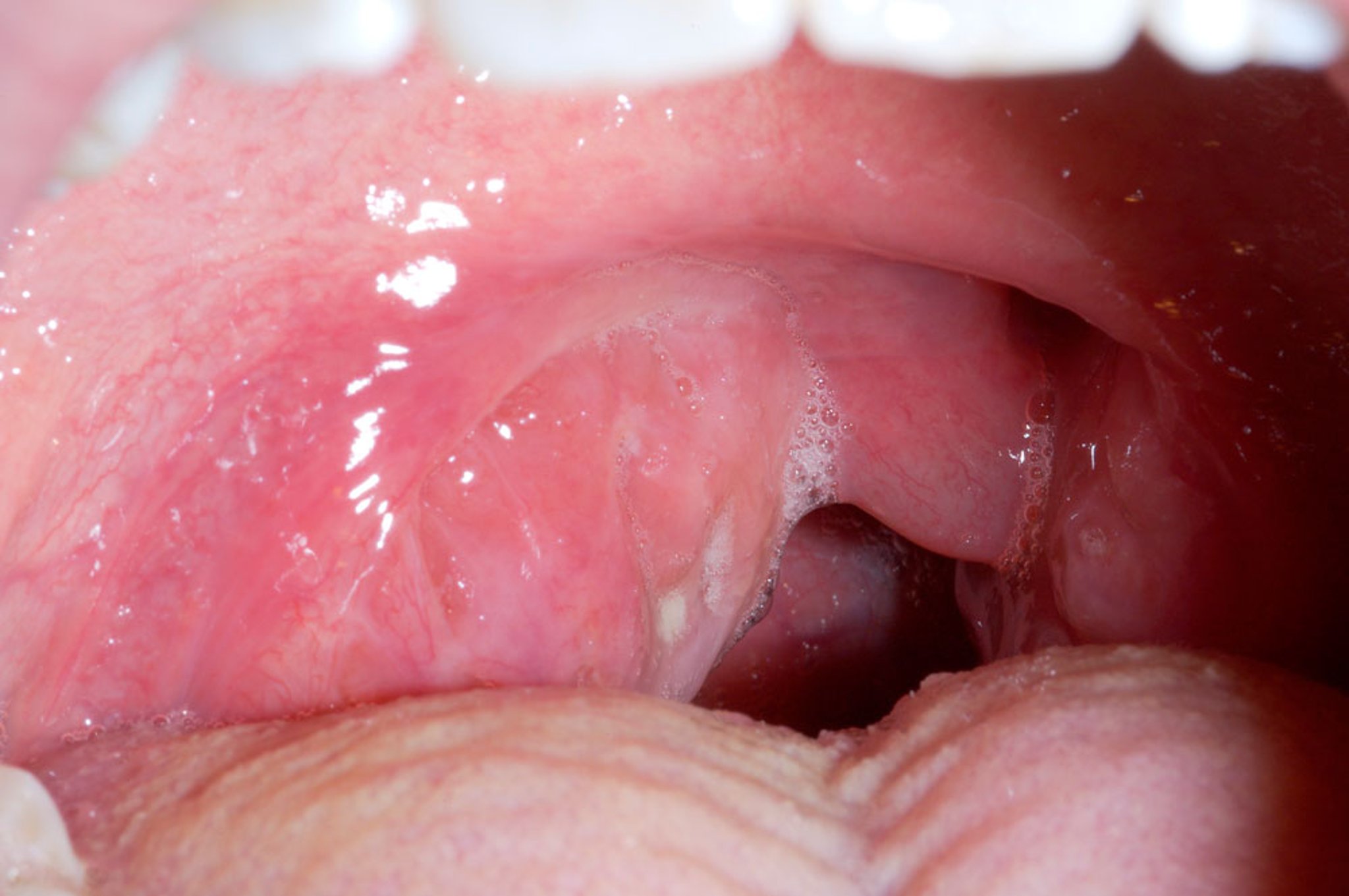
In this patient, the uvula is pushed away from the midline by the swollen tonsillar area, suggesting peritonsillar abscess or cellulitis. There are crypts on the swollen side.
DR P. MARAZZI/SCIENCE PHOTO LIBRARY
Symptoms include gradual onset of severe unilateral sore throat, dysphagia, fever, otalgia, and asymmetric cervical adenopathy. Trismus (lockjaw), a "hot potato" voice (speaking as if a hot object was in the mouth), a toxic appearance (eg, poor or absent eye contact, irritability, inability to be consoled or distracted, fever, anxiety), drooling, severe halitosis, tonsillar erythema, and exudates are common. Abscess and cellulitis both cause swelling above the affected tonsil, but abscess causes a more discrete bulge, with deviation of the soft palate and uvula and pronounced trismus.
Etiology reference
1. Slouka D, Hanakova J, Kostlivy T, et al. Epidemiological and Microbiological Aspects of the Peritonsillar Abscess. Int J Environ Res Public Health. 2020;17(11):4020. Published 2020 Jun 5. doi:10.3390/ijerph17114020
Diagnosis of Peritonsillar Abscess and Cellulitis
Needle aspiration
Sometimes imaging (ultrasound, CT)
The diagnosis of peritonsillar abscess and cellulitis is primarily clinical; however, distinguishing abscess from cellulitis based on physical examination alone is challenging. Peritonsillar abscess and cellulitis are recognized in patients who have a severe sore throat and who have the following:
Trismus
"Hot potato" voice
Uvular deviation
All such patients require needle aspiration of the tonsillar mass and cultures. The absence of pus on needle aspiration may indicate cellulitis (1).
Point-of-care ultrasound can be used for diagnosis and to determine the optimal location for aspiration or incision and drainage; sensitivity is high, but specificity is only moderate (2).
CT of the neck can help confirm the diagnosis when the physical examination is difficult or the diagnosis is in doubt, particularly when the condition must be differentiated from a parapharyngeal infection or other deep neck infection.
Diagnosis references
1. Galioto NJ. Peritonsillar Abscess. Am Fam Physician. 2017;95(8):501-506.
2. Kim DJ, Burton JE, Hammad A, et al. Test characteristics of ultrasound for the diagnosis of peritonsillar abscess: A systematic review and meta-analysis. Acad Emerg Med. 2023;30 (8):859–869. doi: 10.1111/acem.14660
Treatment of Peritonsillar Abscess and Cellulitis
Antibiotics
Drainage of abscess
The treatment of peritonsillar abscess and cellulitis includes antibiotics that cover both aerobes and anaerobes along with supportive care (eg, hydration, pain control). Drainage (needle aspiration or incision and drainage) of the abscess is also required. Most patients can be managed in the outpatient setting.
Cellulitis subsides, usually within 48 hours, with hydration and high-dose penicillin (eg, 2 million units IV every 4 hours or 1 g orally 4 times a day) (1); alternative antibiotics include a first-generation cephalosporin (eg, 1-2 grams IV every 8 hours), amoxicillin (eg, 875 mg oral every 12 hours) or clindamycin. Culture-directed antibiotics are then prescribed for 10 days.
Abscesses are usually incised and drained in the emergency department using thorough local anesthesia and sometimes procedural sedation; low quality evidence suggests incision and drainage may be associated with a lower risk of recurrence compared with needle aspiration alone (2, 3). Ultrasound guidance is sometimes used when the diagnosis of abscess is unclear or when the abscess is small (< 1 cm). Although most patients can be treated as outpatients, some need brief hospitalization for parenteral antibiotics, IV hydration, and airway monitoring.
Rarely, an immediate tonsillectomy is performed, particularly in a young or uncooperative patient who has other indications for elective tonsillectomy (eg, history of frequently recurrent tonsillitis or obstructive sleep apnea). Otherwise, if patients have also had recurrent tonsillitis, elective tonsillectomy is performed 4 to 6 weeks later to prevent abscess recurrence.
Treatment references
1. Hallgren F, Lindell E, Nilsson-Helger B, et al. Antibiotics in treatment of peritonsillar infection: clindamycin versus penicillin. J Laryngol Otol. 2021;135(1):64-69. doi:10.1017/S002221512100013X
2. Alpay M, Yüksel Aslier NG, Danişman MA, et al. Comparative Clinical Outcomes of Needle Aspiration and Incision & Drainage in Peritonsillar Abscess. J Clin Med. 2026;15(6):2347. Published 2026 Mar 19. doi:10.3390/jcm15062347
3. Chang BA, Thamboo A, Burton MJ, et al. Needle aspiration versus incision and drainage for the treatment of peritonsillar abscess. Cochrane Database Syst Rev. 2016;12(12):CD006287. Published 2016 Dec 23. doi:10.1002/14651858.CD006287.pub4
Drug Information for the Topic