Bedbug bites are usually painless but cause reactions, often pruritic, in susceptible patients. Diagnosis is clinical. Treament is symptomatic treatment of bites and chemical and physical eradication of bedbugs.
Etiology of Bedbugs
Bedbug infestations occur throughout the world. The most common bedbugs affecting humans are Cimex lectularius (in temperate climates) and C. hemipterus (mainly in tropical climates); however, due to the rise of international travel and immigration, infestations have been reported outside their usual geographic distribution (1). Bedbugs undergo 5 nymphal stages of development; a blood meal is necessary for each nymph to advance to the next stage and mature into an adult form (2).
Bedbugs hide in cracks and crevices of mattresses and other structures (eg, bed frames, cushions, and walls in areas with less than optimal living conditions) (3). They multiply exponentially; a few bedbugs can multiply to thousands within 2 to 3 months. They move slowly and are attracted to people by warmth and carbon dioxide.
Bedbugs bite exposed skin, usually at night. A feeding is completed in 5 to 10 minutes. Although bedbugs can harbor > 40 types of infectious organisms (eg, Borrelia, Rickettsia, Trypanosoma species), they are not known to transmit these infections to humans (4).
Etiology references
1. Akhoundi M, Zumelzu C, Sereno D, et al. Bed Bugs (Hemiptera, Cimicidae): A Global Challenge for Public Health and Control Management. Diagnostics (Basel). 2023;13(13):2281. Published 2023 Jul 5. doi:10.3390/diagnostics13132281
2. Thomas C, Castillo Valladares H, Berger TG, Chang AY. Scabies, Bedbug, and Body Lice Infestations: A Review. JAMA. Published online September 9, 2024. doi:10.1001/jama.2024.13896
3. Leung AKC, Lam JM, Barankin B, et al. Bed Bug Infestation: An Updated Review. Curr Pediatr Rev. 2024;20(2):137-149. doi:10.2174/1573396320666230406084801
4. Goddard J, deShazo R: Bed bugs (Cimex lectularius) and clinical consequences of their bites. JAMA. 301(13):1358-1366, 2009. doi: 10.1001/jama.2009.40
Symptoms and Signs of Bedbugs
Lesions are generally found on exposed skin and develop some time between the morning after and 10 days after being bitten. Lesions can present as any of the following:
Puncta only
Purpuric macules
Erythematous macules, papules, or wheals, often pruritic and each with a central hemorrhagic punctum
Bullae
Lesions may form linear patterns or may be seen in groups, arranged in the characteristic "breakfast, lunch and dinner" sign (1). Localized papular urticaria may develop after bedbug bites, which is thought to reflect host immune responses to the salivary protein of the bedbug. Older adults develop symptoms less often than do younger people. Lesions resolve after approximately 1 week. Secondary infection can develop.

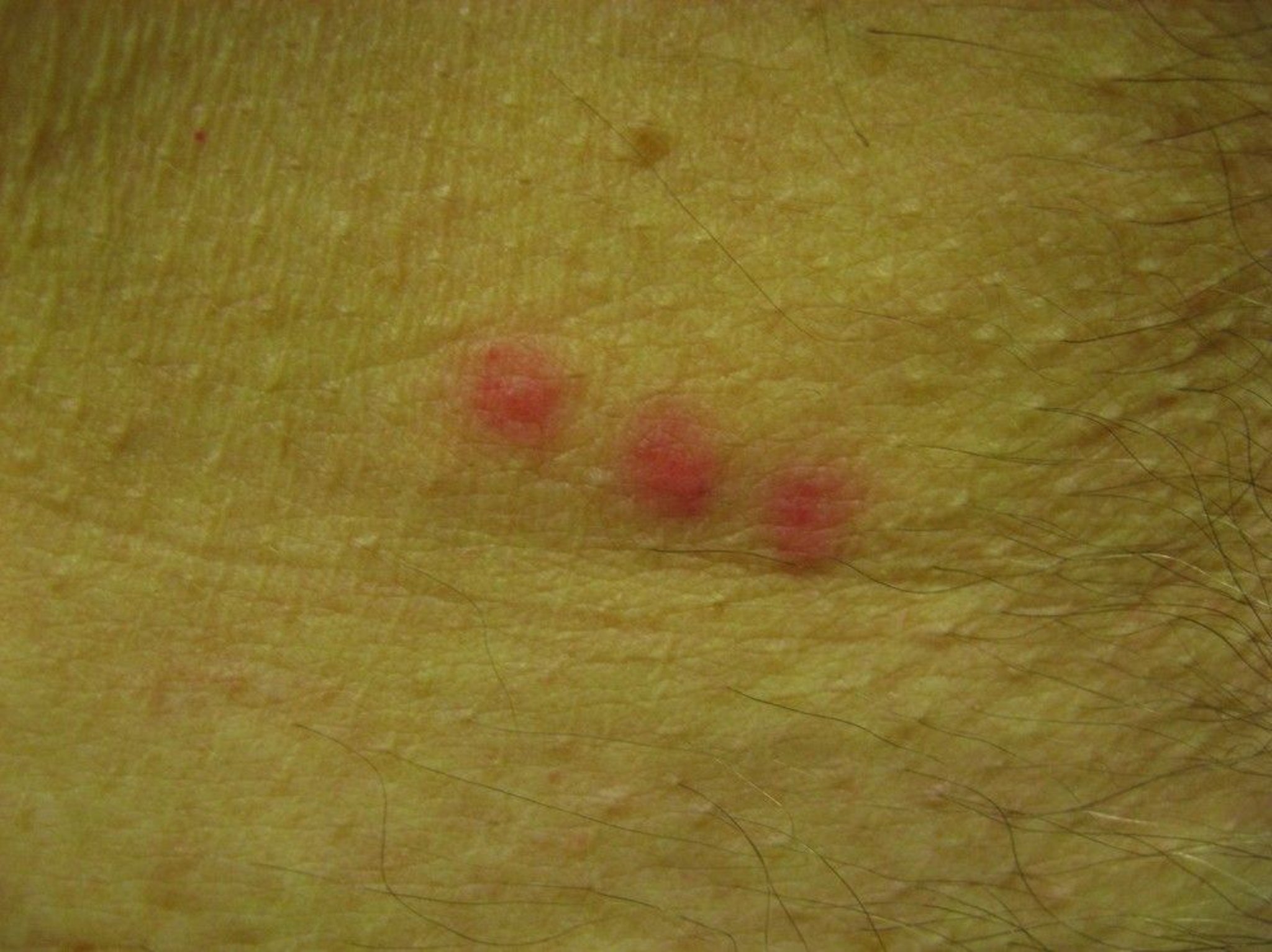
Papules with a central punctum suggest an arthropod bite. The bites in a line, as in this photo, are most indicative of bedbug bites ("breakfast, lunch, and dinner").
© Springer Science+Business Media
Bedbugs have been associated with several mental health effects such as sleep disturbances and anxiety (2). Patients may be anxious about the difficulty and expense of eradicating a bedbug infestation and about the social stigma that can result from infestation. They may isolate themselves to avoid spreading infestation.
Symptoms and signs references
1.Thomas I, Kihiczak GG, Schwartz RA: Bedbug bites: A review. Int J Dermatol. 43(6):430-433, 2004. doi: 10.1111/j.1365-4632.2004.02115.x
2. Ashcroft R, Seko Y, Chan LF, et al. The mental health impact of bed bug infestations: a scoping review. Int J Public Health. 2015;60(7):827-837. doi:10.1007/s00038-015-0713-8
Diagnosis of Bedbugs
History and physical examination alone
Diagnosis based on lesion appearance may be difficult because the appearance of bedbug bites is usually nonspecific. However, most bedbug bites are larger and more edematous than other bites (eg, flea bites).

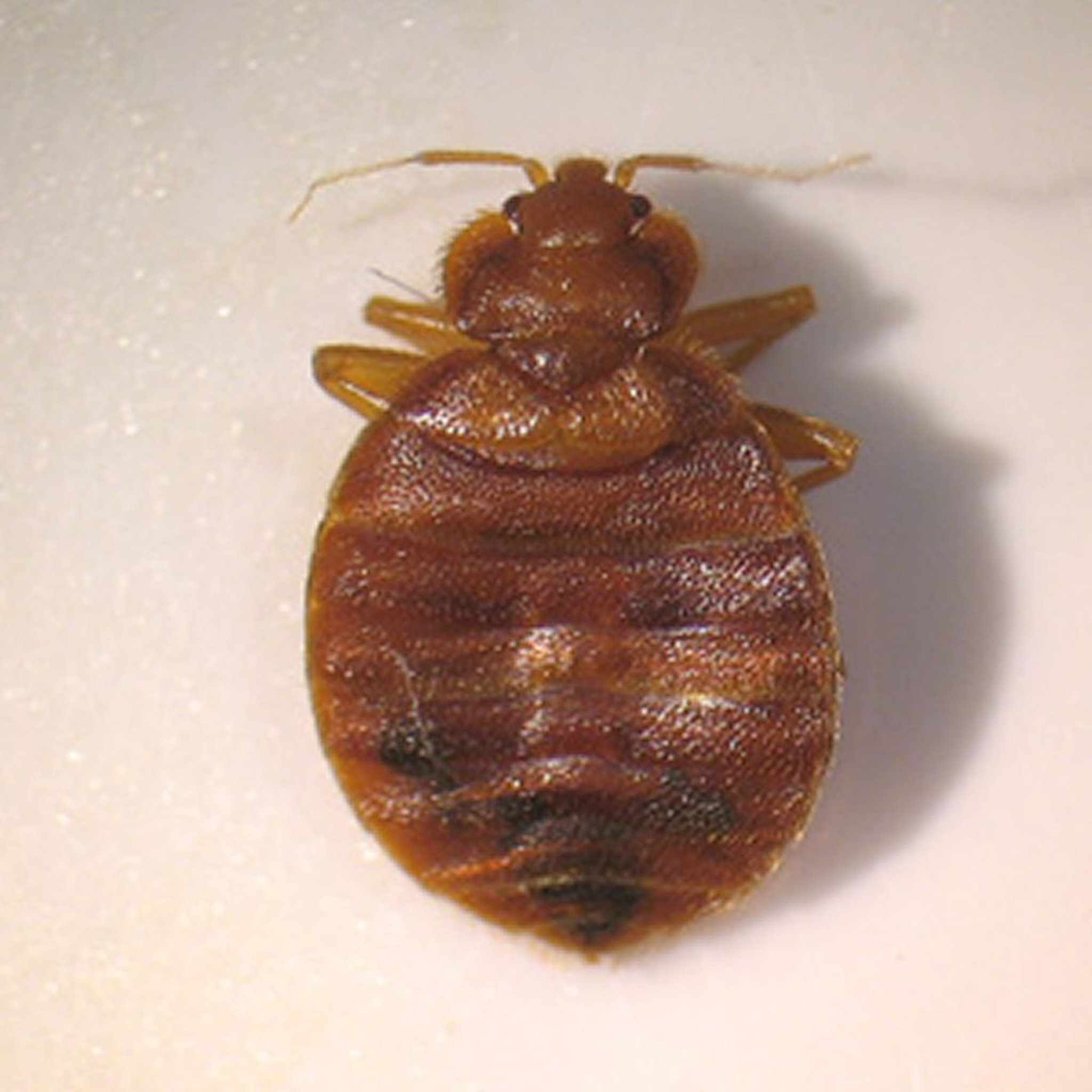
The bedbug depicted has the typical oval, reddish brown body. Its flatness suggests that it has not recently eaten.
Image courtesy of CDC/DPDx.

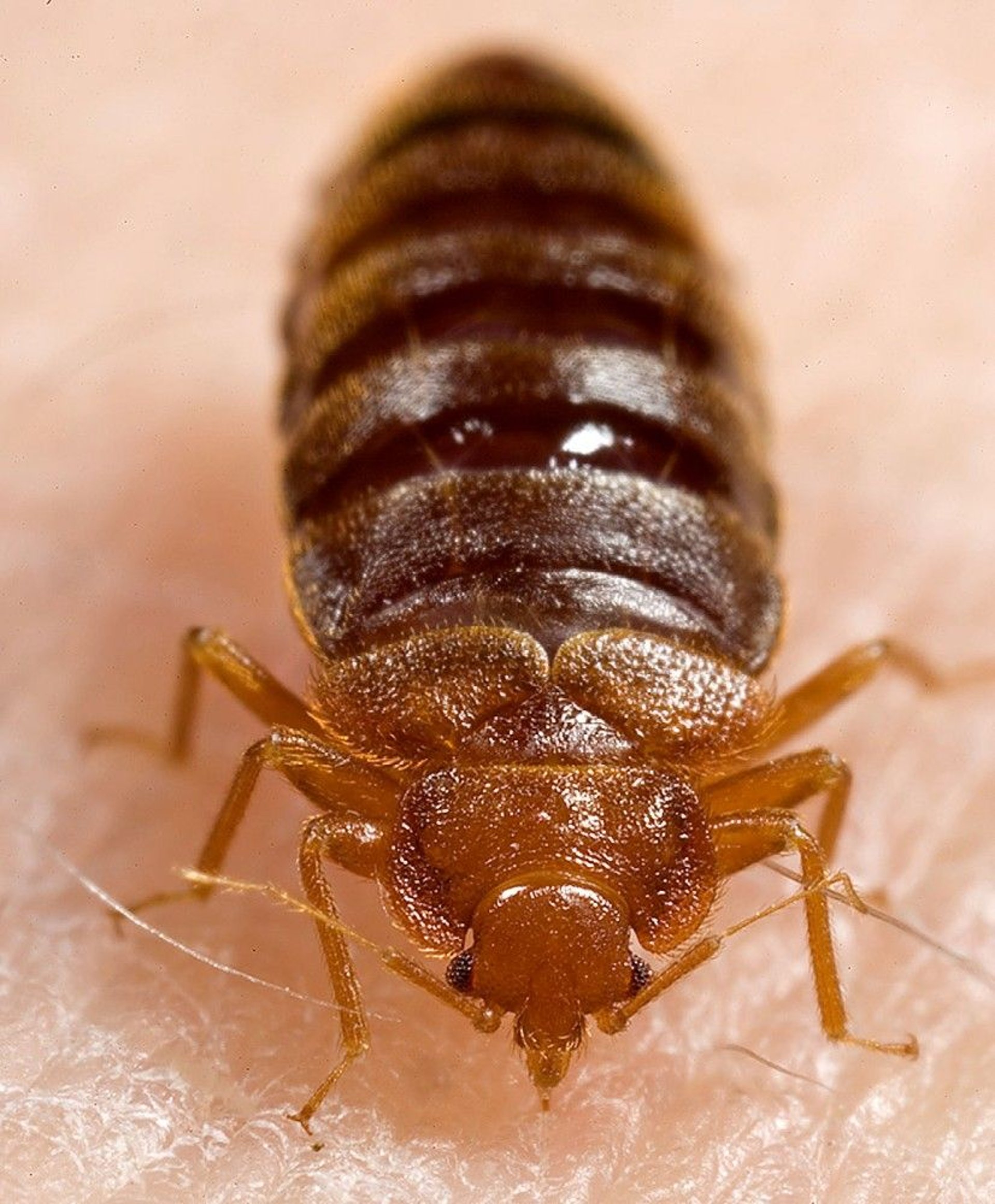
The bedbug depicted has the typical oval, reddish brown body.
Image courtesy of CDC/Harvard University, Dr. Gary Alpert, Urban Pests–Integrated Pest Management (IPM); Dr. Harold Harlan; and Richard Pollack via the Public Health Image Library of the Centers for Disease Control and Prevention.
Identification of bedbugs can help confirm the diagnosis. Bedbugs emit a characteristic musty, sweet odor from specialized glands (sometimes described as berry-like), which can be detected by trained sniffer dogs (1). On inspection, bedbugs have flat, oval, reddish brown bodies. After a blood meal, the body is less flat and more reddish. Adult Cimex lectularis are approximately 5 to 7 mm in length, and C. hemipterus are slightly longer. Bedbug feces or blood may be evident on bed linens or behind wallpaper.
Diagnosis reference
1. Parola P, Izri A. Bedbugs. N Engl J Med. 2020;382(23):2230-2237. doi:10.1056/NEJMcp1905840
Treatment of Bedbugs
Symptomatic treatment
Eradication and prevention of infestations
Bedbug bites are treated symptomatically (eg, with topical glucocorticoids and/or systemic antihistamines) as needed.
Eradicating bedbugs is difficult and is closely linked to detection. Eradication typically requires a multipronged approach and includes accurate detection and monitoring techniques, nonchemical modalities, and chemical agents. Nonchemical control options include exposure to extreme temperatures, exclusion, and physical removal (1).
Physical removal includes vacuuming affected areas and laundering suspect articles, then drying them on the dryer's hottest setting. In addition, environmental inspection by a professional pest management service may be needed. If a bedbug infestation is confirmed, entire rooms should be treated professionally, when possible, by heating to temperatures ≥ 50° C (122° F) or with multiple insecticides. The use of insecticides is limited largely because of growing resistance. Bedbugs and eggs on infested items are killed when frozen at -20° C (-4° F) for at least 2 hours; however, placement in most home kitchen freezers is typically insufficient (2).
Treatment references
1. Doggett SL, Lee CY: Historical and contemporary control options against bed bugs, Cimex spp. Annu Rev Entomol 68:169-190, 2023. doi: 10.1146/annurev-ento-120220-015010
2. Parola P, Izri A: Bedbugs. N Engl J Med 382(23):2230–2237, 2020. doi: 10.1056/NEJMcp1905840
Prevention of Bedbugs
Prevention methods include the use of simplified furniture (eg, metal beds). Harborage of bedbugs can be reduced by sealing cracks and crevices. New sleeping areas (eg, hotel rooms) should be inspected prior to use, with particular attention to the mattress and bedding (1).
Prevention reference
1. Doggett SL, Miller DM, Lee C-Y (eds): Advances in the Biology and Management of Modern Bed Bugs. John Wiley & Sons, Inc, Hoboken, NJ, 2018.
Key Points
Consider bedbug bites particularly if initially asymptomatic lesions cluster linearly on exposed skin.
Thorough inspection for evidence of infestation can help confirm the diagnosis.
Professional pest management assistance is recommended to help eradicate bedbugs.
Eradicate with a multipronged approach that includes prevention, detection and monitoring, nonchemical modalities (eg, heat or cold), and chemical agents.