Chronic paronychia is recurrent or persistent nail fold inflammation. It typically involves the fingernails and is caused by prolonged exposure to water or other irritants (eg, chemotherapeutic medications). Signs and symptoms include a notable absence of pus and presence of erythema; tenderness; and in later stages, fibrosis and/or dystrophy. The diagnosis is clinical. Treatment is based on avoidance of contributing causes, however, topical or intralesional glucocorticoids and topical calcineurin inhibitors may be helpful.
(See also Overview of Nail Disorders.)
Chronic paronychia is an inflammatory disorder of the nail fold skin. It occurs most often in people whose hands are chronically wet (eg, dishwashers, bartenders, housekeepers), particularly if they have hand eczema, are diabetic, or are immunocompromised. Candida is often present, but its role in etiology is unclear; fungal eradication does not always resolve the condition. The condition may be considered to be an irritant dermatitis sometimes with secondary fungal colonization, rather than due to an primary infectious pathology.
Medications such as inhibitors of epidermal growth factor receptor (EGFR), mammalian target of rapamycin (mTOR), and less commonly BRAF gene inhibitors, can cause chemotherapy-induced paronychia along with other skin changes (1). The mechanism is not completely understood. However, most cases seem to be caused by the medication itself such as through alterations in retinoic acid metabolism, and not by secondary infection.
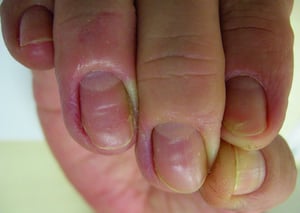
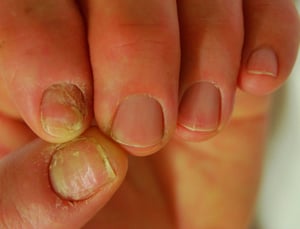
The nail fold may be erythematous and tender with repeated bouts of inflammation and often becomes fibrotic. Unlike acute paronychia, there is almost never pus accumulation. There is often loss of the cuticle and notable separation of the nail fold from the nail plate. This separation leaves a space that allows entry of irritants and microorganisms. The nail may become dystrophic over the long term.
The diagnosis of chronic paronychia is clinical.

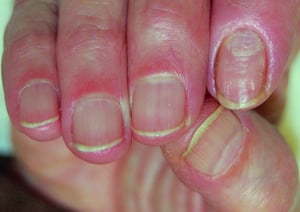
Signs of chronic paronychia in this patient include absent cuticle, swollen proximal nail fold, and Beau lines of the nail plate.
Signs of chronic paronychia in this patient include absent cuticle, swollen proximal nail fold, and Beau lines of the n
© Springer Science+Business Media

© Springer Science+Business Media

© Springer Science+Business Media
Signs of chronic paronychia in this patient include absent cuticle, swollen proximal nail fold, and Beau lines of the nail plate.
Signs of chronic paronychia in this patient include absent cuticle, swollen proximal nail fold, and Beau lines of the n
© Springer Science+Business Media
© Springer Science+Business Media
© Springer Science+Business Media
Reference
1. Axler EN, Iorizzo M, McLellan B, et al. Nail toxicity associated with anticancer agents. J Am Acad Dermatol. 2025;92(6):1327-1336. doi:10.1016/j.jaad.2025.01.069
Treatment of Chronic Paronychia
Avoidance of irritants and excessive water exposure
Topical glucocorticoids or calcineurin inhibitors
Sometimes intralesional glucocorticoids and antifungal medications
The treatment of chronic paronychia centers on strict avoidance of irritants and moisture, combined with topical anti-inflammatory therapy as first-line management. Avoiding irritants and excessive water exposure helps the cuticle reform and close the space between the nail fold and nail plate. Gloves or barrier creams are used if water contact is necessary.
Topical medications that may help include glucocorticoids and tacrolimus 0.1% (a calcineurin inhibitor) (1). Intralesional glucocorticoid injections into the hypertrophic proximal nail fold may expedite improvement. Antifungal treatments (eg, oral fluconazole) are added to therapy only when yeast colonization is a concern.
If there is no response to therapy and a single digit is affected, inflammatory conditions including nail psoriasis, nail lichen planus, or squamous cell carcinoma should be considered. A biopsy is needed to exclude squamous cell carcinoma.
Treatment reference
1. Relhan V, Goel K, Bansal S, Garg VK: Management of chronic paronychia. Indian J Dermatol 59(1):15-20, 2014. doi: 10.4103/0019-5154.123482
Drug Information for the Topic