Cherry angiomas are common benign vascular proliferations, presenting as small papules, most frequently on the trunk and proximal extremities. They were first described by the 19th century British surgeon, Campbell de Morgan, and are sometimes called Campbell de Morgan spots. These range in color from bright red in fair skin to violaceous in dark skin. They increase in number with age and are histologically characterized by proliferating capillaries within the papillary dermis.
They are benign and are without malignant potential. Eruptive cherry angiomatosis (ie, the sudden appearance of multiple cherry angiomas) can be associated with multicentric Castleman disease and hematologic malignancies.

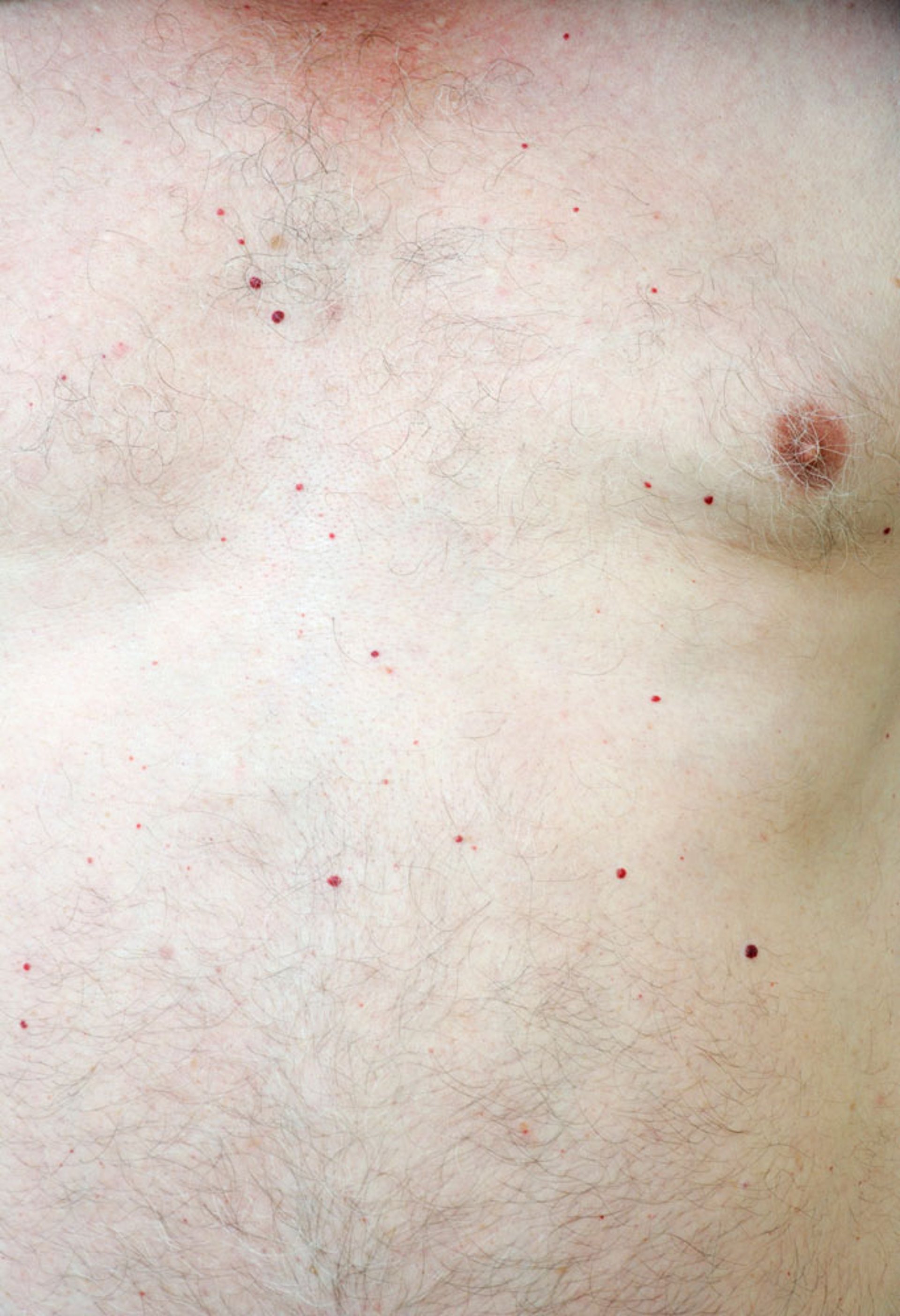
This photo shows cherry angiomas, which are benign papules caused by the proliferation and dilation of cutaneous capillaries; they become more common with age. Cherry angiomas are sometimes called Campbell de Morgan spots.
SCIENCE PHOTO LIBRARY
Diagnosis of Cherry Angiomas
History and physical examination alone
The diagnosis is based on clinical evaluation. Examination with a dermatoscope shows characteristic red, purple, or blue-black lagoons.
Treatment of Cherry Angiomas
Usually unnecessary
Sometimes removal via laser, sclerotherapy, or cryotherapy
Rarely, biopsy
Management of cherry angiomas is not required unless lesions are symptomatic (eg, bleeding) or for cosmetic reasons (1). Treatment options include laser therapy (pulsed dye or Nd:YAG), electrosurgery, cryotherapy, and sclerotherapy, with no single modality clearly superior. Pulsed dye laser is often preferred for minimal pain and good cosmetic outcomes.
In melanoma-prone patients, the presence of cherry angiomas does not alter management, but management should proceed as with any atypical vascular lesion or rapidly changing papule. A biopsy is generally indicated for histopathological examination to exclude malignancy.
Treatment reference
1. Buslach N, Foulad DP, Saedi N, Mesinkovska NA. Treatment Modalities for Cherry Angiomas: A Systematic Review. Dermatol Surg. 2020;46(12):1691-1697. doi:10.1097/DSS.0000000000002791