Keratoacanthomas are round, firm, usually flesh-colored growths that have a central crater that is scaly or crusted. Some keratoacanthomas may be a form of squamous cell carcinoma.
Keratoacanthomas appear most commonly on sun-exposed areas, such as the face, forearms, and back of the hands, and grow quickly. In 1 or 2 months, they typically grow into lumps about 1 inch (about 2.5 centimeters) wide, but sometimes they grow over twice as large. They may spontaneously disappear within a few months, often leaving a scar. It occurs more commonly in men.
The cause of keratoacanthomas is uncertain. Some doctors consider keratoacanthomas to be a form of squamous cell carcinoma, a type of skin cancer, while other doctors consider it to be a benign type of skin cancer Keratoacanthomas often shrink on their own without treatment, but occasionally they can spread aggressively.

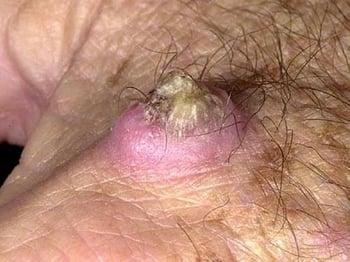
This round, high, firm bump and a central crater is typical of keratoacanthoma, which is thought to be a form of squamous cell carcinoma.

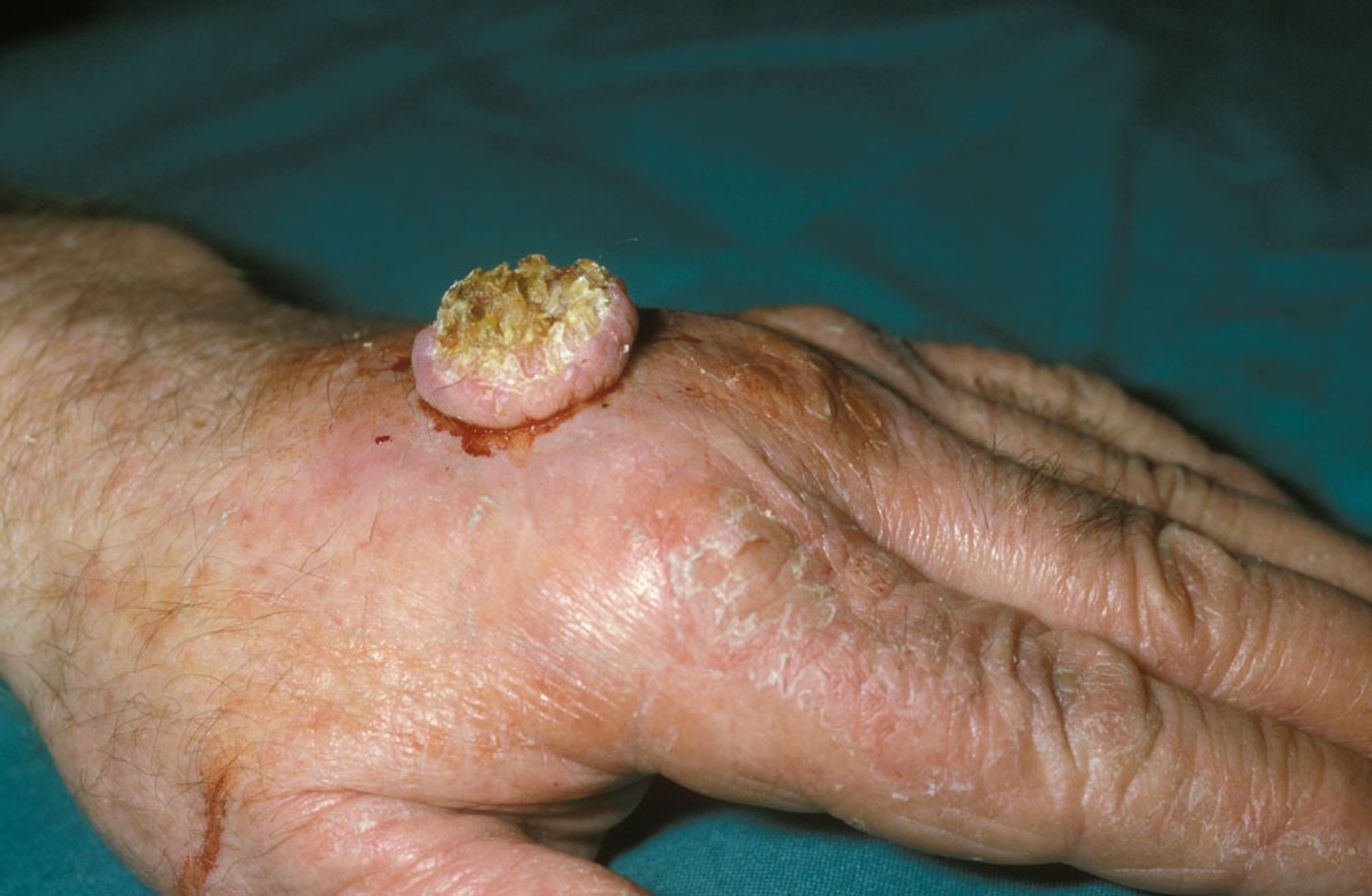
This photo shows a large keratoacanthoma on a person's hand.
DR M.A. ANSARY/SCIENCE PHOTO LIBRARY
Diagnosis of Keratoacanthomas
Biopsy
To confirm the diagnosis of keratoacanthoma, doctors often do a biopsy, in which a piece of skin is removed and examined under a microscope. Sometimes they completely remove the tumor during the biopsy.
Treatment of Keratoacanthomas
Surgery or injections of methotrexate or 5-fluorouracil
There is no guarantee that a keratoacanthoma will spontaneously disappear, and even when they do disappear, there is often a scar. Thus, keratoacanthomas are usually cut out or scraped (curetted) or injected with methotrexate or 5-fluorouracil. Surgery offers the best chance of cure.There is no guarantee that a keratoacanthoma will spontaneously disappear, and even when they do disappear, there is often a scar. Thus, keratoacanthomas are usually cut out or scraped (curetted) or injected with methotrexate or 5-fluorouracil. Surgery offers the best chance of cure.
Prevention of Keratoacanthomas
Because keratoacanthomas may be caused by exposure to sun, people can help prevent this cancer by doing the following, starting in early childhood:
Avoiding the sun: For example, seeking shade, minimizing outdoor activities between 10 AM and 4 PM (when the sun’s rays are strongest), and avoiding sunbathing and the use of tanning beds
Wearing protective clothing: For example, long-sleeved shirts, pants, and broad-brimmed hats
Using sunscreen: At least sun protection factor (SPF) 30 with UVA and UVB protection used as directed and reapplied every 2 hours and after swimming or sweating but not used to prolong sun exposure
More Information
The following English-language resource may be useful. Please note that The Manual is not responsible for the content of this resource.
American Cancer Society: What Are Basal and Squamous Cell Skin Cancers? Information about squamous cell carcinoma, including treatment options and prognosis
Drug Information for the Topic