Pyelonephritis is a bacterial infection of one or both kidneys.
Infection can spread up the urinary tract to the kidneys, or uncommonly the kidneys may become infected through bacteria in the bloodstream.
Chills, fever, back pain, nausea, and vomiting can occur.
Urine tests and imaging tests are done if doctors suspect pyelonephritis.
Antibiotics are given to treat the infection.
The urinary tract consists of the kidneys, ureters (tubes that carry urine from the kidneys to the bladder), bladder, and urethra (the tube through which urine flows out of the body).
Pyelonephritis is more common among women than men.
(See also Overview of Urinary Tract Infections [UTIs].)

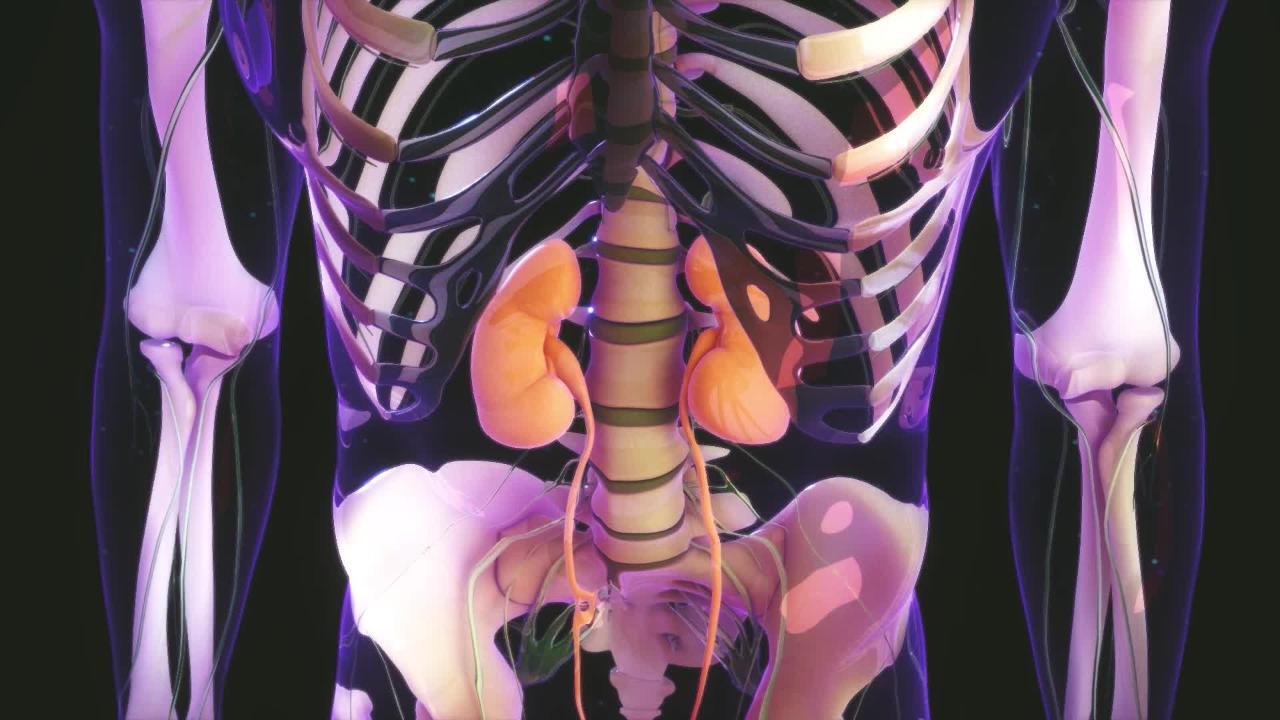
Causes of Kidney Infection
Pyelonephritis is usually caused by bacteria. Rarely, it is caused by fungi or viruses.
Escherichia coli (E. coli) is a type of bacteria that normally inhabits the large intestine. It causes about 80% of cases of pyelonephritis among people who are not hospitalized or living in a nursing home.
Bacteria usually move from the genital area through the urethra to the bladder, up the ureters, and into the kidneys. In a person with a healthy urinary tract, an infection is usually prevented from moving up the ureters into the kidneys by the flow of urine that washes out bacteria and by closure of the ureters at their entrance to the bladder. However, any blockage (obstruction) to the flow of urine, such as a structural abnormality, kidney stone, an enlarged prostate gland, or the backflow (reflux) of urine from the bladder into the ureters increases the likelihood of pyelonephritis.
In a few people, bacteria are carried to the kidneys from another part of the body through the bloodstream. For instance, the bacteria E. coli can spread to the kidneys through the bloodstream.
The risk of pyelonephritis is increased during pregnancy. During pregnancy, the enlarging uterus puts pressure on the ureters, which partially obstructs the normal downward flow of urine. Pregnancy also increases the risk of reflux of urine up the ureters by causing the ureters to dilate and by reducing the muscle contractions that propel urine down the ureters into the bladder.
The risk of pyelonephritis is increased for people who have a kidney transplant.
The risk and severity of pyelonephritis are also increased in people with diabetes or a weakened immune system (which reduces the body's ability to fight infection).
Some people develop long-standing infection (reflux nephropathy or chronic pyelonephritis). Almost all of them have significant underlying abnormalities, such as a urinary tract obstruction, large kidney stones that persist, or, more commonly, reflux of urine from the bladder into the ureters (which occurs mostly in young children). Chronic pyelonephritis can cause bacteria to be released into the bloodstream, sometimes resulting in an infection in the opposite kidney or elsewhere in the body. Chronic pyelonephritis may severely damage the kidneys.
Symptoms of Kidney Infection
Symptoms of pyelonephritis often begin suddenly with chills, fever, pain in the lower part of the back on either side, abdominal pain, nausea, and vomiting.
About one-third of people with pyelonephritis also have symptoms of cystitis (bladder infection), including frequent, painful urination. One or both kidneys may be enlarged and painful, and doctors may find tenderness in the small of the back on the affected side. Sometimes the muscles of the abdomen are tightly contracted. Irritation resulting from the infection or the passing of a kidney stone (if one is present) can cause spasms of the ureters. If the ureters spasm, people may have episodes of intense pain (renal colic).
In older adults and people whose bladder is malfunctioning because of nerve damage (neurogenic bladder) or who have a bladder catheter inserted for an extended period, pyelonephritis may not cause any symptoms that seem to indicate a problem in the urinary tract. Instead, in these people pyelonephritis may manifest as a decrease in mental function (delirium or confusion) or as an infection of the bloodstream (sepsis).
In chronic pyelonephritis, the pain may be vague, and fever may come and go or not occur at all.
Diagnosis of Kidney Infection
Urinalysis
Urine culture
Imaging tests
Doctors can usually diagnose pyelonephritis based on typical symptoms such as chills, fever, pain in the lower part of the back, and frequent, painful urination.
A midstream (clean-catch) urine specimen is collected so that the urine is not contaminated with bacteria from the vagina or the tip of the penis. A strip of test paper is sometimes dipped into the urine to do 2 quick and simple tests for substances that are normally not found in urine. The testing strip can detect nitrites that are released by bacteria. The testing strip can also detect leukocyte esterase (an enzyme found in certain white blood cells), which may indicate that the body is fighting the infection (see Urinalysis and Urine Culture).
In addition, the urine specimen can be examined under a microscope to see the number of red and white blood cells and whether it contains bacteria. Sometimes, urine cultures, in which bacteria from a urine sample are grown in a laboratory, are done to identify the numbers and type of bacteria. If the person has an infection, one type of bacteria is usually present in large numbers.
Imaging tests are usually not need to diagnose pyelonephritis. However, in some cases, doctors may order imaging tests which include ultrasounds, computed tomography (CT) scans, or intravenous urography (IVU). These tests may be done in:
People who have intense back pain (typical of renal colic [kidney stone pain])
People who do not respond to antibiotic treatment within 72 hours
People whose symptoms return shortly after antibiotic treatment is finished
People who have chronic or recurring pyelonephritis
People whose blood test results indicate kidney damage
Men (because they so rarely develop pyelonephritis)
Ultrasounds or CT scans may reveal kidney stones, structural abnormalities, or other causes of blockages in the urinary tract.
Blood tests may be done to check for elevated white blood cell levels (suggesting infection), bacteria in the blood, or kidney damage.


Treatment of Kidney Infection
Antibiotics
Occasionally surgery
Antibiotics are started as soon as the doctor suspects pyelonephritis and samples have been taken for laboratory tests. The choice of antibiotic or its dosage may be modified based on the laboratory test results, how sick the person is, whether the bacteria common in the community can be treated with common antibiotics (and which antibiotics), and whether the infection started in the hospital, where bacteria tend to be more resistant to antibiotics. Other factors that can alter the choice or dosage of antibiotic include whether the person's immune system is impaired and whether the person has a urinary tract abnormality (such as an obstruction).
Sometimes people do not have to be hospitalized and can receive outpatient treatment with antibiotics given by mouth. Outpatient treatment is usually successful in people who have:
No nausea or vomiting
No signs of dehydration or sepsis
No other disorders that weaken the immune system, such as certain cancers, diabetes mellitus, or advanced HIV infection (also called AIDS)
No blockage or abnormality of urinary tract and no kidney stones
No signs of very severe infection, such as low blood pressure or confusion
Pain that is controlled with pain medications taken by mouth
Otherwise, people are usually treated initially in the hospital. Pregnant people may need to be hospitalized. People who are hospitalized are first given antibiotics by vein (intravenously) for about 3 days. They are then usually allowed to go home where they can switch to antibiotics taken by mouth.
Antibiotic treatment of pyelonephritis is given for about 1 to 2 weeks. However, antibiotic therapy may continue for up to 6 weeks for men in whom the infection is due to prostatitis, which is more difficult to eradicate. A final urine sample is usually taken shortly after the antibiotic treatment is finished to make sure the infection has been eradicated.
Surgery is necessary only if imaging tests show that something is blocking the urinary tract, such as a structural abnormality or a particularly large kidney stone. Removal of the infected kidney may be necessary for people with chronic pyelonephritis who are about to undergo kidney transplantation. Spread of infection to the transplanted kidney is particularly risky because the person takes immunosuppressant medications, which prevent rejection of the transplanted kidney but also weaken the body's ability to fight infection.
Prognosis for Kidney Infection
Most people recover fully.
Delayed recovery and the risk of complications are more likely if the person needs hospitalization, the infecting organism is resistant to commonly used antibiotics, or the person has a disorder that weakens the immune system (such as certain cancers, diabetes mellitus, or advanced HIV infection) or a kidney stone.
Prevention of Kidney Infection
People who have frequent episodes of pyelonephritis or whose infection returns after antibiotic treatment is finished may be advised to take a different antibiotic on a long-term basis to prevent recurring infection. The ideal duration of such therapy is unknown. If the infection returns after stopping this antibiotic, people may need to take an antibiotic indefinitely.
People who are pregnant or who may become pregnant while taking an antibiotic to treat pyelonephritis should talk to their doctor about which antibiotics are safe to take during pregnancy.