Tumors of the ear may be noncancerous (benign) or cancerous (malignant). Most ear tumors are found when people see them or when a doctor looks in the ear because people notice their hearing seems decreased.
Noncancerous ear tumors
Noncancerous tumors may develop in the ear canal, blocking it and causing hearing loss and a buildup of earwax. Such tumors include
Epidermal inclusion cysts (sometimes referred to as sebaceous cysts): Small sacs filled with skin secretions
Osteomas and exostoses: Noncancerous bone growths
Keloids: Growths of excess scar tissue after an injury or ear piercing
Exostoses occur in people who swim in cold water, such as scuba divers and surfers. "Surfer's ear" is a common term for bony exostoses in the ear canal.
Most osteomas and exostoses are small and require no treatment. The most effective treatment for large osteomas and exostoses that obstruct the ear canal, trap water, and/or cause infection or hearing loss is surgical removal. After treatment, hearing usually returns to normal.
Keloids can be repeatedly injected with a steroid (sometimes also called a glucocorticoid or corticosteroid, such as triamcinolone, or surgically removed. People may be given additional steroid injections or even radiation after surgical removal.Keloids can be repeatedly injected with a steroid (sometimes also called a glucocorticoid or corticosteroid, such as triamcinolone, or surgically removed. People may be given additional steroid injections or even radiation after surgical removal.
Cancerous ear tumors
Basal cell carcinoma and squamous cell carcinoma are common skin cancers that can develop on the external ear after repeated and prolonged exposure to the sun. People who have chronic ear infections may have an increased risk of developing squamous cell carcinoma. When these cancers first appear, they can be successfully treated by removing them surgically or by applying radiation therapy. More advanced cancers may require surgical removal of a larger area of the external ear. Melanoma is another, more rapidly spreading form of skin cancer that can also develop in the skin of the outer ear canal and must be removed surgically.

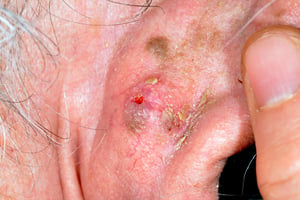
Squamous cell carcinomas can have various appearances. This photo shows an area that is scaly, crusted, and darker than the surrounding skin. It was diagnosed as squamous cell carcinoma after a biopsy.
Squamous cell carcinomas can have various appearances. This photo shows an area that is scaly, crusted, and darker than
DR P. MARAZZI/SCIENCE PHOTO LIBRARY


This photo shows basal cell carcinoma, a skin cancer, on the skin of the outer ear.
This photo shows basal cell carcinoma, a skin cancer, on the skin of the outer ear.
SCIENCE PHOTO LIBRARY


This photo shows malignant melanoma, a skin cancer, on the earlobe.
This photo shows malignant melanoma, a skin cancer, on the earlobe.
DR P. MARAZZI/SCIENCE PHOTO LIBRARY
Squamous cell carcinomas can have various appearances. This photo shows an area that is scaly, crusted, and darker than the surrounding skin. It was diagnosed as squamous cell carcinoma after a biopsy.
Squamous cell carcinomas can have various appearances. This photo shows an area that is scaly, crusted, and darker than
DR P. MARAZZI/SCIENCE PHOTO LIBRARY
This photo shows basal cell carcinoma, a skin cancer, on the skin of the outer ear.
This photo shows basal cell carcinoma, a skin cancer, on the skin of the outer ear.
SCIENCE PHOTO LIBRARY
This photo shows malignant melanoma, a skin cancer, on the earlobe.
This photo shows malignant melanoma, a skin cancer, on the earlobe.
DR P. MARAZZI/SCIENCE PHOTO LIBRARY
Ceruminoma (cancer of the cells that produce earwax) develops in the outer third of the ear canal. These tumors do not spread (metastasize) to other areas but they are destructive to the ear canal. Ceruminomas have nothing to do with earwax buildup. Treatment consists of removing the tumor and surrounding tissue surgically.
Drug Information for the Topic