Craniosynostosis is a birth defect in which 1 or more of the skull's sutures close too early.
Birth defects, also called congenital anomalies, are physical abnormalities that occur before a baby is born. "Congenital" means "present at birth." (See also Introduction to Birth Defects of the Face and Skull.)
Sutures of the Skull
The sutures are bands of tissue that connect the bones of the skull. The sutures allow the skull to grow as the brain grows inside. |

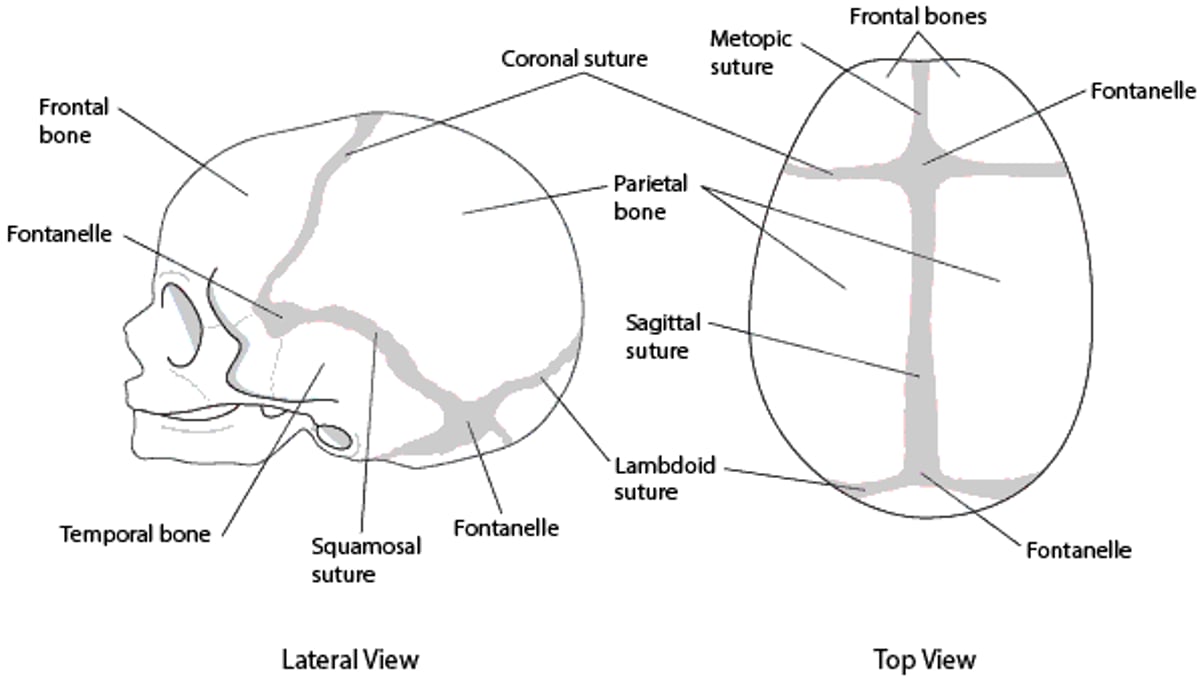
The skull is not a single bone. Between the different bones of the skull are the sutures, bands of tissue that connect the bones. The sutures allow the skull to grow as the brain grows inside. They remain flexible for several years after birth and close and harden as the baby grows, and the skull bones fuse together. After the sutures close, the skull cannot grow any more.
Craniosynostosis results when these sutures close too early, which restricts the ability of the brain and skull to grow to a normal shape and size. Craniosynostosis may occur spontaneously or may be caused by mutations in the baby's genes.
This defect occurs in 1 in every 1,700 babies. About 20 to 50% of children who have craniosynostosis develop learning disabilities.
There are several types of craniosynostosis, depending on which suture is closed. The 2 most common types, sagittal and coronal, are discussed below.
Doctors base their diagnosis on the evaluations of experts, such as neurosurgeons or members of a craniofacial team, as well as on imaging (often computed tomography [CT] or sometimes ultrasound). Treatment, when necessary, is surgical. Sometimes a helmet is also worn after surgery, and occasionally before surgery, to help reshape the skull.
Sagittal craniosynostosis
Craniosynostosis of the sagittal suture (the suture on top of the head running from the baby's fontanelle or soft spot to the back of the head) is the most common type. This type of craniosynostosis results in a narrow and long skull (dolichocephaly).


These photos show a 6-week-old infant who has craniosynostosis of the sagittal suture (sagittal craniosynostosis), which causes a narrow and long skull (dolichocephaly).
Coronal craniosynostosis
Craniosynostosis of the coronal sutures (the sutures running across the head to the left and right of the soft spot) is the next most common type. This type of craniosynostosis results in a short and broad skull if the sutures on both sides of the soft spot are closed (brachycephaly) or in a diagonal skull if the sutures on only one side of the soft spot are closed (plagiocephaly). Children who have this type of craniosynostosis often have other defects of the face and skull.


This image shows a 10-week-old infant who has craniosynostosis of the left coronal suture. This defect has caused the right side of the forehead to appear pushed forward and the eyes to be uneven.
Diagnosis of Craniosynostosis
A doctor's evaluation
Usually imaging tests such as CT scan
Sometimes genetic testing
Doctors can identify craniosynostoses during a physical examination.
Doctors usually also do imaging tests of the skull and brain.
A baby who has craniosynostosis may be evaluated by a geneticist. A geneticist is a doctor who specializes in genetics (the science of genes and how certain qualities or traits are passed from parents to children). Genetic testing of a sample of the baby's blood may be done to look for chromosome and gene abnormalities. This testing can help doctors determine whether a specific genetic disorder is the cause and rule out other causes.
Treatment of Craniosynostosis
Surgery
Special helmet
Craniosynostoses are usually corrected with surgery. After surgery, babies often wear a special helmet to help mold their skull into a more regular shape. Occasionally a helmet is worn before surgery.
Because abnormal genes may be involved in the formation of craniosynostoses, affected families may benefit from genetic counseling.