Candidiasis is a fungal infection caused by several species of the yeast Candida, especially Candida albicans.
When the yeast Candida grows out of control, it can spread to through the bloodstream and to other parts of the body and cause infection.
The most common type of candidiasis is a superficial infection of the mouth, vagina, or skin that causes white or red patches and itching, irritation, or both.
People whose immune system is weakened may have serious infections of the esophagus and other internal organs.
A sample of infected material is examined under a microscope and sent for culture.
Antifungal medications may be applied directly to the affected area or taken by mouth, but serious infections require medications given by vein.
Candida are yeast that are normally present on the skin, in the intestinal tract, and in the genital area. Usually, Candida in these areas does not cause problems. However, the fungi sometimes cause skin infections, mouth infections (affecting the mucous membranes), or infections of the vulva and vagina. Such infections can develop in people with a healthy immune system, but they are more common among or persistent in people with diabetes, cancer, or advanced HIV infection (also called AIDS) and in pregnant people. Candidiasis of the mouth and esophagus are common among people with advanced HIV infection. Candidiasis is also common among people who are taking antibiotics because the antibiotics kill the bacteria that normally live in the body and compete with Candida for nutrients in the body, allowing Candida to grow unchecked.
Candidiasis is bothersome but rarely life threatening. However, some forms of candidiasis are serious. They include:
Invasive candidiasis
Candidemia (the most common form of invasive candidiasis)
In invasive candidiasis, the infection spreads to other parts of the body, such as the heart valves, brain, spleen, kidneys, and eyes. Invasive candidiasis occurs mainly in people with a weakened immune system and in hospitalized people. Candidiasis is one of the most common infections acquired in the hospital.
Candidiasis of the esophagus is one of the illnesses indicating that HIV infection has developed into advanced HIV infection (also called AIDS).
Candidemia is when candidal infection spreads through the bloodstream. It is a serious infection. In the United States, Candida is a common cause of bloodstream infections. The risk of developing this infection is increased by certain conditions, such as the following:
Major abdominal surgery
Use of intravenous lines or tubes—particularly a tube inserted into one of the large veins of the neck, upper chest, or groin (central venous catheter) or a tube used to provide nutrition (intravenous feeding)
Use of certain antibiotics
Candidemia is often fatal if not promptly treated.
(See also Overview of Fungal Infections, Candidiasis (Yeast Infection) of the skin, and Vaginal Yeast Infection.)
Symptoms of Candidiasis
Infection of the mouth (thrush) causes the following:
Creamy, white, painful patches inside the mouth
Cracking at the corners of the mouth (cheilitis)
A red, painful, smooth tongue

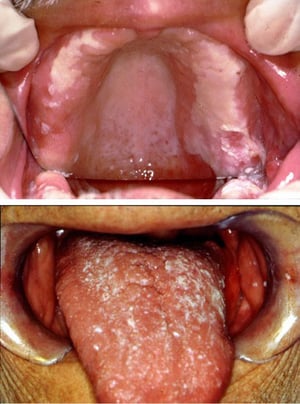
In candidiasis of the mouth (thrush), white, painful patches form in the mouth—for example, under dentures (top photo) or on the tongue (bottom photo).
In candidiasis of the mouth (thrush), white, painful patches form in the mouth—for example, under dentures (top photo)
Images courtesy of Jonathan Ship, MD.

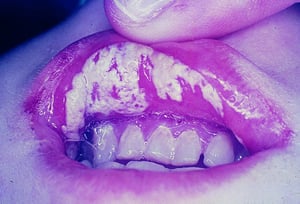
In candidiasis of the mouth, white, painful patches may form on the inside of the lips.
In candidiasis of the mouth, white, painful patches may form on the inside of the lips.
© Springer Science+Business Media

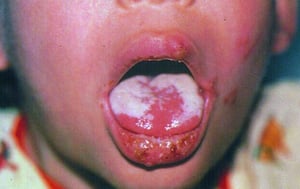
In candidiasis of the mouth, white, painful patches may form on the tongue.
In candidiasis of the mouth, white, painful patches may form on the tongue.
© Springer Science+Business Media
In candidiasis of the mouth (thrush), white, painful patches form in the mouth—for example, under dentures (top photo) or on the tongue (bottom photo).
In candidiasis of the mouth (thrush), white, painful patches form in the mouth—for example, under dentures (top photo)
Images courtesy of Jonathan Ship, MD.
In candidiasis of the mouth, white, painful patches may form on the inside of the lips.
In candidiasis of the mouth, white, painful patches may form on the inside of the lips.
© Springer Science+Business Media
In candidiasis of the mouth, white, painful patches may form on the tongue.
In candidiasis of the mouth, white, painful patches may form on the tongue.
© Springer Science+Business Media
Patches in the esophagus cause pain or difficulty swallowing.

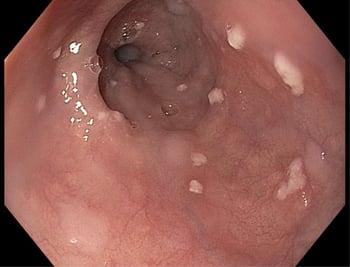
This photo was taken during an examination of the wall of the esophagus using a flexible viewing tube called an endoscope.
The photo shows several whitish or yellowish patches that have a characteristic "cottage cheese" appearance and are caused by the fungus Candida.
When the skin is infected, a burning rash develops. Some types of diaper rash are caused by Candida.
If the infection spreads to other parts of the body or through the bloodstream, it is more serious. It can cause fever, a heart murmur, enlargement of the spleen, dangerously low blood pressure (shock), and decreased urine production. An infection of the retina and inner parts of the eye can cause blindness.
If the infection is severe, several organs may stop functioning, and the infection can become fatal.
Diagnosis of Candidiasis
Examination and culture of a sample of blood or infected tissue
Sometimes blood tests
Polymerase chain reaction (PCR) test
Many candidal infections, especially those affecting the skin or mucous membranes such as the mouth and vagina, are apparent from the symptoms alone.


To confirm the diagnosis, a doctor must identify the fungi in a sample viewed under a microscope. Samples of blood or other infected tissues may be sent to a laboratory to be cultured and examined to identify the fungi.
Doctors may do blood tests to detect Candida.
Other tests that detect genetic material in microorganisms may be done, including polymerase chain reaction (PCR). The PCR test is used to produce many copies of a gene from the fungus, making the fungus much easier to identify.
Other tests can be done on blood or tissue samples to detect Candida proteins in the blood. One such test is called matrix-assisted laser desorption/ionization–time of flight or MALDI-TOF. These tests can help doctors make the diagnosis.
If candidemia is diagnosed, doctors may examine the eyes to determine whether the eyes are infected.
Treatment of Candidiasis
Antifungal medications
Candidiasis that occurs only on the skin or in the mouth or vagina can be treated with antifungal medications (such as clotrimazole and nystatin) that are applied directly to the affected area. A doctor may also prescribe the antifungal medication fluconazole to be taken by mouth.
For infections of the esophagus, doctors prescribe antifungal medications (such as fluconazole or itraconazole) to be taken by mouth. If these medications are ineffective or if the infection is severe, other antifungal medications are used.
Candidiasis that has spread throughout the blood and body is usually treated with anidulafungin, caspofungin, or micafungin given intravenously. People may be switched to fluconazole, which can be given intravenously or by mouth (orally). If the infection starts to go away, most people are switched to oral medications. If the infection is difficult to treat, amphotericin B may be given intravenously. Doctors may continue treatment for 2 to 3 weeks in people who have a serious infection.
Candidiasis is more serious and less responsive to treatment in people with certain disorders, such as diabetes or a weakened immune system (for example, in people with a low number of white blood cells called neutrophils), or conditions (for example, those requiring nutrition and feeding given intravenously, or the placement of a urinary catheter). In people with diabetes, controlling blood sugar levels helps cure the infection. Infected medical devices such as catheters are sometimes removed, especially if people also have a bloodstream infection.
Drug Information for the Topic