Sunburn is an acute inflammatory dermatosis characterized by erythema and sometimes pain and blisters caused by overexposure to solar ultraviolet radiation. Diagnosis is clinical. Treatment is similar to that for thermal burns, including cool compresses, nonsteroidal anti-inflammatory drugs, and, for severe cases, sterile dressings and topical antimicrobials. Prevention is crucial and consists of sun avoidance and use of sunscreens.
Sunburn results from overexposure of the skin to ultraviolet (UV) radiation; wavelengths in the UVB spectrum (280 to 320 nm) cause the most pronounced effects.
Risk factors include lightly pigmented skin, lack of protective measures, and environmental factors that alter the character and amount of sunburn-producing UV radiation.
Excessive exposure damages skin cell DNA and triggers an inflammatory cascade involving eicosanoids (such as prostaglandins). Damaged keratinocytes induce a downstream cascade of events (1). By triggering innate immune responses, damage-associated molecular patterns (DAMPs) are released, which activate Toll-like receptors and inflammasomes, leading to caspase-1 activation (2) and ultimately the secretion of pro-inflammatory cytokines such as interleukins (IL)-1, IL-18, and IL-33 (3).
(See also Overview of Effects of Sunlight.)
Symptoms and Signs of Sunburn

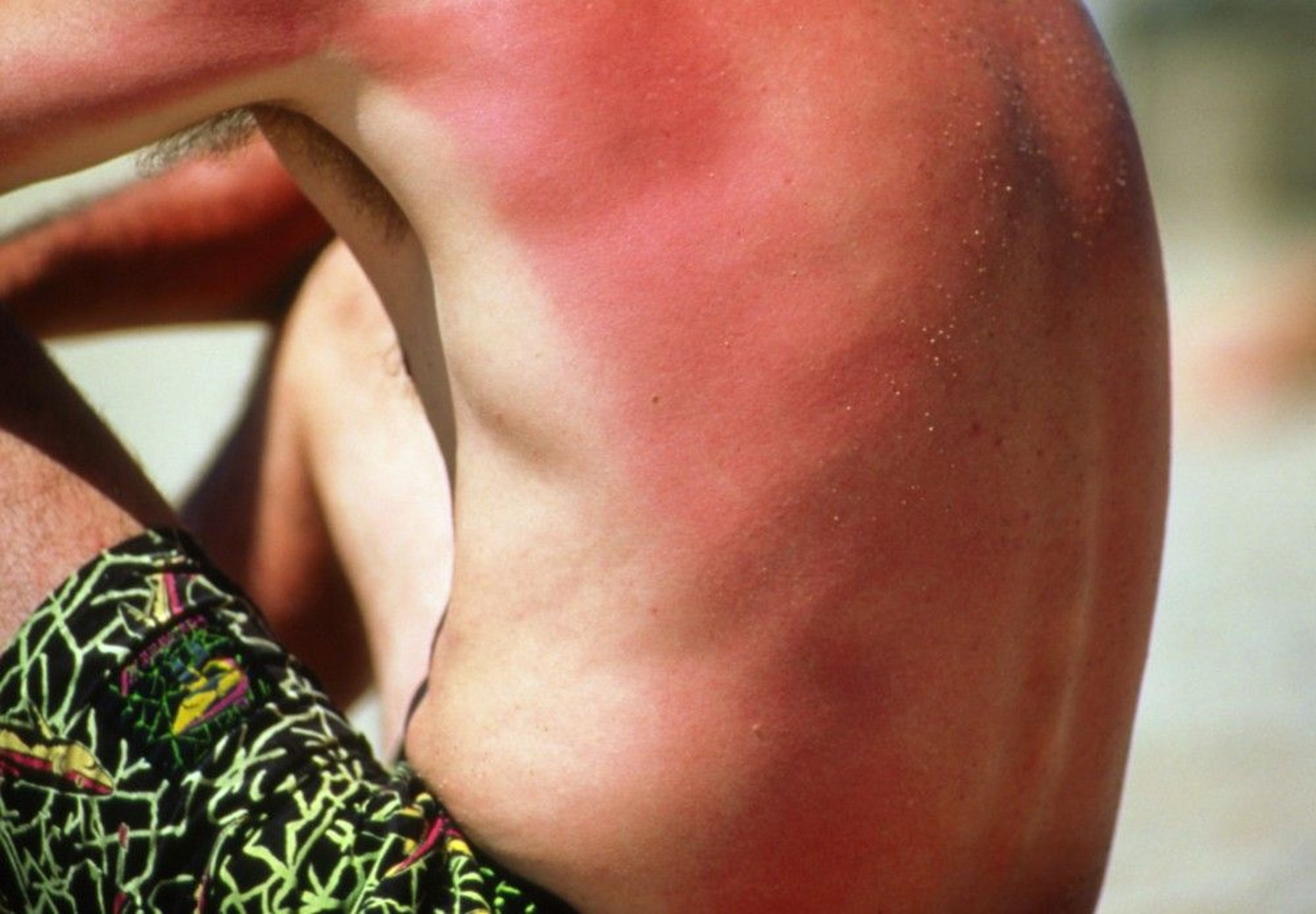
This photo shows reddened skin on the back and arms of a patient with mild sunburn.
SINCLAIR STAMMERS/SCIENCE PHOTO LIBRARY
Symptoms and signs of sunburn appear in 1 to 24 hours and, except in severe reactions, peak within 72 hours (usually between 12 hours and 24 hours). Skin changes range from mild erythema, with subsequent superficial scaling, to pain, swelling, skin tenderness, and in severe cases, blistering. Constitutional symptoms (eg, fever, chills, weakness, shock), similar to those of a thermal burn, may develop if a large area of the body surface is affected. Very sunburned skin may exfoliate days later.

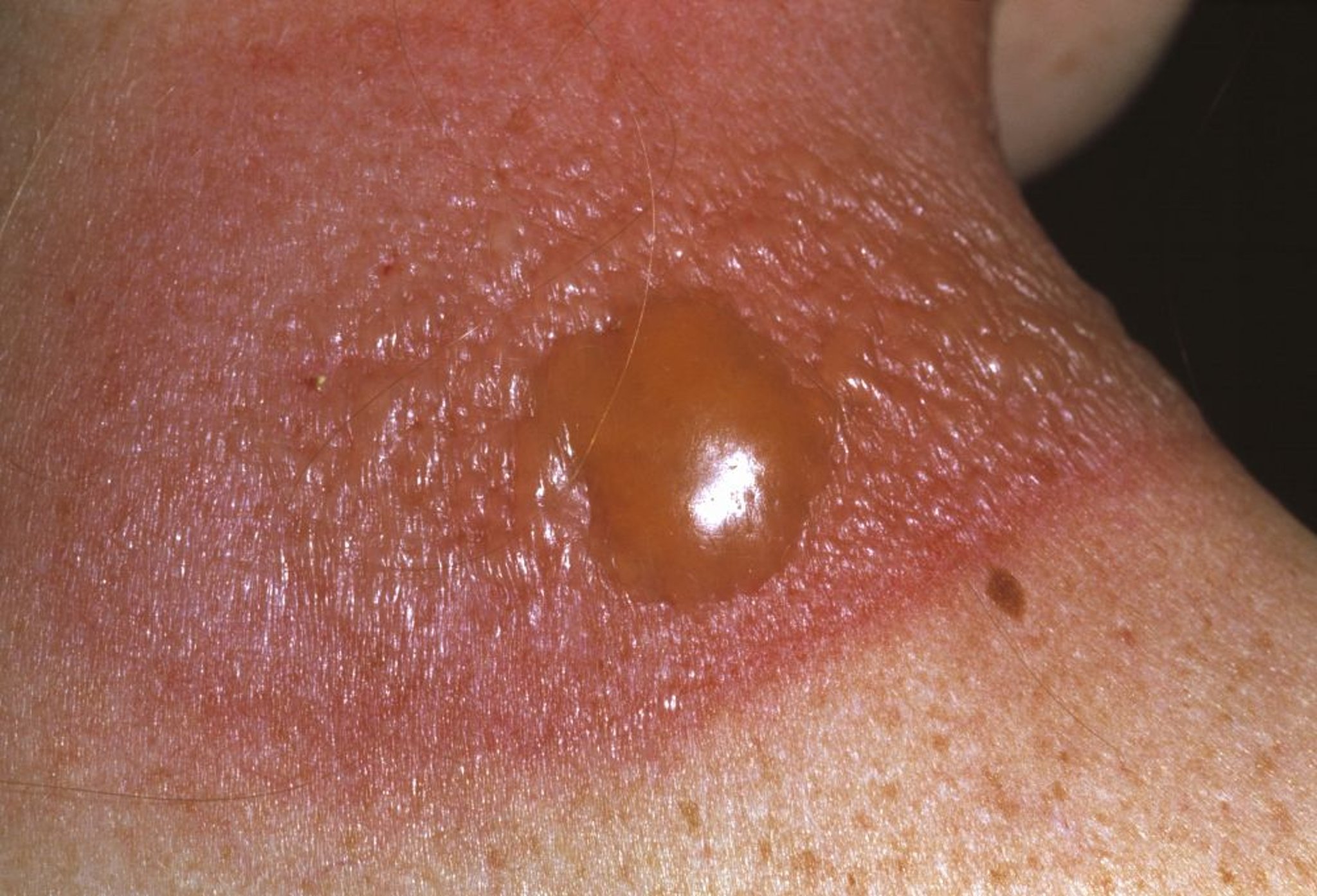
The skin has become reddened, inflamed, and blistered in this patient with severe sunburn.
DR P. MARAZZI/SCIENCE PHOTO LIBRARY
The most common complications of sunburn are secondary infection, permanent blotchy pigmentation, and in the long-run, a significantly increased risk of skin cancer (basal cell carcinoma, squamous cell carcinomas, and malignant melanoma). Exfoliated skin can remain extremely sensitive to sunlight for several weeks.
The diagnosis of sunburn is based on clinical history of exposure and characteristic clinical appearance on physical examination.
General references
1. Bernard JJ, Gallo RL, Krutmann J. Photoimmunology: how ultraviolet radiation affects the immune system. Nat Rev Immunol. 2019 Nov;19(11):688-701. doi: 10.1038/s41577-019-0185-9
2. Faustin B, Reed JC. Sunburned skin activates inflammasomes. Trends Cell Biol. 2008 Jan;18(1):4-8. doi: 10.1016/j.tcb.2007.10.004
3. Nasti TH, Timares L. Inflammasome activation of IL-1 family mediators in response to cutaneous photodamage. Photochem Photobiol. 2012;88(5):1111-1125. doi:10.1111/j.1751-1097.2012.01182.x
Treatment of Sunburn
Cold compresses
Nonsteroidal anti-inflammatory drugs (NSAIDs)
Recommended treatments for sunburn focus on symptomatic relief and skin protection. Because sunburnt skin can be exquisitely sensitive, prevention of further exposure is critical until sunburn has completely subsided. Cold tap-water compresses and oral NSAIDs help provide symptomatic relief, as may topical treatments (eg, aloe vera, other water-based lotions). Petrolatum-based products such as petroleum jelly should be avoided in severe sunburns. Topical glucocorticoids have not been shown to bet particularly effective (1). Ointments or lotions containing local anesthetics (eg, benzocaine) or diphenhydramine should be used sparingly and only on unbroken skin, because of the risk of ). Ointments or lotions containing local anesthetics (eg, benzocaine) or diphenhydramine should be used sparingly and only on unbroken skin, because of the risk ofallergic contact dermatitis.
Blistered areas should be managed similarly to other partial-thickness burns (see Initial wound care), with sterile dressings and antimicrobial salves.
Treatment reference
1. Faurschou A, Wulf HC. Topical corticosteroids in the treatment of acute sunburn: a randomized, double-blind clinical trial. Arch Dermatol. 2008 May;144(5):620-4. doi: 10.1001/archderm.144.5.620
Prevention of Sunburn
Simple precautions (eg, avoiding the sun especially during midday; wearing tightly woven clothing, a hat, and sunglasses; applying sunscreens) significantly reduce the chances of sunburn.