Rosacea is a chronic inflammatory disorder characterized by facial flushing, telangiectasias, erythema, papules, pustules, and, in severe cases, phymatous changes such as rhinophyma. Diagnosis is based on the characteristic appearance and history. Treatment depends on severity and includes topical metronidazole, topical and oral antibiotics, topical ivermectin, rarely isotretinoin, and, for severe rhinophyma, surgery.
Rosacea is a chronic inflammatory skin disorder causing a spectrum of disease. Its prevalence ranges between 1 and 20% worldwide (1).
Rosacea most commonly affects patients aged 30 to 50 with fair complexions, most notably those of Irish and other Northern European descent, but it affects and is probably under-recognized in dark-skinned patients.
General reference
1. Yang F, Wang L, Song D, et al. Signaling pathways and targeted therapy for rosacea. Front Immunol. 2024;15:1367994. Published 2024 Sep 16. doi:10.3389/fimmu.2024.1367994
Etiology of Rosacea
The etiology of rosacea is poorly characterized. Some proposed associations include (1):
Abnormal vasomotor control
Impaired facial venous drainage
Increased follicle mites (Demodex folliculorum)
Increased angiogenesis, ferritin expression, and reactive oxygen species
Dysfunction of antimicrobial peptides (eg, cathelicidin)
Sunlight exposure is thought to be the most common trigger for rosacea. Diet plays no consistent role, but some agents (eg, amiodarone, topical and nasal glucocorticoids, high doses of B6 and B12, some components in sunscreen) may worsen rosacea. Although the exact molecular mechanisms of rosacea pathogenesis is yet to be determined, cytokine pathways including interleukin (IL)-17, JAK/STAT, and vascular endothelial growth factor (VEGF) may play a role.

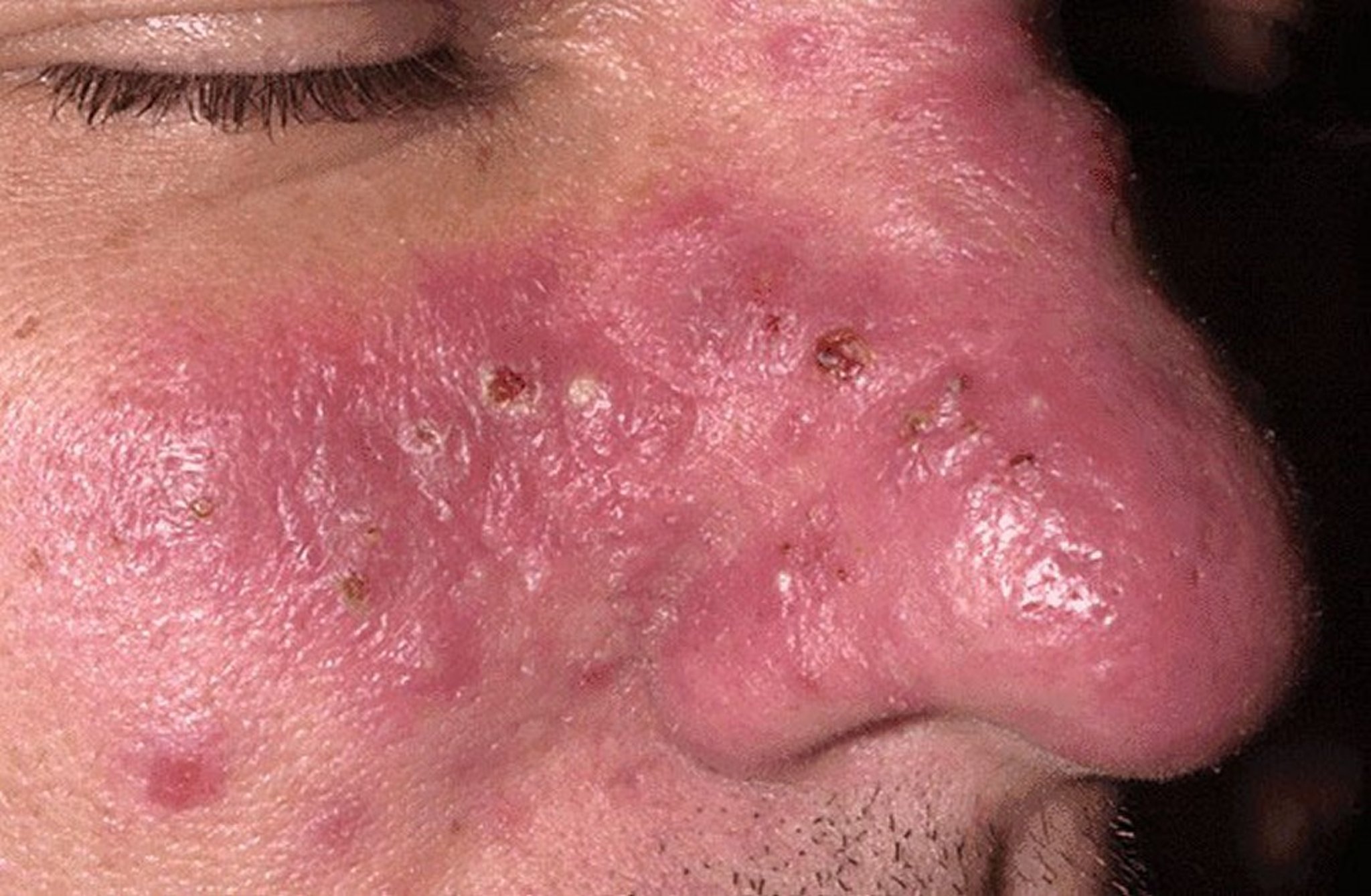
Rosacea is characterized by facial skin changes, including flushing, telangiectasias, erythema, papules, pustules, and, in severe cases, rhinophyma.
Photo provided by Thomas Habif, MD.
Etiology reference
1. Wang H, Zhou C. Advances in the pathogenesis of rosacea. Front Immunol. 2026;16:1705588. Published 2026 Jan 21. doi:10.3389/fimmu.2025.1705588
Symptoms and Signs of Rosacea
Rosacea primarily affects the face and scalp and manifests in 4 phases:
Pre-rosacea
Vascular
Inflammatory
Late
In the pre-rosacea phase, patients describe embarrassing flushing and blushing, often accompanied by uncomfortable stinging. Common reported triggers for these flares include sun exposure, emotional stress, cold or hot weather, alcohol, spicy foods, exercise, wind, cosmetics, and hot baths or hot drinks. These symptoms persist throughout other phases of the disorder.
In the vascular phase, patients develop facial erythema and edema with multiple telangiectases, possibly as a result of persistent vasomotor instability.

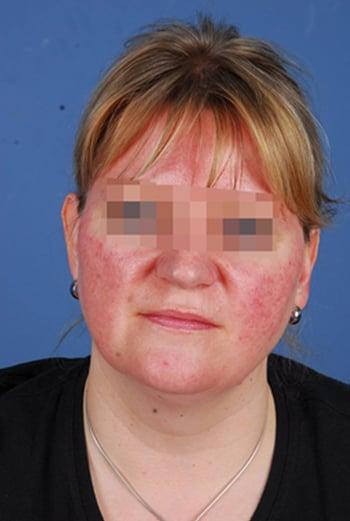
This photo shows erythema and telangiectasias on the cheeks of a patient with vascular rosacea.
An inflammatory phase often follows, in which sterile papules and pustules (leading to the designation of rosacea as adult acne) develop.

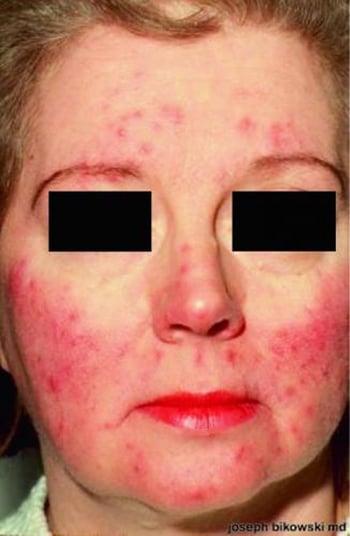
This photo shows vivid erythema and papules in a patient with inflammatory rosacea. Pustules are also present, but faint.
The late phase (developing in some patients), is characterized by coarse tissue hyperplasia of the cheeks and nose (phymatous changes, including rhinophyma causing a large, erythematous, bulbous nose) caused by tissue inflammation, collagen deposition, and sebaceous gland hyperplasia.
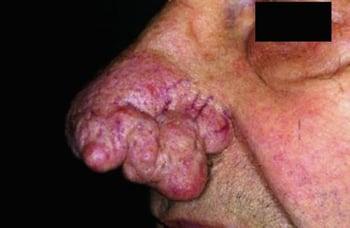
This photo shows rhinophyma, characterized by thickened skin, nodules, and anatomical enlargement, in a patient with rosacea.
The phases of rosacea are usually sequential in occurrence. However, some patients may have initial manifestations of the inflammatory stage, having bypassed the earlier stages. Treatment may cause rosacea to return to an earlier stage. Progression to the late stage does not inevitably occur in all patients.
Ocular rosacea often precedes or accompanies facial rosacea and manifests as some combination of blepharoconjunctivitis, iritis, scleritis, and keratitis, causing pruritus, foreign body sensation, erythema, and edema of the eye.

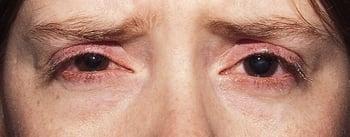
This photo shows bilateral conjunctival erythema with eyelid erythema and swelling in a patient with ocular rosacea.
Diagnosis of Rosacea
History and physical examination alone
The diagnosis of rosacea is based on characteristic appearance; there are no specific diagnostic tests (1). The age of onset and absence of comedones help distinguish rosacea from acne. Neurogenic rosacea is an emerging characterization for some patients who flush very easily and prominently; this subtype may be associated with other concomitant neurologic or psychiatric conditions.
Differential diagnosis of rosacea includes acne vulgaris, systemic lupus erythematosus, sarcoidosis, photodermatitis, drug eruptions (particularly caused by iodides and bromides), granulomas of the skin, and perioral dermatitis.
Diagnosis reference
1. Schaller M, Almeida LMC, Bewley A, et al. Recommendations for rosacea diagnosis, classification and management: update from the global ROSacea COnsensus 2019 panel. Br J Dermatol. 2020;182(5):1269-1276. doi:10.1111/bjd.18420
Treatment of Rosacea
Avoidance of triggers
Consideration of topical or oral antibiotics or topical azelaic acid or ivermectin
For flushing or persistent erythema, consideration of topical brimonidine or oxymetazoline and sometimes oral beta blockers
For recalcitrant cases, consideration of oral isotretinoin
For rhinophyma, consideration of dermabrasion, laser ablation, and tissue excision
For telangiectasia, consideration of laser or electrocautery treatment
The initial treatment of rosacea primarily involves avoidance of triggers (including use of sunscreen, which is protective for most patients but a trigger for some) (1, 2). Antibiotics and/or azelaic acid may be used for inflammatory disease. The objective of treatment is control of symptoms, not cure.
First-line topical treatments include:
Metronidazole (1% cream, 0.75% lotion, or 0.75% gel) 2 times/day or
Azelaic acid (20% cream or 15% gel) 2 times/day
Sometimes, benzoyl peroxide (2.5% gel, lotion, or cream) 1 to 2 times/day
Alternative therapies include:
Minocycline (1.5% foam) once/day
Ivermectin (1% cream) once/day
Sodium sulfacetamide/sulfur (10/5% lotion) 2 times/day
Clindamycin (1% solution, gel, or lotion) 2 times/day
Erythromycin (2% solution) 2 times/day
Oral antibiotics are indicated for patients with multiple papules or pustules and for those with ocular rosacea; options include:
Doxycycline 40 mg once/day
Tetracycline 250 to 500 mg 2 times/day
Minocycline 40 mg once/day (3)
Erythromycin 250 to 500 mg 2 times/day
Azithromycin 250 mg once/day or various alternate-day or pulse-dose regimens
Dose should be reduced to the lowest one that controls symptoms once a beneficial response is achieved. Subantimicrobial doses of doxycycline (eg, 40 mg once a day in a preparation containing 30 mg of immediate-release and 10 mg of sustained-release doxycycline) are effective for acne and rosacea. Conventional dosing for doxycycline is 50 to 100 mg 2 times/day and is given for patients requiring longer durations of treatment. Short pulses of oral ivermectin have also been useful for pustular flares.
Persistent erythema or flushing may be treated with (4):
Brimonidine 0.33% gel (a topical alpha-2-selective adrenergic agonist brimonidine) once/day, or
Oxymetazoline hydrochloride 1% cream (a primarily alpha-1a agonist) once/day
Oral beta-blockers can be effective and should be considered if other treatments are ineffective (5).
Recalcitrant cases may respond to oral isotretinoin.
Techniques for the treatment of rhinophyma include dermabrasion, laser ablation, and tissue excision; cosmetic results are good.
Techniques for the treatment of telangiectasia include laser and electrocautery.
Treatment references
1. Thiboutot D, Anderson R, Cook-Bolden F, et al. Standard management options for rosacea: The 2019 update by the National Rosacea Society Expert Committee. J Am Acad Dermatol. 2020;82(6):1501-1510. doi:10.1016/j.jaad.2020.01.077
2. Asai Y, Tan J, Baibergenova A, et al. Canadian Clinical Practice Guidelines for Rosacea. J Cutan Med Surg.2016;20(5):432-445. doi:10.1177/1203475416650427
3. Bhatia N, Del Rosso J, Stein Gold L, et al. Efficacy, Safety, and Tolerability of Oral DFD-29, a Low-Dose Formulation of Minocycline, in Rosacea: Two Phase 3 Randomized Clinical Trials. JAMA Dermatol. 2025;161(5):499-507. doi:10.1001/jamadermatol.2024.6542
4. Baumann L, Goldberg DJ, Stein Gold L, et al. Pivotal trial of the efficacy and safety of oxymetazoline cream 1.0% for the treatment of persistent facial erythema associated with rosacea: Findings from the second REVEAL trial. J Drugs Dermatol. 2018;17(3):290–298.
5. Logger JGM, Olydam JI, Driessen RJB. Use of beta-blockers for rosacea-associated facial erythema and flushing: A systematic review and update on proposed mode of action. J Am Acad Dermatol. 2020;83(4):1088-1097. doi: 10.1016/j.jaad.2020.04.129
Key Points
Consider rosacea if patients have facial flushing and blushing, with or without stinging, often triggered by sun exposure, emotional stress, cold or hot weather, alcohol, spicy foods, exercise, wind, cosmetics, or hot baths or hot drinks.
Diagnosis of rosacea is based on its typical appearance (eg, central facial erythema and edema with or without pustules, papules, or multiple telangiectases; phymatous changes; ocular changes such as conjunctival and eyelid erythema and swelling).
Treat rosacea with avoidance of triggers; treat inflammation, depending on severity, with topical antibiotics and/or azelaic acid, oral antibiotics, isotretinoin, or topical ivermectin.
Consider brimonidine or oxymetazoline for persistent erythema or flushing.
Dermabrasion, laser ablation, and tissue excision for rhinophyma give good cosmetic results.
Consider laser or electrocautery for telangiectasia.
Drug Information for the Topic