Juvenile angiofibromas are rare and benign growths that can develop in the nasopharynx. Diagnosis is with imaging. Treatment is excision.
Juvenile angiofibromas are most common among adolescent boys. They are vascular and grow slowly. They can spread into the orbits or cranial vault or recur after treatment.
Symptoms and Signs of Juvenile Angiofibromas
Common symptoms of juvenile angiofibromas include nasal obstruction and epistaxis (sometimes severe, usually unilateral).
The tumor may cause facial swelling, eye bulging, or nasal disfigurement or mass.

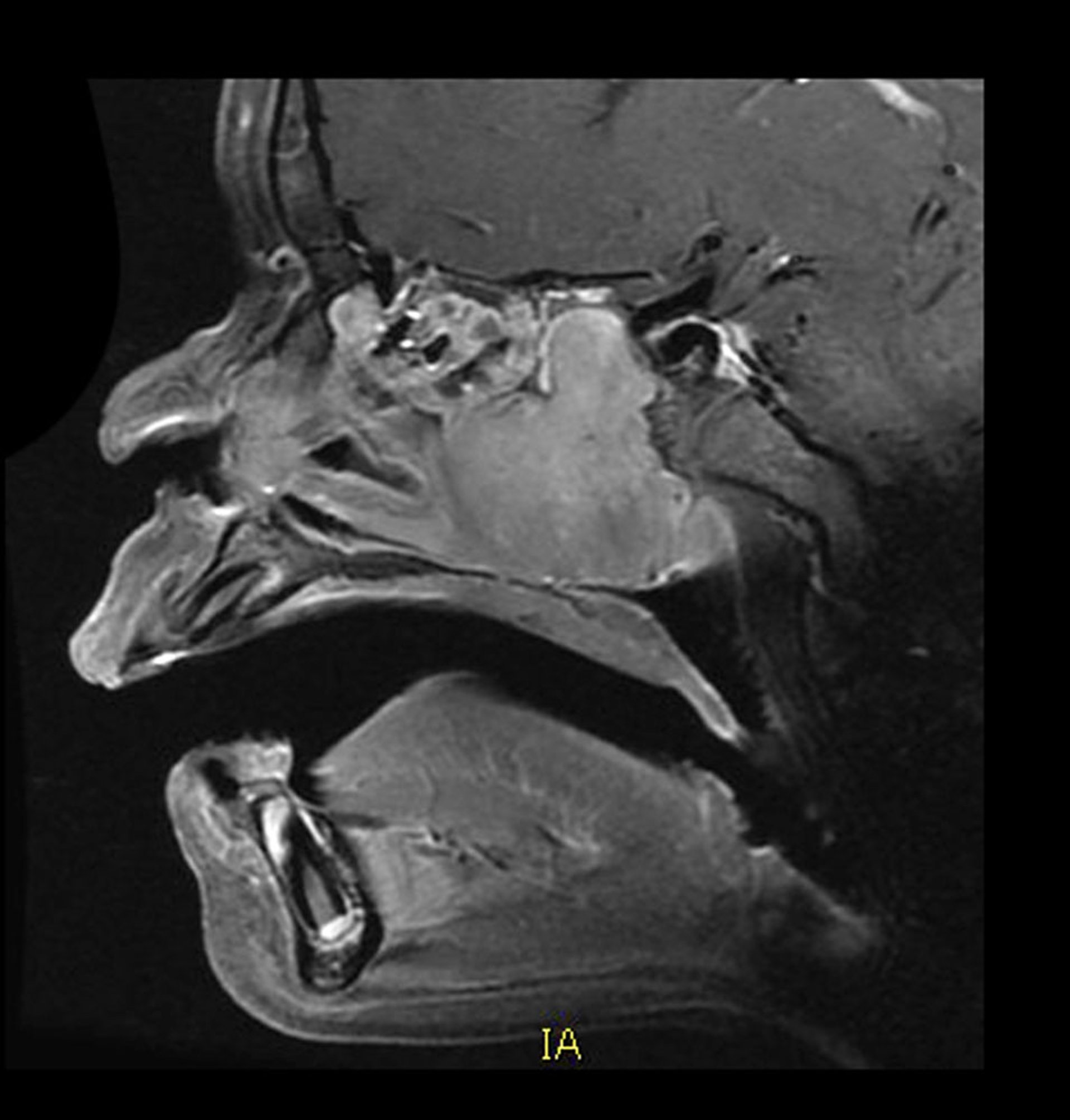
This sagittal, contrast-enhanced MRI shows the typical location and appearance of a vascular juvenile nasopharyngeal angiofibroma. There is a homogeneously enhancing mass in the posterior nasal cavity growing posteriorly into the sphenoid sinus. There is associated bone destruction also.
Living Art Enterprises/SCIENCE PHOTO LIBRARY
Diagnosis of Juvenile Angiofibromas
CT and MRI
Diagnosis of juvenile angiofibromas usually requires CT and MRI.
Angiography is often done so that the tumor vessels can be embolized before surgery.
Because incising the tumor may cause severe bleeding, incisional biopsy is avoided.
Treatment of Juvenile Angiofibromas
Excision and sometimes radiation therapy
Treatment of juvenile angiofibromas is excision. Endoscopic surgical approaches are recommended for most juvenile angiofibromas.
Radiation therapy is sometimes used adjunctively, particularly if complete excision is difficult or impossible or if the tumor recurs (1, 2).
Довідкові матеріали щодо лікування
1. Safadi A, Schreiber A, Fliss DM, Nicolai P. Juvenile Angiofibroma: Current Management Strategies. J Neurol Surg B Skull Base. 2018;79(1):21-30. doi:10.1055/s-0037-1615810
2. Lopez EM, Farzal Z, Dean KM, et al. Outcomes in Pediatric Endoscopic Skull Base Surgery: A Systematic Review. J Neurol Surg B Skull Base. 2022;84(1):24-37. Published 2022 Jan 16. doi:10.1055/a-1725-9151