Achilles tendon injuries include inflammation of the paratenon and partial or complete tears.
Achilles tendinitis is very common among running athletes. The calf muscles attach to the calcaneus via the Achilles tendon. During running, the calf muscles help with the lift-off phase of gait. Repetitive forces from running combined with insufficient recovery time can initially cause inflammation in the tendon paratenon (fatty areolar tissue that surrounds the tendon). A complete tear of the Achilles tendon is a serious injury, usually resulting from sudden, forceful stress. Tendon tears can occur with minimal exertion in people who have taken fluoroquinolone antibiotics.
Symptoms and Signs of Achilles Tendinitis
The primary symptom of Achilles tendon inflammation is pain in the back of the heel, which initially increases when exercise is begun and often lessens as exercise continues.
A complete tear of the Achilles tendon typically occurs with a sudden forceful change in direction when running or playing tennis and is often accompanied by a sensation of having been struck in the back of the ankle and calf with an object such as a baseball bat.
Diagnosis of Achilles Tendinitis
Clinical evaluation
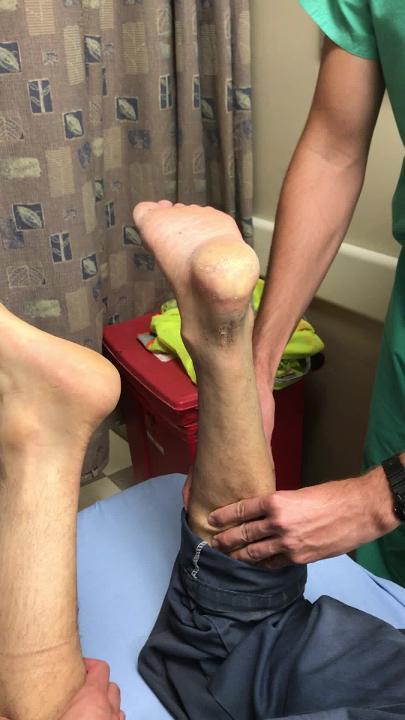
On examination, an inflamed or partially torn Achilles tendon is tender when squeezed between the fingers. Complete tears are differentiated by
Sudden, severe pain and inability to walk on the extremity
A palpable defect along the course of the tendon
A positive Thompson test (while the patient lies prone on the examination table, the examiner squeezes the calf muscle; this maneuver by the examiner does not cause the normally expected plantar flexion of the foot)

Treatment of Achilles Tendinitis
Ice, nonsteroidal anti-inflammatory drugs (NSAIDs), and stretches
Modification of activities
Sometimes a heel lift
Tendon inflammation should initially be treated with ice, gentle calf muscle stretching, and use of NSAIDs.
A heel lift can be placed in the shoes to take tension off the tendon. Athletes should be instructed to avoid uphill and downhill running until the tendon is not painful and to engage in cross-training aerobic conditioning.
Most clinicians treat complete tears of the Achilles tendon with surgical repair. However, recent studies (1, 2, 3) have shown that nonoperative management (including highly structured rehabilitation activities) gives long-term results similar to those of surgical repair in terms of ankle strength, range of motion in the ankle, rates of repeat tear of the tendon, and ability to do pre-injury activity.

1. Stand facing or next to wall with hands on the wall.
2. Bend knee on involved side to place top of involved foot dow
Courtesy of Tomah Memorial Hospital, Department of Physical Therapy, Tomah, WI; Elizabeth C.K. Bender, MSPT, ATC, CSCS; and Whitney Gnewikow, DPT, ATC.

1. Sit in chair.
2. Bend knee on involved side to place top of involved foot down toward the floor with toes pointing d
Courtesy of Tomah Memorial Hospital, Department of Physical Therapy, Tomah, WI; Elizabeth C.K. Bender, MSPT, ATC, CSCS; and Whitney Gnewikow, DPT, ATC.

1. Stand facing or next to wall with hands on the wall for support.
2. Place uninvolved leg forward.
3. Keep rear leg s
Courtesy of Tomah Memorial Hospital, Department of Physical Therapy, Tomah, WI; Elizabeth C.K. Bender, MSPT, ATC, CSCS; and Whitney Gnewikow, DPT, ATC.

1. Stand facing or next to wall with hands on the wall for support.
2. Place uninvolved leg forward.
3. Keep heels on t
Courtesy of Tomah Memorial Hospital, Department of Physical Therapy, Tomah, WI; Elizabeth C.K. Bender, MSPT, ATC, CSCS; and Whitney Gnewikow, DPT, ATC.

1. Stand on balls of feet with heels off the floor.
2. Walk on balls of feet while keeping knees straight.
3. Walk as f
Courtesy of Tomah Memorial Hospital, Department of Physical Therapy, Tomah, WI; Elizabeth C.K. Bender, MSPT, ATC, CSCS; and Whitney Gnewikow, DPT, ATC.

1. Stand on heels with balls of feet off the floor.
2. Walk on heels while keeping knees straight.
3. Walk as far as ab
Courtesy of Tomah Memorial Hospital, Department of Physical Therapy, Tomah, WI; Elizabeth C.K. Bender, MSPT, ATC, CSCS; and Whitney Gnewikow, DPT, ATC.

1. Stand with both feet on step with heels off edge of step. Hold on for support.
2. Raise up on balls of feet.
3. Focu
Courtesy of Tomah Memorial Hospital, Department of Physical Therapy, Tomah, WI; Elizabeth C.K. Bender, MSPT, ATC, CSCS; and Whitney Gnewikow, DPT, ATC.


1. Stand facing or next to wall with hands on the wall.
2. Bend knee on involved side to place top of involved foot down toward the floor with toes pointing down.
3. Bend knee on uninvolved side and slowly lower body until stretch is felt over the top of the foot and ankle.
4. Hold exercise for 30 second.
5. Perform 1 set of 4 repetitions, 3 times a day.
6. Special Instructions
a. Perform plantarflexion stretching while either sitting or standing, whichever is most comfortable.
Courtesy of Tomah Memorial Hospital, Department of Physical Therapy, Tomah, WI; Elizabeth C.K. Bender, MSPT, ATC, CSCS; and Whitney Gnewikow, DPT, ATC.

1. Sit in chair.
2. Bend knee on involved side to place top of involved foot down toward the floor with toes pointing down.
3. Slowly sit forward in the chair and push foot into plantarflexion until a stretch is felt over the top of the foot and ankle.
4. Hold exercise for 30 seconds.
5. Perform 1 set of 4 repetitions, 3 times a day.
6. Special Instructions
a. Perform plantarflexion stretching while either sitting or standing, whichever is most comfortable.
Courtesy of Tomah Memorial Hospital, Department of Physical Therapy, Tomah, WI; Elizabeth C.K. Bender, MSPT, ATC, CSCS; and Whitney Gnewikow, DPT, ATC.

1. Stand facing or next to wall with hands on the wall for support.
2. Place uninvolved leg forward.
3. Keep rear leg straight with knees and toes pointing toward the wall, keep rear heel on the floor.
4. Bend knee on uninvolved leg and lean hips toward the wall to feel a stretch along the calf of the rear leg.
5. Hold exercise for 30 seconds.
6. Perform 1 set of 4 repetitions, 3 times a day.
(It is important to maintain a straight back posture with the heel firmly planted [not lifted] during the stretch.)
Courtesy of Tomah Memorial Hospital, Department of Physical Therapy, Tomah, WI; Elizabeth C.K. Bender, MSPT, ATC, CSCS; and Whitney Gnewikow, DPT, ATC.

1. Stand facing or next to wall with hands on the wall for support.
2. Place uninvolved leg forward.
3. Keep heels on the floor and slowly bend both knees to feel stretch along the calf of the rear leg.
4. Hold exercise for 30 seconds.
5. Perform 1 set of 4 repetitions, 3 times a day.
Courtesy of Tomah Memorial Hospital, Department of Physical Therapy, Tomah, WI; Elizabeth C.K. Bender, MSPT, ATC, CSCS; and Whitney Gnewikow, DPT, ATC.

1. Stand on balls of feet with heels off the floor.
2. Walk on balls of feet while keeping knees straight.
3. Walk as far as able during given time frame, stop at point of fatigue.
4. Perform 3 sets of 1 minute, 1 time a day.
Courtesy of Tomah Memorial Hospital, Department of Physical Therapy, Tomah, WI; Elizabeth C.K. Bender, MSPT, ATC, CSCS; and Whitney Gnewikow, DPT, ATC.

1. Stand on heels with balls of feet off the floor.
2. Walk on heels while keeping knees straight.
3. Walk as far as able during given time frame, stop at point of fatigue.
4. Perform 3 sets of 1 minute, 1 time a day.
Courtesy of Tomah Memorial Hospital, Department of Physical Therapy, Tomah, WI; Elizabeth C.K. Bender, MSPT, ATC, CSCS; and Whitney Gnewikow, DPT, ATC.

1. Stand with both feet on step with heels off edge of step. Hold on for support.
2. Raise up on balls of feet.
3. Focus on slowly lowering heels to below the height of the step.
4. Return to starting position and repeat.
5. Perform 3 sets of 10 repetitions, 1 time a day.
Courtesy of Tomah Memorial Hospital, Department of Physical Therapy, Tomah, WI; Elizabeth C.K. Bender, MSPT, ATC, CSCS; and Whitney Gnewikow, DPT, ATC.
Довідкові матеріали щодо лікування
1. Lantto L, Heikkinen J, Flinkkila T, et al: A prospective randomized trial comparing surgical and nonsurgical treatments of acute Achilles tendon ruptures. Am J Sports Med 44(9):2406-2414, 2016. doi: 10.1177/0363546516651060
2. Parisien RL, Dodson CC, Trofa DP, et al: Face off: Surgical versus nonsurgical treatment of acute Achilles tendon ruptures. AAOS Now July 2016, cover.
3. Myhrvold SB, Brouwer EF, Andresen TKM, et al: Nonoperative or surgical treatment of acute Achilles' tendon rupture. N Engl J Med 386(15):1409-1420, 2022. doi: 10.1056/NEJMoa2108447