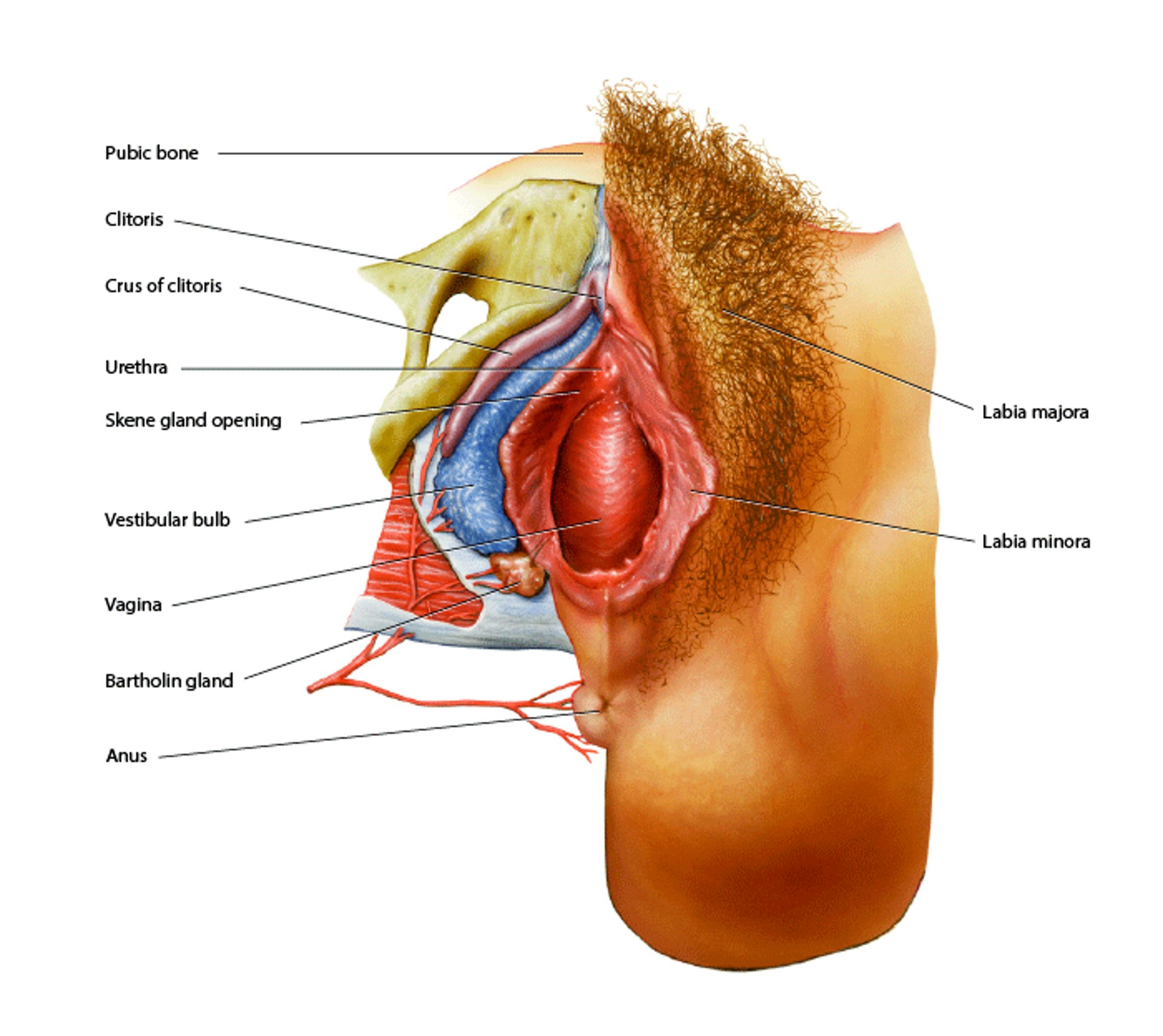
Vulvar Anatomy
The vagina is a fibromuscular canal lined by nonkeratinized stratified squamous epithelium and contains no glands. Vaginal lubrication is mainly from transudation through the vaginal epithelium and secretions from the cervix and Bartholin glands. The urethra is located in the anterior portion of the vaginal introitus. The paraurethral (Skene) glands open adjacent to the urethral meatus and are homologous to the male prostate. The tissue surrounding the vagina is the vulva, which includes the labia minora, labia majora, and the glans and hood of the clitoris (most anteriorly and in the midline, anterior to the urethra). The vestibule is the region bounded by the labia minora and contains the urethral meatus, vaginal introitus, and the openings of the Bartholin and paraurethral glands.
Anterior to the clitoris is the mons pubis (tissue that covers the pubic bone). Posterior to the vagina is the perineum, an area of skin between the vagina and anus. The crura of the clitoris (purple) extend subcutaneously and are composed of erectile tissue. The bulb of the vestibule (blue) also consists of erectile tissue. On each side, posterolateral to the vaginal introitus (at approximately the 4- and 8-o'clock positions), the Bartholin (greater vestibular) glands are located. They secrete mucus that contributes to the lubrication of the vulvar vestibule, especially during sexual arousal.
BO VEISLAND/SCIENCE PHOTO LIBRARY